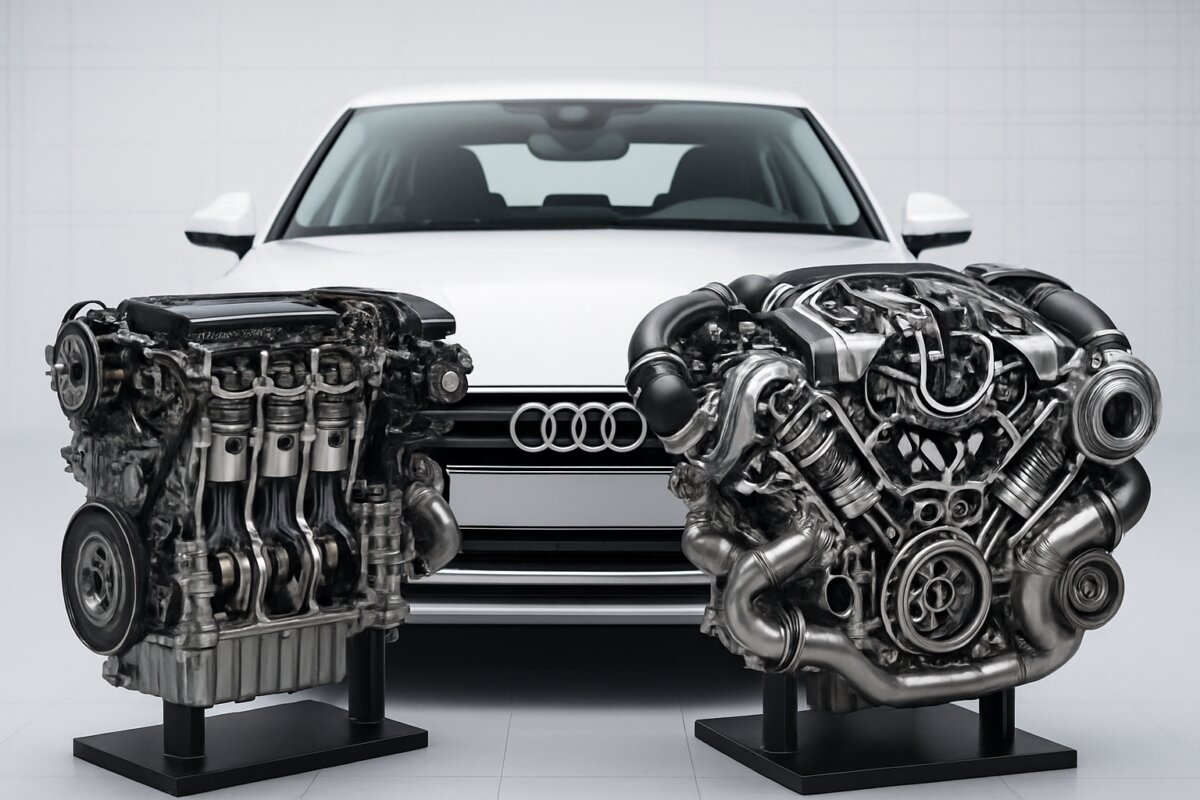
The Audi A5 sits comfortably in the premium coupé and Sportback segment, where engine choice defines the ownership experience. Whether you’re after spirited driving dynamics or refined efficiency, the powerplant selection matters enormously. Across two generations, Audi has equipped the A5 with a diverse range of petrol and diesel engines, from frugal four-cylinder units to muscular V6 options. The lineup spans from the efficient 2.0 TFSI producing 190 PS to the potent S5’s 354 PS turbocharged V6, with torque figures ranging from 320 Nm to 500 Nm depending on specification.
Comparison table of all engines
| Engine | Power output | Torque | Fuel consumption | Reliability |
|---|---|---|---|---|
| 2.0 TFSI (190 PS) | 190 PS / 140 kW | 320 Nm | 42-48 mpg | Very Good |
| 2.0 TFSI (252 PS) | 252 PS / 185 kW | 370 Nm | 38-44 mpg | Good |
| 3.0 TFSI (354 PS) | 354 PS / 260 kW | 500 Nm | 32-38 mpg | Good |
| 2.0 TDI (190 PS) | 190 PS / 140 kW | 400 Nm | 52-60 mpg | Very Good |
| 3.0 TDI (286 PS) | 286 PS / 210 kW | 620 Nm | 45-52 mpg | Excellent |
2.0 TFSI (190 PS) overview
This turbocharged inline-four represents the entry point into A5 ownership and delivers a balanced blend of performance and economy. The 1,984 cc unit features direct fuel injection and variable valve timing, producing its peak power at 4,200-6,000 rpm. It’s the volume seller across European markets and offers sufficient grunt for most drivers without excessive running costs.
The EA888 architecture underpinning this engine has proven itself across the Volkswagen Group portfolio. With forced induction via a single turbocharger, throttle response is immediate from low revs, making urban driving effortless. Regular maintenance of the air filter ensures optimal performance and protects the turbocharger from contaminants.
Pros
- Excellent real-world fuel economy averaging 44 mpg on motorways
- Strong mid-range torque delivery from 1,500 rpm onwards
- Lower insurance groups compared to six-cylinder variants
- Widely available spare parts and aftermarket support
- Adequate performance for overtaking and motorway cruising
Cons
- Four-cylinder thrum lacks the refinement of V6 alternatives
- Timing chain tensioner issues on earlier examples require monitoring
- Carbon buildup on intake valves due to direct injection design
- High-pressure fuel pump failures reported on pre-2015 models
Our mechanics at Autopartspro recommend inspecting the cam belt and related components every 60,000 miles, even though this engine uses a chain. The auxiliary belt system requires attention to prevent accessory failure.
2.0 TFSI (252 PS) overview
The uprated version of the 2.0-litre four-cylinder brings genuine performance credentials to the A5 range. Sharing its displacement with the 190 PS variant, this engine achieves its higher output through revised turbocharger mapping, enhanced cooling systems, and optimised fuelling. Peak torque arrives at just 1,600 rpm and holds steady until 4,500 rpm.
Fitted predominantly to Quattro-equipped models, this powerplant transforms the A5 into a genuinely rapid machine. The enhanced specification includes upgraded engine mounts to manage the increased torque, whilst the intercooler receives additional capacity to maintain consistent performance during spirited driving.
Pros
- Rapid acceleration with 0-60 mph achieved in under 6 seconds
- Retains reasonable fuel consumption at 42 mpg on long journeys
- Relatively affordable compared to V6 running costs
- Strong tuning potential for enthusiasts seeking more power
- Quattro all-wheel-drive provides excellent traction in all conditions
Cons
- Higher tax bracket due to increased CO2 emissions
- Turbocharger operates under greater stress, reducing longevity
- Premium fuel recommended for optimal performance and economy
- Clutch wear accelerated on manual transmission variants
3.0 TFSI (354 PS) overview
Reserved for S5 models, this supercharged V6 delivers thrilling performance with characteristic smoothness. The 2,995 cc engine employs a mechanically-driven supercharger rather than turbocharging, eliminating lag and providing linear power delivery across the rev range. It’s a masterclass in refined brutality, propelling the A5 to 62 mph in just 4.7 seconds.
The EA837 engine represents the pinnacle of naturally-aspirated refinement combined with forced induction efficiency. Unlike turbocharged equivalents, the supercharger provides instant boost from idle, making this engine exceptionally responsive. The sophisticated fuelling system requires quality injectors and a healthy fuel pump to maintain proper operation.
Pros
- Exceptional smoothness befitting a six-cylinder configuration
- No turbo lag whatsoever due to supercharger design
- Reliable when maintained properly with documented service history
- Addictive exhaust note enhanced by sport exhaust systems
- Strong residual values due to S5 desirability
Cons
- Fuel consumption rarely exceeds 35 mpg even when driven gently
- Premium road tax due to higher emissions bracket
- Supercharger belt service required every 60,000 miles
- Higher insurance premiums reflect performance credentials
- Complex engine bay makes DIY maintenance challenging
2.0 TDI (190 PS) overview
The diesel four-cylinder has become the sensible choice for high-mileage drivers who prioritise economy without sacrificing performance. This 1,968 cc turbocharged unit produces an impressive 400 Nm of torque, providing effortless cruising ability and strong overtaking punch. The direct injection system ensures maximum efficiency from every drop of fuel.
Modern common-rail technology keeps this diesel refined and responsive. Unlike older compression-ignition engines, vibration and noise are well-suppressed, though it never quite matches petrol smoothness. The particulate filter requires regular motorway runs to regenerate properly, preventing blockages that plague urban-only vehicles.
Pros
- Outstanding fuel economy approaching 60 mpg on motorway journeys
- Massive torque output makes overtaking effortless
- Lower CO2 emissions result in reduced tax liability
- Engine longevity typically exceeds 200,000 miles with proper care
- Excellent for towing due to low-down torque characteristics
Cons
- AdBlue system adds complexity and running costs
- EGR valve carbon buildup requires periodic cleaning
- Dual-mass flywheel replacement expensive around 100,000 miles
- DPF regeneration issues if used exclusively for short journeys
Autopartspro specialists strongly advise checking the oil filter and ensuring proper engine oil specification. Diesel engines are particularly sensitive to oil quality, and using incorrect grades accelerates wear significantly.
3.0 TDI (286 PS) overview
The range-topping diesel V6 combines effortless performance with remarkable efficiency. This 2,967 cc powerhouse produces a staggering 620 Nm of torque, making it the torque king of the A5 lineup. Twin turbochargers work sequentially to eliminate lag whilst maximising boost across the entire rev range. It’s a spectacular engine that redefines expectations of diesel performance.
Fitted exclusively to SQ5 and higher-specification A5 models, this engine showcases what modern diesel technology can achieve. The bi-turbo arrangement uses a smaller turbocharger for low-rpm response and a larger unit for high-rpm power. Maintaining the turbocharger hoses and ensuring clean fuel filters prevents expensive repairs down the line.
Pros
- Phenomenal torque delivery rivalling petrol V8 engines
- Capable of 50+ mpg on motorways despite performance capability
- Incredibly refined for a diesel with minimal vibration
- Proven reliability with many examples exceeding 150,000 miles
- Exceptional towing capacity for caravans or trailers
Cons
- Complex twin-turbo system increases potential failure points
- Expensive to repair when major components fail
- Requires premium diesel for optimal performance and longevity
- Emissions regulations may affect future resale values
Maintenance cost
| Engine | Recommended interval | Estimated cost | Cost per 10,000 miles |
|---|---|---|---|
| 2.0 TFSI (190 PS) | 12 months/10,000 miles | £320-£450 | £320-£450 |
| 2.0 TFSI (252 PS) | 12 months/10,000 miles | £350-£500 | £350-£500 |
| 3.0 TFSI (354 PS) | 12 months/10,000 miles | £450-£650 | £450-£650 |
| 2.0 TDI (190 PS) | 12 months/12,500 miles | £380-£520 | £304-£416 |
| 3.0 TDI (286 PS) | 12 months/12,500 miles | £500-£700 | £400-£560 |
These figures include oil changes, filter replacements, and general inspection costs. Major services involving spark plugs, transmission fluid, and brake components will increase costs substantially. The V6 engines require more oil and premium consumables, explaining their higher maintenance expenses.
Engine sound and character
The four-cylinder petrol engines produce a characteristic growl under acceleration, though they lack the theatrical presence of larger powerplants. At motorway speeds, they settle into a muted hum that won’t intrude on conversations. The 252 PS variant sounds marginally more purposeful due to revised exhaust routing and sportier mapping.
By contrast, the 3.0 TFSI V6 delivers a glorious symphony that grows increasingly aggressive as revs climb. The supercharger whine adds a mechanical edge that enthusiasts adore. It’s an engine that encourages spirited driving purely for the auditory experience. Fitting an aftermarket muffler can enhance the soundtrack further without compromising refinement.
Diesel engines naturally sound more industrial, though Audi’s sound insulation does an admirable job of masking clatter. The 2.0 TDI emits a purposeful rumble at idle that fades to near-silence at cruise. The 3.0 TDI impresses with its smoothness, and many passengers wouldn’t identify it as a diesel without prior knowledge. Both diesels benefit from quality engine mounts that prevent vibration transmission into the cabin.
Who each engine is best for
| Engine | Daily commuters | Performance enthusiasts | Long-distance drivers | Budget-conscious owners |
|---|---|---|---|---|
| 2.0 TFSI (190 PS) | Excellent | Fair | Good | Excellent |
| 2.0 TFSI (252 PS) | Good | Very Good | Good | Fair |
| 3.0 TFSI (354 PS) | Fair | Excellent | Fair | Poor |
| 2.0 TDI (190 PS) | Very Good | Fair | Excellent | Very Good |
| 3.0 TDI (286 PS) | Good | Very Good | Excellent | Fair |
Selecting the right engine depends entirely on your priorities and driving patterns. The 2.0 TFSI 190 PS suits those seeking affordable running costs with acceptable performance. Performance enthusiasts should gravitate towards the 3.0 TFSI for maximum thrills, whilst the 2.0 TDI makes perfect sense for motorway miles. The 3.0 TDI occupies a unique position, offering near-petrol V6 performance with diesel efficiency.
Frequently asked questions (FAQ)
Which Audi A5 engine is most reliable?
The 2.0 TDI demonstrates exceptional reliability when maintained properly with regular oil changes and quality filters. The 3.0 TDI also boasts excellent longevity, frequently exceeding 200,000 miles without major issues when serviced correctly.
Are Audi A5 engines expensive to maintain?
Maintenance costs vary significantly by engine type. Four-cylinder units cost £320-£520 annually, whilst V6 engines require £450-£700 per service. Using quality aftermarket parts from specialists like Autopartspro reduces expenses without compromising quality.
What engine problems affect the Audi A5?
Common issues include timing chain tensioner wear on early 2.0 TFSI engines, carbon buildup on direct injection motors, and DPF regeneration problems on diesels used for short journeys. Regular servicing and motorway driving minimise these concerns.
Is the 2.0 TFSI engine good for daily driving?
Absolutely. The 2.0 TFSI provides ample performance for daily use whilst delivering reasonable fuel economy. Its widespread availability ensures parts like water pumps and tensioner pulleys remain affordable and readily available.
Should I choose petrol or diesel for my A5?
If you cover over 15,000 miles annually, diesel makes financial sense due to superior economy. For lower mileages or enthusiastic driving, petrol engines provide better responsiveness and lower complexity, reducing potential repair costs.

 Loading...