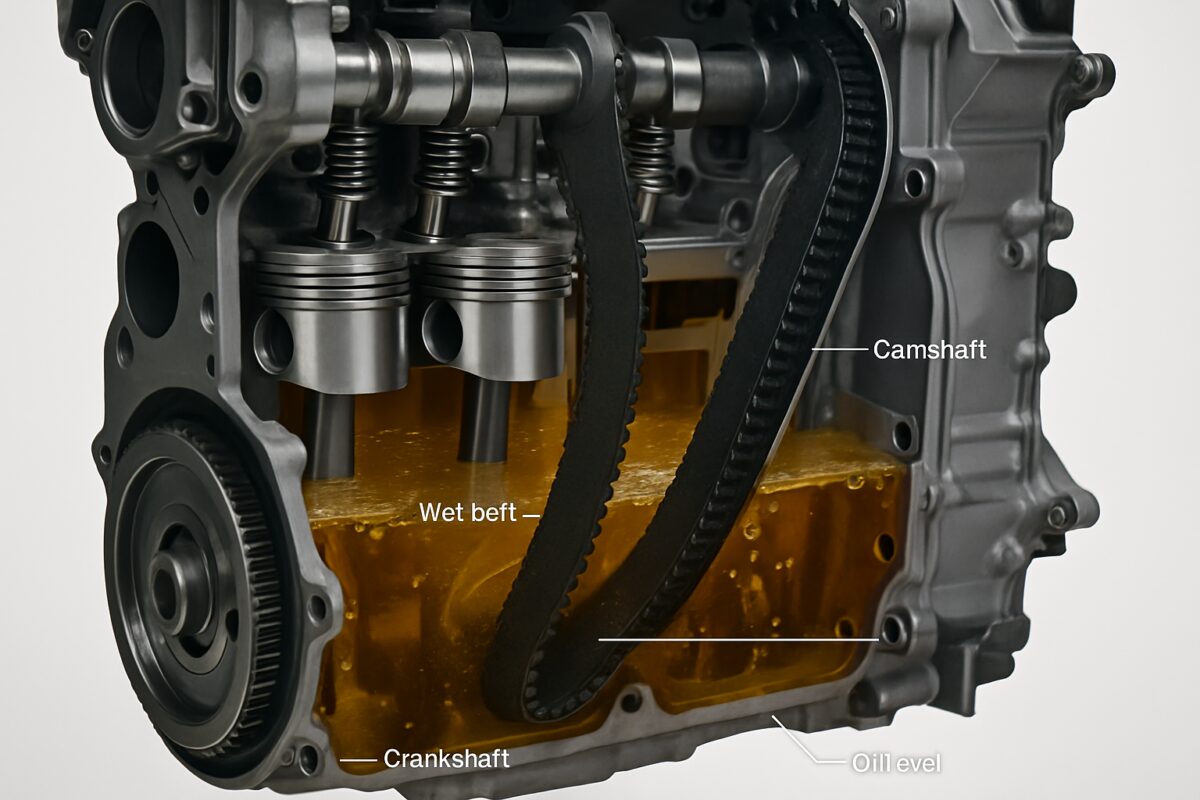
A wet belt is an engine timing belt that operates submerged in oil within the crankcase, combining the functions of a traditional timing belt and chain system. Unlike conventional timing belts that run dry, wet belts require regular replacement every 150,000 to 200,000 miles or 10 years, with failure potentially causing catastrophic engine damage costing thousands of pounds to repair.
The automotive industry has witnessed significant changes in engine design over recent years. One innovation that has generated considerable discussion amongst mechanics is the wet belt system. Understanding this technology is crucial for vehicle owners, particularly those driving Ford models equipped with these systems.
What is a wet belt system
A wet belt represents a hybrid approach to engine timing systems. Rather than using a traditional timing chain or dry timing belt, manufacturers employ a rubber belt that operates within the engine’s oil-filled environment. This design allows the belt to benefit from constant lubrication whilst maintaining the lighter weight and quieter operation associated with belt-driven systems.
The system connects the crankshaft to the camshaft, ensuring precise valve timing throughout the engine’s operation. The belt material differs from standard timing belts, featuring enhanced rubber compounds designed to withstand constant oil exposure. However, this oil exposure also creates unique maintenance challenges that traditional belt systems don’t face.
Our specialists at Autopartspro have observed that whilst wet belts offer certain engineering advantages, they require more frequent attention than their dry counterparts. The oil environment can cause the rubber to degrade over time, making replacement intervals critical to engine longevity.
Which cars have wet belt systems
Ford has been the primary advocate of wet belt technology, implementing these systems across several popular models. The most commonly affected vehicles include:
Ford models with wet belts
- Ford Focus (2011 onwards with 1.0 EcoBoost engines)
- Ford Fiesta (2012 onwards with 1.0 EcoBoost engines)
- Ford Mondeo (certain 1.0 and 1.5 EcoBoost variants)
- Ford Puma (1.0 EcoBoost models)
- Ford EcoSport (1.0 EcoBoost versions)
The technology primarily appears in Ford’s three-cylinder EcoBoost engines, though some four-cylinder variants also utilise wet belt systems. These engines have become increasingly popular due to their fuel efficiency and compact design, making wet belt maintenance a concern for thousands of UK drivers.
Other manufacturers and wet belt adoption
Whilst Ford dominates the wet belt market, other manufacturers have experimented with similar technologies. Some Vauxhall models and certain European brands have incorporated wet belt systems, though to a lesser extent than Ford’s widespread adoption.
The relatively limited adoption by other manufacturers reflects ongoing industry debate about the long-term viability of wet belt systems versus traditional timing chains or dry belts.
Signs your wet belt needs replacement
Recognising wet belt failure symptoms can prevent catastrophic engine damage. Our experienced mechanics recommend monitoring these warning signs:
Early warning indicators
- Engine rattling noises, particularly during cold starts
- Reduced engine performance and power output
- Oil contamination with rubber particles
- Engine misfiring or rough idle
- Metallic debris in engine oil during changes
Unlike traditional timing belts that often fail suddenly, wet belts can provide some advance warning through oil analysis. Regular oil filter changes become crucial for monitoring belt condition, as degraded rubber particles will appear in the oil system.
Advanced failure symptoms
When wet belt failure becomes imminent, drivers may experience more severe symptoms. Engine knock becomes pronounced, particularly under acceleration. The vehicle may struggle to start, especially when cold. In extreme cases, complete timing failure occurs, potentially causing valve and piston damage requiring extensive engine rebuilds.
Professional diagnosis becomes essential when these symptoms appear. Our technicians use specialised equipment to assess timing accuracy and belt condition without disassembly.
Wet belt replacement intervals and costs
Understanding replacement schedules helps prevent unexpected failures and costly repairs. Ford’s official recommendations have evolved as real-world data emerged from widespread wet belt usage.
| Engine Type | Original Interval | Revised Interval | Typical Cost Range |
|---|---|---|---|
| 1.0 EcoBoost | 200,000 miles | 150,000 miles | £800-£1,200 |
| 1.5 EcoBoost | 200,000 miles | 150,000 miles | £900-£1,400 |
The revision of replacement intervals reflects real-world experience with wet belt durability. Initially optimistic mileage targets proved unrealistic, leading to premature failures and warranty claims. Current recommendations provide more realistic expectations for belt longevity.
Factors affecting replacement timing
Several variables influence when wet belt replacement becomes necessary. Driving conditions play a significant role, with stop-start urban driving proving more demanding than motorway miles. Oil change frequency directly impacts belt life, as contaminated oil accelerates rubber degradation.
Climate conditions also affect belt longevity. Cold weather starting places additional stress on wet belt systems, whilst extreme heat can accelerate oil breakdown. Our mechanics recommend more frequent inspections for vehicles operating in harsh conditions.
Professional Tip: Never ignore oil change intervals on wet belt engines. Clean oil is essential for belt longevity, and extending service intervals can significantly reduce belt life. We recommend checking oil condition every 3,000 miles, especially in high-mileage vehicles.
Wet belt vs traditional timing systems comparison
Understanding the differences between wet belts and conventional timing systems helps explain their advantages and disadvantages. Each system offers distinct characteristics that affect maintenance requirements and longevity.
| System Type | Replacement Interval | Typical Cost | Failure Warning |
|---|---|---|---|
| Wet Belt | 150,000 miles | £800-£1,400 | Oil contamination |
| Timing Chain | 200,000+ miles | £1,200-£2,000 | Rattling noise |
| Dry Timing Belt | 60,000-100,000 miles | £400-£800 | Visual inspection |
Advantages of wet belt systems
Wet belts offer several engineering benefits that explain their adoption. Weight reduction compared to timing chains improves fuel economy and reduces engine vibration. Operating within the oil system provides consistent lubrication, theoretically extending belt life compared to dry belts.
Noise reduction represents another advantage, as oil-bathed operation significantly quietens timing system noise. This contributes to the refined operation that characterises modern EcoBoost engines. Manufacturing costs are lower than timing chain systems, allowing more affordable engine production.
Disadvantages and concerns
Despite theoretical advantages, wet belt systems present significant challenges. Oil contamination from rubber particles requires more frequent filter changes and potentially shorter oil service intervals. Belt replacement requires extensive engine disassembly, increasing labour costs compared to accessible timing belt systems.
Failure consequences can be severe, as wet belt failure often causes interference engine damage. Unlike timing chains that typically provide warning signs, wet belt failure can occur with minimal advance notice, leading to expensive repairs.
Maintenance best practices for wet belt engines
Proper maintenance significantly extends wet belt life and prevents premature failure. Our technicians have developed specific protocols for wet belt engine care based on extensive field experience.
Oil maintenance regime
- Use only manufacturer-specified oil grades and viscosities
- Never extend oil change intervals beyond Ford recommendations
- Monitor oil condition between changes for rubber contamination
- Replace oil filters at every service to remove belt particles
- Consider more frequent changes in severe driving conditions
Oil quality becomes paramount in wet belt engines. Using incorrect specifications can accelerate belt degradation and void warranty coverage. Our parts department stocks approved oils for all Ford EcoBoost applications, ensuring compatibility and performance.
Monitoring and inspection protocols
Regular monitoring helps identify developing issues before catastrophic failure. Professional inspections should include oil analysis for rubber particles, timing accuracy checks, and engine noise evaluation. These assessments help predict belt condition and plan replacement timing.
DIY monitoring involves checking oil colour and consistency during routine checks. Dark, gritty oil may indicate belt deterioration, whilst metallic particles suggest more serious internal wear. Unusual engine noises warrant immediate professional assessment.
Cost implications and repair scenarios
Understanding the financial implications of wet belt ownership helps inform maintenance decisions and budgeting. Costs extend beyond simple belt replacement to include associated components and potential failure damage.
Preventive replacement costs
Planned wet belt replacement involves replacing the belt, tensioners, and associated seals. Labour represents the majority of costs due to engine disassembly requirements. Additional components such as water pump replacement may be recommended during belt service.
Our pricing reflects competitive rates whilst ensuring quality workmanship. Using genuine or OEM equivalent parts provides reliability and warranty coverage. Budget alternatives may offer short-term savings but often compromise longevity.
Failure repair scenarios
Wet belt failure consequences vary depending on failure mode and engine condition. Minor failures may require only belt and tensioner replacement, whilst catastrophic failures can damage valves, pistons, and cylinder heads. Repair costs escalate rapidly when internal engine damage occurs.
Insurance considerations become relevant for major failures, as some policies may cover mechanical breakdown. However, neglected maintenance can void such coverage, emphasising the importance of following service schedules.
Professional replacement procedures
Wet belt replacement requires specialised knowledge and equipment beyond typical timing belt services. Our certified technicians follow manufacturer protocols to ensure proper installation and timing accuracy.
The replacement process begins with engine oil drainage and component removal to access the wet belt chamber. Special tools ensure accurate timing mark alignment, whilst new belts require specific tensioning procedures. Post-installation checks verify timing accuracy and proper operation.
Quality control measures include timing verification, oil system flushing, and comprehensive testing. These steps ensure reliable operation and prevent premature failure due to installation errors. Our workshop guarantees all wet belt replacement work with comprehensive warranties.
Understanding wet belt technology helps Ford owners make informed maintenance decisions and avoid costly failures. Regular servicing, quality oil, and timely replacement prevent most wet belt problems. When replacement becomes necessary, professional installation ensures reliable operation and protects your investment. For genuine belt components and expert advice, our parts specialists provide comprehensive support for all wet belt requirements. Proper maintenance today prevents expensive repairs tomorrow, making wet belt care an essential aspect of modern Ford ownership.
Frequently Asked Questions (FAQ)
How often should I change the oil in a wet belt engine?
Follow Ford’s service intervals strictly, typically every 12,500 miles or 12 months. Never extend intervals as clean oil is crucial for wet belt longevity.
Can I drive with a failing wet belt?
Avoid driving with suspected wet belt issues. Failure can cause catastrophic engine damage, making immediate professional inspection essential for safety and cost prevention.
What happens if my wet belt breaks whilst driving?
Engine damage is likely, including bent valves and damaged pistons. Stop immediately, turn off the engine, and arrange recovery to prevent further damage.
Are wet belts covered under Ford warranty?
Coverage depends on vehicle age and mileage. Ford has extended warranties for some wet belt issues, but regular maintenance records are required.
Can I replace a wet belt with a timing chain?
Conversion isn’t possible due to fundamental engine design differences. Wet belt engines require wet belt replacement using manufacturer-specified components for proper operation.

 Loading...