

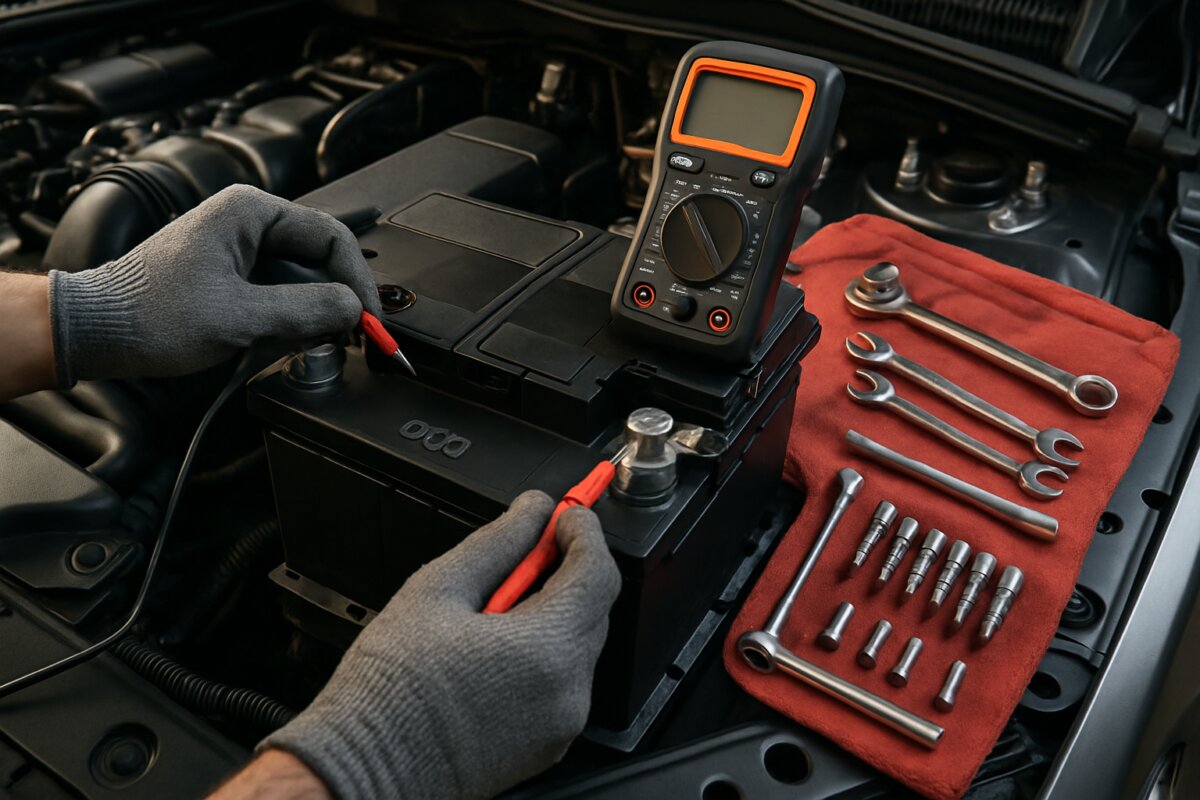
Car battery sizes guide: battery sizes chart & what size for my car depends on your vehicle’s make, model, and engine type. Most UK cars use Group 063, 075, or 096 batteries, with cold cranking amps (CCA) ranging from 380A to 850A. Check your owner’s manual or existing battery label for the correct BCI group size, terminal orientation, and physical dimensions to ensure proper fitment and electrical compatibility.
Getting the wrong battery can leave you stranded with a flat car or, worse, damage your electrical system. The battery is the heart of your vehicle’s electrical network, powering everything from the starter motor to the onboard diagnostics. Modern vehicles with advanced electronics demand precise specifications, making it critical to understand battery sizing before you buy.
Understanding battery group sizes
Battery group sizes are standardised codes developed by the Battery Council International (BCI). These numbers indicate the battery’s physical dimensions, terminal positions, and hold-down configuration. In the UK, you’ll typically encounter European DIN sizes alongside BCI classifications.
Common European sizes include 063, 075, 096, and 110, whilst American classifications use numbers like 35, 51R, or 65. Each designation ensures the battery fits your vehicle’s tray and connects correctly to the terminals. Terminal placement matters enormously—positive and negative posts must align with your car’s cable layout.
Physical dimensions vary significantly between groups. A Group 063 battery measures approximately 242 x 175 x 190mm, whilst a Group 110 extends to 353 x 175 x 190mm. Installing an oversized battery risks contact with the bonnet or surrounding components, potentially causing short circuits or physical damage.
Always measure your battery tray before purchasing a replacement. A 5mm difference in height can prevent proper bonnet closure, leading to water ingress and electrical faults.
Cold cranking amps and reserve capacity
Cold cranking amps (CCA) measure a battery’s ability to start an engine in freezing conditions. Specifically, CCA indicates how many amps a battery delivers at -18°C for 30 seconds whilst maintaining at least 7.2 volts. Higher CCA ratings provide more starting power, crucial for diesel engines and cold UK winters.
Most petrol engines require 400-600 CCA, whilst diesel engines often need 600-850 CCA due to higher compression ratios and glow plug demands. Undersizing CCA leaves you vulnerable to hard starting, particularly on frosty mornings when engine oil thickens and electrical demand peaks.
Reserve capacity (RC) measures how long a battery can run essential electrical systems if your generator fails. Expressed in minutes, RC indicates runtime at 25 amps before voltage drops below 10.5 volts. A higher RC rating provides additional safety margin during electrical system failures or extended accessory use with the engine off.
Modern vehicles with extensive electronics benefit from batteries rated at 100+ minutes RC. This specification becomes particularly important if you frequently use heated seats, infotainment systems, or auxiliary lighting without the engine running.
Battery types and technologies
Three primary battery technologies dominate the UK automotive market: flooded lead-acid, absorbed glass mat (AGM), and enhanced flooded batteries (EFB). Each type suits different vehicle requirements and driving patterns.
Flooded lead-acid batteries remain the most economical option for conventional vehicles without stop-start technology. These traditional batteries use liquid electrolyte and require periodic maintenance, though modern sealed versions eliminate water top-ups. They provide reliable performance for standard electrical loads but struggle with frequent deep discharges.
AGM batteries use fibreglass mat separators soaked in electrolyte, offering superior vibration resistance and faster charging. They’re mandatory for vehicles with stop-start systems and regenerative braking. AGM technology handles repeated charge-discharge cycles without degradation, making them ideal for urban driving with frequent engine restarts. Expect to pay 50-100% more than flooded batteries, but lifespan typically doubles.
EFB batteries bridge the gap between flooded and AGM technologies. They feature thicker plates and improved electrolyte circulation, providing better cycle durability than standard batteries at a lower price point than AGM. Many entry-level stop-start vehicles specify EFB batteries as the minimum requirement.
Installing a standard flooded battery in a stop-start vehicle will cause premature failure within 12-18 months. Always match or exceed the OEM-specified battery technology to avoid expensive replacements.
How to identify your current battery size
Locating your current battery specifications is straightforward if you know where to look. The existing battery carries a label displaying the group size, CCA rating, and manufacturing date. This label typically appears on the top or front face of the battery case.
Look for a three-digit European code (like 096) or a BCI group number (like 51R). The ‘R’ suffix indicates reversed terminal polarity compared to standard orientation. Note the CCA figure, usually prominently displayed, and check for EN (European Standard) or DIN (German Standard) specifications.
Your vehicle’s owner manual provides definitive battery specifications in the technical data section. This information includes group size, minimum CCA requirements, and approved battery types. Some manufacturers specify multiple compatible sizes, offering flexibility based on your budget and performance needs.
The Vehicle Identification Number (VIN) allows parts specialists to cross-reference exact battery specifications. Online catalogues at AutoPartsPro use VIN lookup to eliminate guesswork, ensuring you receive a battery that matches your vehicle’s electrical architecture and physical mounting points.
Measure your battery tray if you’re considering alternative sizes. Length, width, and height constraints determine fitment, whilst hold-down bracket positions must align with your chosen battery’s mounting points. Terminal orientation is non-negotiable—cables must reach their respective posts without strain or modification.
Battery sizes chart for common UK vehicles
| Vehicle Type | Common Group Size | CCA Range | Battery Technology |
|---|---|---|---|
| Small petrol (Fiesta, Corsa, Polo) | 063, 075 | 380-480A | Flooded/EFB |
| Medium petrol (Focus, Astra, Golf) | 075, 096 | 480-600A | EFB/AGM |
| Large petrol (Mondeo, Insignia, Passat) | 096, 110 | 600-740A | AGM |
| Small diesel (Fiesta, Corsa, Polo) | 075, 096 | 520-640A | EFB/AGM |
| Medium diesel (Focus, Astra, Golf) | 096, 110 | 640-760A | AGM |
| Large diesel/SUV | 110, 019 | 760-850A | AGM |
This chart provides general guidance, but always verify specifications against your vehicle’s documentation. Engine variants within the same model may require different battery sizes—a 1.0-litre petrol engine needs less starting power than a 2.0-litre diesel.
Tools and equipment needed
Replacing a car battery requires minimal tools but proper safety equipment. Having everything prepared before you start prevents delays and ensures a safe installation process.
Essential tools
- 10mm or 13mm spanner (most common terminal sizes)
- Socket set for hold-down bracket removal
- Battery terminal brush or sensor cleaner
- Wire brush for cable ends
- Torque wrench (optional but recommended)
- Battery memory saver (preserves radio codes and ECU settings)
Safety equipment
- Safety goggles (battery acid protection)
- Nitrile gloves (acid and lead protection)
- Baking soda solution (neutralises acid spills)
- Old towels or absorbent material
Optional items
- Battery carrier handle (reduces back strain)
- Dielectric grease (prevents terminal corrosion)
- Anti-corrosion washers
- Multimeter (verify charging system performance)
According to AutoPartsPro’s technical specialists, using a memory saver prevents the need to reset dozens of electronic modules. Modern vehicles store critical data in volatile memory that erases when power disconnects, including radio security codes, seat positions, and adaptive transmission settings.
Safety precautions when handling batteries
Car batteries contain sulphuric acid and produce explosive hydrogen gas during charging. Following proper safety protocols prevents serious injuries and vehicle damage.
Always wear eye protection when working near batteries. Battery acid causes severe chemical burns to eyes and skin. If contact occurs, flush immediately with copious amounts of water and seek medical attention. Keep a baking soda solution nearby to neutralise acid spills on metal surfaces or clothing.
Remove all metal jewellery, particularly rings and watches, before working on batteries. A dropped spanner creating a short circuit can weld metal objects to terminals, causing severe burns and potentially igniting hydrogen gas. Ensure the ignition is off and all electrical accessories are disabled before disconnecting cables.
Work in a well-ventilated area, especially when charging batteries. Hydrogen gas accumulates around the battery, creating an explosion risk. Never smoke or create sparks near batteries. A single spark can ignite hydrogen, causing the battery to explode with tremendous force, spraying acid and plastic shrapnel.
Disconnect the negative terminal first when removing a battery, then the positive terminal. This sequence prevents accidental short circuits if your spanner contacts the vehicle body. When installing, connect positive first, then negative. This procedure minimises spark risk and prevents damage to sensitive electronics.
Batteries are heavy—Group 096 batteries weigh approximately 18-20kg. Use proper lifting technique with bent knees and straight back. Battery carrier handles distribute weight evenly, reducing injury risk. Never carry batteries by the terminals, as this can cause internal plate damage.
Step-by-step battery replacement process
Step 1: Prepare the vehicle
Park on level ground and engage the handbrake. Switch off all electrical accessories including lights, radio, and climate control. Open the bonnet and locate the battery, typically found in the engine bay corner. Some vehicles house batteries in the boot or under rear seats—consult your owner’s manual for exact location.
Photograph the battery orientation and cable connections using your phone. These reference images prove invaluable during reassembly, particularly with complex cable routing or multiple earth points. If using a memory saver, connect it to the cigarette lighter socket before disconnecting the battery.
Step 2: Remove the old battery
Using a 10mm or 13mm spanner, loosen the negative terminal (marked with a minus sign or black cover) first. Wiggle the cable connector whilst pulling upward to break corrosion bonds. Position the cable away from the terminal to prevent accidental contact. Repeat the process for the positive terminal (marked with a plus sign or red cover).
Remove the hold-down bracket or clamp securing the battery. These vary by manufacturer but typically use 10mm or 13mm bolts. Some European vehicles employ a bar across the battery top, whilst Japanese cars often use a base clamp. Store all fixings safely—they’re vehicle-specific and rarely included with replacement batteries.
Lift the battery straight up and out of the tray. Avoid tilting excessively, which can slosh acid through vent caps. Place the old battery on a protected surface—never directly on concrete, which can cause discharge through microscopic current paths.
Step 3: Clean the battery tray and terminals
Inspect the battery tray for corrosion, which appears as white, blue, or green crusty deposits. This material is corrosive—wear gloves. Mix baking soda with water to create a cleaning solution, then scrub affected areas with a wire brush. The solution fizzes as it neutralises acid.
Clean cable terminals using a battery terminal brush or spark plug wire brush. Remove all corrosion until bare metal shines. Corroded connections increase electrical resistance, causing voltage drops that affect starter performance and charging efficiency.
Rinse the tray with clean water and dry thoroughly. Moisture trapped under the new battery accelerates corrosion and can create current paths that slowly discharge the battery. Apply a thin coat of petroleum jelly or dielectric grease to tray surfaces for long-term corrosion protection.
Step 4: Install the new battery
Verify the new battery matches the required specifications: group size, CCA rating, and terminal orientation. Lower the battery into the tray, ensuring it sits flush without rocking. Terminal posts should align with cable ends without forcing or stretching cables.
Reinstall the hold-down bracket or clamp, tightening just enough to prevent movement. Over-tightening cracks the battery case, leading to acid leaks and internal damage. The battery should resist side-to-side movement but shouldn’t compress under clamping force.
Connect the positive terminal first, sliding the cable connector fully onto the terminal post. Tighten the bolt until snug—typical torque specifications range from 10-15 Nm for side terminals and 15-20 Nm for top posts. Excessive torque strips threads or cracks terminals.
Connect the negative terminal using the same procedure. Apply dielectric grease or petroleum jelly to exposed terminal surfaces to prevent corrosion. Some technicians prefer anti-corrosion washers, which contain compounds that neutralise acid vapours.
Step 5: Verify installation and test systems
Double-check all connections are tight and properly oriented. Remove any tools from the engine bay—a dropped spanner across terminals causes spectacular shorts. If you used a memory saver, disconnect it now.
Start the engine and verify it cranks normally. Modern vehicles may require an idle period for the alternator regulator to calibrate to the new battery. Check dashboard warning lights—the battery light should extinguish immediately after starting.
Test electrical accessories: lights, wipers, windows, and climate control. Some vehicles require battery registration through diagnostic software, particularly German manufacturers. This process informs the charging system about the new battery’s specifications, optimising charge rates and extending service life.
Use a multimeter to verify charging system operation. With the engine running, battery voltage should read 13.8-14.4 volts. Lower readings indicate charging system problems, whilst higher voltages suggest control unit faults that can overcharge and damage the new battery.
Common mistakes to avoid
Installing an incorrect battery type ranks as the most frequent error. Fitting a standard flooded battery in a stop-start vehicle causes rapid failure due to excessive cycling. The battery management system expects AGM or EFB technology and adjusts charging accordingly. A mismatched battery receives incorrect charge profiles, leading to sulphation and capacity loss within months.
Reversing terminal connections creates immediate and catastrophic damage. Modern vehicles contain dozens of electronic modules with polarity-sensitive components. Reversed polarity destroys diodes, burns wiring, and can fry expensive control units. Always connect positive to positive and negative to negative, double-checking before tightening terminals.
Over-tightening terminal bolts cracks battery posts or strips threads in the terminal connector. Damaged terminals prevent proper electrical contact, causing intermittent starting problems and voltage drops. Use moderate force—connections should be snug, not brutally tight. A torque wrench eliminates guesswork and prevents damage.
Neglecting to clean terminals before installation guarantees future problems. Corrosion acts as an insulator, reducing current flow and increasing resistance. This resistance generates heat during high-current events like starting, accelerating corrosion in a destructive feedback loop. Invest five minutes cleaning terminals to avoid premature battery failure.
Failing to secure the hold-down bracket allows the battery to move during driving. Vibration damages internal plates, causing short circuits between cells. A loose battery also stresses cable connections, potentially causing intermittent electrical faults. Some insurance policies void coverage for damage caused by unsecured batteries.
When should you replace your car battery?
Most car batteries last 3-5 years under normal conditions, though this varies significantly with climate, driving patterns, and vehicle electrical loads. UK winters accelerate battery degradation—cold temperatures reduce chemical reaction rates, diminishing available capacity when you need it most.
Several symptoms indicate imminent battery failure. Slow engine cranking, particularly on cold mornings, suggests reduced CCA capacity. If your starter labours longer than usual before the engine fires, your battery lacks sufficient current delivery. This symptom often appears gradually over weeks or months.
Dimming headlights at idle that brighten when you rev the engine indicate a weak battery struggling to maintain voltage. The generator compensates during acceleration, but at idle, the compromised battery can’t sustain electrical demands. This symptom becomes particularly noticeable with multiple accessories operating simultaneously.
Illuminated battery warning lights or dashboard messages require immediate attention. Modern vehicles monitor battery health through voltage sensors and current measurement. Warning indicators suggest the battery can’t hold charge or the charging system has failed. Ignoring these warnings risks being stranded with a completely flat battery.
Swollen or bloated battery cases indicate internal damage from overcharging or freezing. A battery exposed to excessive charge voltage generates gas faster than vents can release it, causing case deformation. Similarly, a deeply discharged battery can freeze in winter, expanding and cracking the case. Replace swollen batteries immediately—they pose explosion and acid leak risks.
Visible corrosion around terminals, particularly excessive white or blue-green deposits, suggests acid leakage from failing seals. Whilst some terminal corrosion is normal, heavy deposits indicate the battery is venting excessively, a sign of internal breakdown. Clean the terminals and monitor closely—replacement will likely be necessary within months.
According to AutoPartsPro’s workshop specialists, preventative replacement beats roadside recovery every time. If your battery approaches four years old and you notice any warning signs, replacement during scheduled maintenance is far more convenient than dealing with a failure in a supermarket car park during a rainstorm.
Related maintenance you can do at the same time
Battery replacement provides an excellent opportunity to service related electrical and engine components. With the battery disconnected, you’ve already created a safe working environment for several maintenance tasks.
Inspect and clean all earth straps and ground connections. These cables connect the battery negative terminal to the chassis and engine block. Corroded earth connections cause mysterious electrical faults, rough running, and starting problems. Remove, clean, and reinstall all visible ground straps, applying dielectric grease to prevent future corrosion.
Check the generator drive belt condition and tension. A worn or loose belt reduces charging efficiency, forcing the new battery to work harder. Look for cracks, glazing, or fraying along the belt edges. Belt replacement is straightforward and inexpensive insurance against charging system failure.
Replace the air filter if it’s been 12,000 miles or more since the last change. With the bonnet open and tools already out, this ten-minute job improves fuel efficiency and throttle response. A clogged air filter increases fuel consumption by up to 10%, costing far more than the filter itself.
Top up engine oil and coolant levels whilst you’re under the bonnet. Modern engines consume oil between service intervals, particularly on motorway runs. Low oil levels cause accelerated wear, whilst insufficient coolant risks overheating damage. Both checks take seconds and prevent expensive failures.
Clean or replace the cabin filter, which affects heating and air conditioning performance. A blocked cabin filter reduces airflow, forcing the blower motor to work harder and drawing more current from your new battery. Fresh cabin filters also improve air quality and reduce allergens inside the vehicle.
Inspect battery cable condition along their entire length. Damaged insulation, particularly near connection points, can cause short circuits or allow moisture ingress. Cracked or brittle cables should be replaced—they’re safety-critical components that handle hundreds of amps during starting.
Frequently asked questions
Can I fit a larger battery than specified?
You can install a higher CCA battery than specified provided the physical dimensions and terminal orientation match. The charging system will handle the increased capacity without issues. However, avoid batteries with significantly lower CCA ratings, which struggle to meet starting demands.
Do I need to register a new battery with the car’s computer?
German manufacturers (BMW, Mercedes-Benz, Audi, VW) typically require battery registration through diagnostic software. This process calibrates the intelligent battery sensor and optimises charge rates. Skipping registration reduces battery lifespan and can cause premature failure. Japanese and British manufacturers rarely require registration.
How long should I run the engine after installing a new battery?
Run the engine for at least 20-30 minutes after installation to allow the battery to charge and the vehicle systems to recalibrate. Avoid short trips immediately after installation. The battery arrives with approximately 75-80% charge, requiring several hours of driving to reach full capacity.
Can I recondition an old battery instead of replacing it?
Reconditioning only works for batteries suffering from sulphation without physical damage. Purpose-built desulphation chargers can sometimes recover capacity, but success rates are low with modern sealed batteries. If the battery has failed load testing or shows physical damage, replacement is the only reliable solution.
Why does my new battery keep going flat?
A new battery that repeatedly discharges indicates underlying electrical problems rather than battery faults. Common causes include parasitic draws from faulty modules, damaged alternator diodes, or corroded ground connections. A professional electrical system test identifies the fault before you waste money on multiple battery replacements.
Selecting the proper battery size ensures reliable starting performance and protects your vehicle’s electrical system from damage. Modern vehicles demand precise specifications, making it worth the extra time to verify group size, CCA rating, and technology type before purchase. The specialists at AutoPartsPro can cross-reference your vehicle’s VIN to guarantee you receive the correct battery specification, eliminating guesswork and ensuring years of trouble-free motoring.

 Loading...


