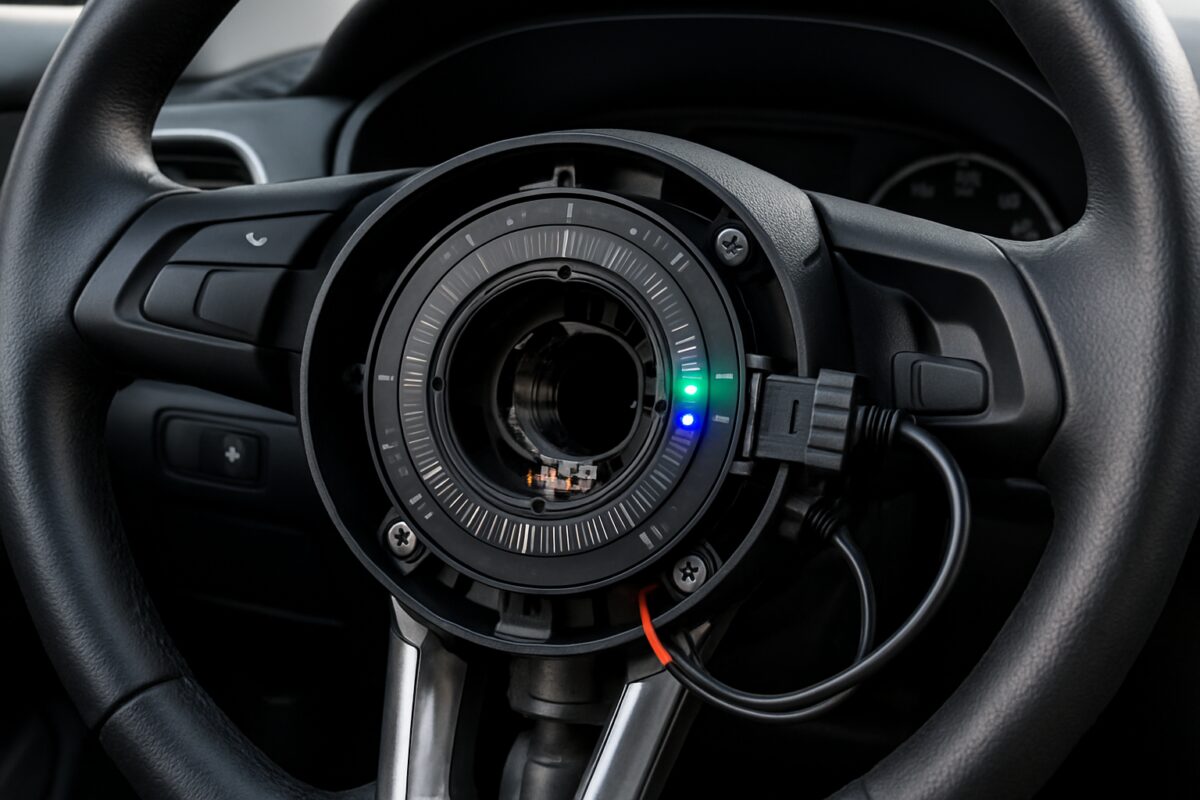
The steering angle sensor is a critical component that monitors your vehicle’s steering wheel position and sends this information to various safety systems. When this sensor fails, you’ll notice warning lights on your dashboard, loss of stability control, and potentially dangerous handling issues. Understanding how to recognise and test steering angle sensor problems can save you money on repairs and ensure your safety on the road.
What is a steering angle sensor and how does it work
The steering angle sensor, often abbreviated as SAS, is a sophisticated electronic device mounted on your vehicle’s steering column. This component continuously monitors the position and rotation speed of your steering wheel, providing real-time data to your car’s electronic control systems.
Modern vehicles rely heavily on this sensor to operate multiple safety and stability systems effectively. The device uses optical or magnetic technology to detect the steering wheel’s exact position relative to its centre point. This information is crucial for systems that need to understand which direction the vehicle is intended to travel.
According to our specialists at AutoPartsPro, the steering angle sensor works by measuring the steering wheel’s rotation in degrees from its neutral position. The sensor can detect movements as small as 0.1 degrees, making it incredibly precise in its measurements.
The sensor communicates with various vehicle systems through the Controller Area Network (CAN) bus. This allows multiple systems to receive steering angle data simultaneously, ensuring coordinated operation across different vehicle functions.
Systems that depend on steering angle sensor data
Several critical vehicle systems rely on accurate steering angle information to function properly. Understanding these systems helps explain why a faulty sensor can cause such widespread problems.
Primary systems affected:
- Electronic Stability Control (ESC)
- Anti-lock Braking System (ABS)
- Traction Control System (TCS)
- Lane Keeping Assist
- Adaptive cruise control
The Electronic Stability Control system uses steering angle data to determine driver intent versus actual vehicle movement. When the sensor detects that you’re turning the wheel but the vehicle isn’t responding appropriately, ESC intervenes to help maintain control.
Modern ABS sensor systems also integrate with steering angle data to provide more sophisticated braking assistance. This integration allows the system to apply individual wheel brakes more effectively during emergency manoeuvres.
Lane keeping assist systems use steering angle information to understand when you’re making intentional steering inputs versus unintentional lane departures. Without accurate sensor data, these systems cannot function reliably.
Advanced driver assistance systems integration
Today’s vehicles feature increasingly sophisticated driver assistance technologies that depend on steering angle sensor data. These systems work together to provide a safer driving experience, but they all require accurate steering position information.
Adaptive cruise control systems use steering angle data to predict the vehicle’s intended path. This information helps the system maintain appropriate following distances around curves and during lane changes.
Electric power steering systems also benefit from steering angle sensor data. The information helps these systems provide appropriate steering assistance and feedback to the driver.
Common signs of steering angle sensor failure
Recognising the early warning signs of steering angle sensor failure can prevent more serious problems and ensure your safety. These symptoms often develop gradually, making them easy to overlook initially.
The most obvious indicator is the appearance of warning lights on your dashboard. You’ll typically see the ESC, ABS, or traction control warning lights illuminate when the sensor begins to fail. These lights may appear intermittently at first but will become more persistent as the problem worsens.
According to our mechanics at AutoPartsPro, steering feel changes are another early indicator of sensor problems. You might notice that your steering feels less responsive or that the vehicle doesn’t track straight as it should. The steering wheel may also feel loose or disconnected from the wheels.
Key failure symptoms:
- Dashboard warning lights (ESC, ABS, TCS)
- Loss of power steering assistance
- Vehicle pulling to one side
- Erratic stability control activation
- Disabled driver assistance features
| Symptom | Severity | Immediate Action Required |
|---|---|---|
| Warning lights only | Medium | Book diagnostic check |
| Loss of steering assistance | High | Stop driving safely |
| Vehicle pulling strongly | Critical | Immediate professional help |
Some drivers report unusual noises from the steering column when the sensor begins to fail. You might hear clicking, grinding, or whirring sounds when turning the steering wheel. These noises often indicate that the sensor’s mechanical components are wearing out.
Advanced diagnostic indicators
Modern vehicles provide additional diagnostic information through their onboard computers. If you have access to an OBD-II scanner, you can check for specific fault codes related to steering angle sensor problems.
Common fault codes include C0545, C0550, and U0415, though the exact codes vary between manufacturers. These codes provide valuable information about the specific nature of the sensor failure.
Some vehicles also display specific error messages on their information screens. Messages like “Steering Angle Sensor Malfunction” or “ESC System Fault” provide clear indication of sensor-related problems.
Professional tip: If your stability control systems suddenly become unavailable after routine maintenance involving the steering system, the steering angle sensor may simply need recalibration rather than replacement.
How to test a steering angle sensor
Testing a steering angle sensor requires specific diagnostic equipment and procedures. While some basic checks can be performed by experienced DIY mechanics, professional diagnosis is often necessary for accurate results.
The most reliable method involves using professional diagnostic equipment that can communicate with your vehicle’s electronic control modules. These tools can display real-time steering angle data and compare it to expected values.
Our AutoPartsPro specialists recommend starting with a visual inspection of the steering column area. Look for damaged wiring, loose connections, or signs of moisture intrusion around the sensor housing. Physical damage to the sensor or its connections often causes failure.
Basic testing procedure:
- Connect OBD-II diagnostic scanner
- Check for stored fault codes
- Monitor live steering angle data
- Perform steering wheel calibration
- Test system functionality
| Test Parameter | Expected Reading | Failure Indication |
|---|---|---|
| Centre position | 0 degrees ±2 | Constant offset |
| Full lock left | -540 degrees typical | Incorrect maximum |
| Full lock right | +540 degrees typical | Erratic readings |
Professional testing involves more sophisticated procedures. Technicians use specialised equipment to monitor sensor output while manipulating the steering wheel through its full range of motion. This testing reveals intermittent faults that might not show up during static checks.
DIY testing limitations
While basic OBD-II scanners can read steering angle sensor fault codes, they often cannot display live data from the sensor. This limitation makes it difficult to perform comprehensive testing without professional equipment.
Some multimeter testing is possible, but it requires detailed knowledge of the sensor’s electrical specifications. Incorrect testing procedures can damage the sensor or other electronic components, making professional diagnosis the safer option.
Many steering angle sensors require specific calibration procedures after replacement or when certain fault codes appear. These procedures often require manufacturer-specific diagnostic tools and cannot be performed with generic equipment.
Steering angle sensor replacement and calibration
Replacing a steering angle sensor involves more than simply swapping the old part for a new one. The process requires careful attention to safety procedures and proper calibration of the new sensor.
Safety is paramount when working on steering systems. The vehicle should be on level ground with the wheels pointing straight ahead before beginning any work. Many vehicles require the battery to be disconnected to prevent accidental airbag deployment.
The physical replacement process varies between vehicle makes and models. Some sensors are easily accessible once the steering wheel is removed, while others require more extensive disassembly of steering column components.
Calibration is crucial after sensor replacement. The new sensor must learn the vehicle’s specific steering characteristics and centre position. This process typically involves using diagnostic equipment to guide the calibration procedure.
AutoPartsPro’s experienced technicians emphasise that proper calibration ensures accurate operation of all steering-dependent safety systems. Skipping this step can result in continued warning lights and compromised vehicle safety.
Post-replacement testing
After installation and calibration, comprehensive testing ensures the new sensor operates correctly. This testing involves checking all related warning lights and verifying that safety systems function as intended.
A proper test drive should include various manoeuvres to exercise all steering-dependent systems. The technician should verify that stability control, ABS, and other systems respond appropriately to steering inputs.
Some vehicles require additional procedures, such as wheel alignment checks, to ensure optimal performance after steering system work. These additional steps help prevent future problems and ensure proper vehicle handling.
Prevention and maintenance tips
Preventing steering angle sensor problems involves maintaining the entire steering system and protecting electronic components from damage. Regular maintenance can extend sensor life and prevent unexpected failures.
Keep the steering column area clean and dry. Moisture intrusion is a common cause of sensor failure, particularly in vehicles exposed to heavy rain or flooding. Check for water leaks around door seals and windscreen areas that could affect the steering column.
Avoid harsh impacts to the steering wheel or column. Aggressive driving over potholes or kerbs can damage the sensitive sensor components. Similarly, hanging heavy items from the steering wheel can stress the sensor mounting.
Regular vehicle maintenance helps identify potential problems before they cause sensor failure. Have your steering system inspected during routine service intervals, paying particular attention to worn tie rod ends or other components that might affect steering precision.
Warning signs to monitor
Stay alert for subtle changes in steering feel or vehicle behaviour. Early detection of problems allows for less expensive repairs and prevents safety-critical system failures.
Pay attention to warning light patterns on your dashboard. Intermittent lights often indicate developing problems that will worsen if not addressed promptly. Don’t ignore warning lights, even if they appear to clear themselves.
Monitor your vehicle’s handling characteristics during different driving conditions. Changes in straight-line stability, turning response, or braking behaviour can all indicate steering angle sensor problems.
Cost considerations and replacement options
Steering angle sensor replacement costs vary significantly depending on your vehicle’s make, model, and the complexity of the installation. Understanding these factors helps you budget appropriately for repairs.
The sensor itself typically costs between £80 and £300, depending on the vehicle type. Luxury vehicles and those with advanced driver assistance systems often require more expensive sensors with additional features.
Labour costs for replacement can range from £150 to £400, depending on the sensor’s location and the complexity of the calibration procedures. Vehicles requiring extensive steering column disassembly will incur higher labour charges.
Some manufacturers offer updated sensor designs that address common failure modes in older models. These improved sensors may cost slightly more but can provide better long-term reliability.
Choosing quality replacement parts
When selecting a replacement steering angle sensor, quality should be your primary consideration. Cheap aftermarket sensors may save money initially but often fail prematurely, leading to repeated repairs.
OEM (Original Equipment Manufacturer) sensors provide the best compatibility and reliability. These parts are designed specifically for your vehicle and meet the manufacturer’s exact specifications.
High-quality aftermarket sensors from reputable suppliers can offer good value while maintaining reliability. Research the supplier’s reputation and warranty terms before purchasing to ensure you’re getting a quality product.
Understanding your steering angle sensor’s role in vehicle safety and knowing how to recognise failure symptoms empowers you to address problems promptly. Whether you’re dealing with warning lights, handling issues, or considering preventive maintenance, proper knowledge helps ensure your vehicle’s safety systems function reliably. Regular attention to your steering system and prompt professional diagnosis of any problems will keep you safe on Britain’s roads while avoiding costly emergency repairs.
Frequently Asked Questions (FAQ)
Can I drive with a faulty steering angle sensor?
Driving with a faulty sensor is possible but dangerous. Safety systems like ESC and ABS may not function properly, increasing accident risk significantly.
How often should steering angle sensors be replaced?
These sensors typically last 100,000-150,000 miles under normal conditions. Replacement is usually only needed when they fail or become damaged through impact.
Will disconnecting the battery reset steering angle sensor problems?
Battery disconnection may temporarily clear warning lights but won’t fix sensor hardware problems. Professional calibration is required for permanent resolution of issues.
Can wheel alignment affect steering angle sensor readings?
Poor alignment can cause steering wheel off-centre positioning, which may trigger sensor fault codes. Proper alignment ensures accurate sensor calibration and operation.
Are steering angle sensor problems covered under vehicle warranty?
Coverage depends on your specific warranty terms and vehicle age. Manufacturing defects are typically covered, but damage from impacts or wear isn’t.

 Loading...