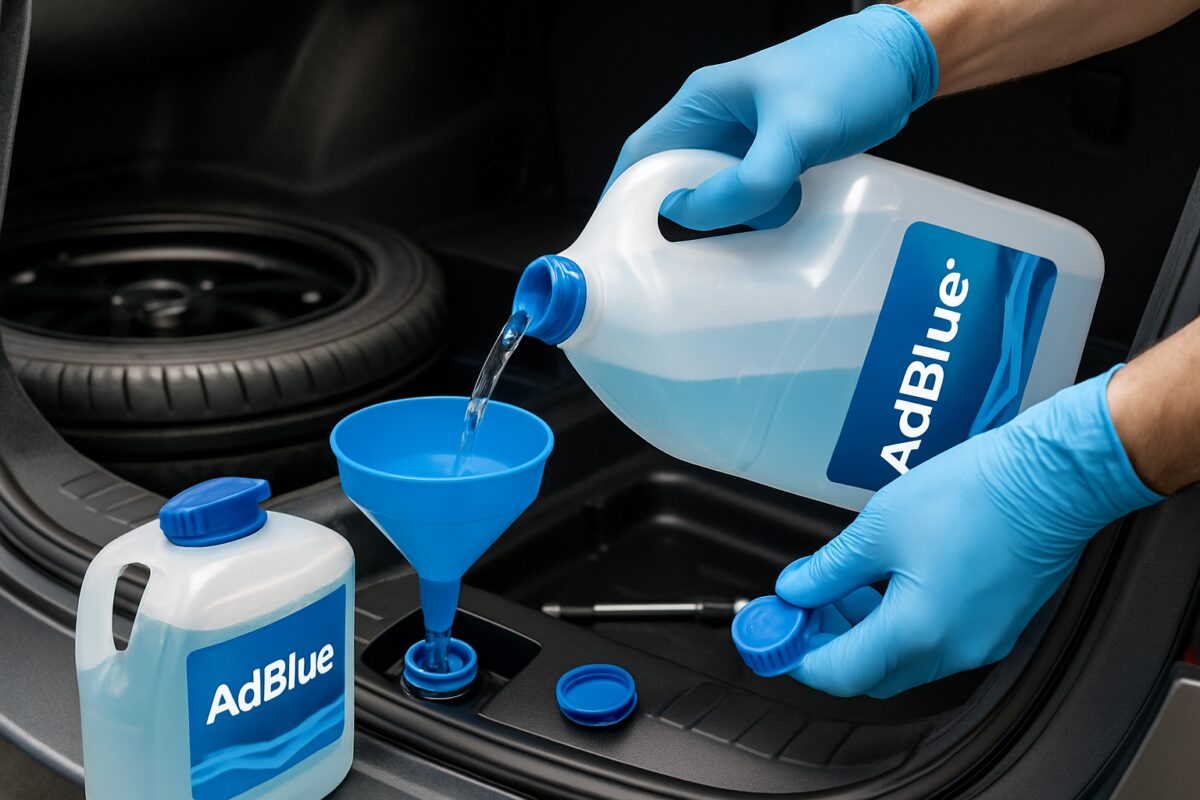
Adding AdBlue® to your car requires locating the blue-capped filler neck, typically in the boot or near the fuel tank. Pour slowly using a funnel to prevent spillage, adding between 5-20 litres depending on your tank size. Most vehicles accept 10-15 litres during a standard refill. Always use certified AdBlue® solution and avoid overfilling to prevent system damage.
Tools & parts required
Before starting the AdBlue® refill process, gather the essential items to ensure a clean and efficient operation.
Parts needed:
- Certified AdBlue® solution (ISO 22241 compliant)
- Disposable gloves
- Clean cloth or paper towels
Tools required:
- AdBlue® funnel or spout
- Measuring jug (optional)
- Torch or mobile phone light
Always ensure the AdBlue® solution matches your vehicle’s specifications. The fluid must meet ISO 22241 standards to avoid costly damage to the SCR system.
Safety precautions
AdBlue® is generally safe but requires proper handling to avoid complications.
- Work in a well-ventilated area away from direct sunlight
- Wear protective gloves to prevent skin contact
- Keep AdBlue® away from metal surfaces to prevent corrosion
- Store unused solution in original containers at temperatures between -11°C and 30°C
If AdBlue® contacts skin or clothing, rinse immediately with clean water. The solution can crystallise and damage paintwork if left untreated.
Step-by-step instructions
Follow this systematic approach to safely refill your vehicle’s AdBlue® tank.
Step 1: Locate the AdBlue® filler cap
Check your vehicle’s manual to find the AdBlue® filler neck. Common locations include the boot area, next to the spare wheel, or near the fuel filler cap. Look for a blue-coloured cap marked with ‘AdBlue®’ or ‘DEF’ text.
Step 2: Prepare the refill area
Park on level ground and engage the handbrake. Turn off the engine and remove the key. Clean around the filler cap to prevent contamination entering the system.
Step 3: Open the AdBlue® tank
Remove the blue cap by turning anti-clockwise. Some vehicles require pressing down whilst turning. Keep the cap clean and place it on a protected surface.
Step 4: Insert the funnel and pour slowly
Insert your AdBlue® funnel firmly into the filler neck. Pour slowly to avoid air bubbles and spillage. A steady, controlled flow prevents the system from detecting false fill levels.
Step 5: Monitor the fill level
Most tanks hold between 15-25 litres when completely empty. Stop pouring when the tank reaches approximately 95% capacity. The system will indicate when full through dashboard warnings or by the fluid backing up into the filler neck.
Step 6: Replace the cap and clean up
Replace the blue cap firmly, ensuring proper sealing. Clean any spillages immediately with water. Dispose of empty containers according to local recycling guidelines.
Common mistakes to avoid
Understanding these frequent errors helps prevent costly repairs and ensures optimal system performance.
- Using non-certified AdBlue® solutions that damage SCR catalysts
- Overfilling the tank, causing system pressure problems
- Mixing AdBlue® with diesel fuel, resulting in catastrophic engine damage
- Ignoring low AdBlue® warnings, leading to vehicle immobilisation
- Storing AdBlue® in unsuitable containers or extreme temperatures
Always purchase AdBlue® from reputable suppliers and check expiry dates. Degraded solution loses effectiveness and may trigger fault codes.
Professional tip: Our mechanics at AutoPartsPro recommend checking your AdBlue® level monthly alongside other fluid inspections. This prevents emergency top-ups and ensures consistent emission control performance.
When should you refill AdBlue®?
Understanding consumption patterns helps plan refills and avoid unexpected vehicle limitations.
Most diesel vehicles consume approximately 1 litre of AdBlue® per 1,000 miles, though this varies with driving conditions. Highway driving typically uses less than urban stop-start traffic.
Dashboard warnings appear when levels drop below 2,400km range. Some vehicles display countdown timers showing remaining mileage before engine restrictions activate.
Temperature affects consumption rates. Cold weather increases usage whilst hot conditions may cause expansion in the tank.
Expert insight: According to our AutoPartsPro specialists, maintaining AdBlue® levels above 25% prevents crystallisation in the injector system and ensures optimal SCR catalyst efficiency throughout varying weather conditions.
Related maintenance you can do at the same time
Maximise efficiency by combining AdBlue® refills with complementary maintenance tasks.
Consider replacing your air filter during AdBlue® servicing, particularly if approaching service intervals. Clean air filtration improves combustion efficiency and reduces emission system stress.
Check and top up engine oil levels while accessing the boot area. Proper lubrication supports emission control system longevity.
Inspect particulate filter condition if accessible. Blocked DPFs increase AdBlue® consumption and reduce overall system efficiency.
Consider scheduling professional diagnostics using OBD2 diagnostic tools to verify emission system performance.
Frequently asked questions
How much AdBlue® should I add to my car?
Add between 5-20 litres depending on tank size and current level. Most standard refills require 10-15 litres for optimal range.
Can I overfill my AdBlue® tank?
Yes, overfilling can damage the system. Stop when fluid reaches the filler neck or dashboard indicates full capacity.
What happens if I use wrong AdBlue® solution?
Non-compliant solutions damage SCR catalysts, potentially costing thousands in repairs. Always use ISO 22241 certified products.
How often should I check AdBlue® levels?
Check monthly or every 1,000 miles. Dashboard warnings typically appear with 2,400km remaining range.
Can I mix different AdBlue® brands?
Yes, all ISO 22241 compliant solutions are chemically identical and safely mixable regardless of manufacturer.
Proper AdBlue® maintenance represents a straightforward yet crucial aspect of modern diesel vehicle ownership. Following correct procedures and using quality solutions ensures your emission control system operates efficiently whilst avoiding expensive repairs. Remember to check levels regularly and address low warnings promptly to maintain unrestricted vehicle operation. For additional guidance on diesel maintenance, explore our comprehensive guides on diesel filter replacement and DPF cleaning procedures to keep your vehicle running smoothly.

 Loading...