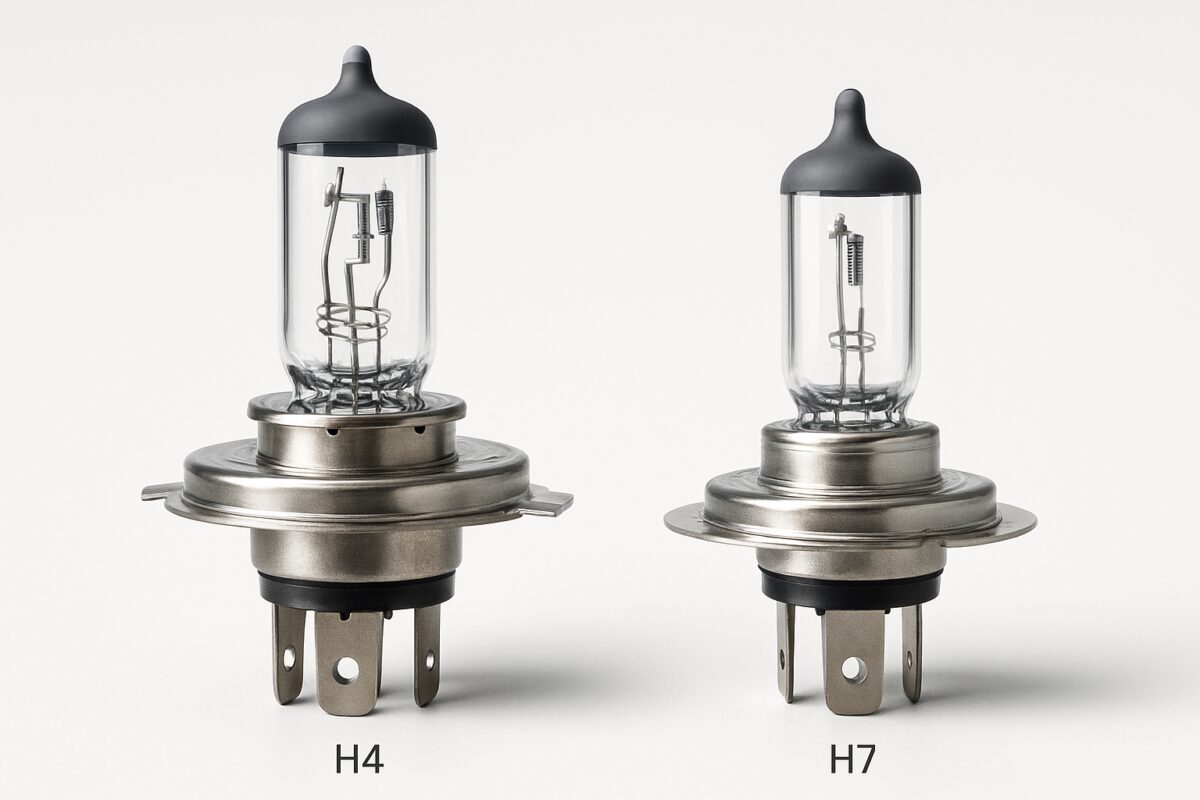
The main difference between H4 and H7 headlight bulbs lies in their design and functionality: H4 bulbs are dual-filament bulbs providing both high and low beam functions from a single unit, whilst H7 bulbs are single-filament bulbs that require separate units for high and low beams. This fundamental distinction affects vehicle compatibility, installation complexity, and overall lighting performance for UK drivers.
Quick comparison table
Here’s a comprehensive overview of H4 versus H7 headlight bulbs to help you make an informed decision quickly.
| Attribute | H4 Bulb | H7 Bulb |
|---|---|---|
| Price range | £8-30 per bulb | £6-25 per bulb |
| Durability | 600-1000 hours | 550-1000 hours |
| Performance | Moderate brightness | Higher brightness potential |
| Installation | Single unit replacement | Requires two separate bulbs |
| Maintenance | Simpler (one bulb per headlamp) | More complex (two bulbs per side) |
| Best use case | Older vehicles, budget-conscious drivers | Modern cars, performance-focused drivers |
H4 headlight bulb overview
The H4 bulb represents traditional automotive lighting technology with its dual-filament design. This bulb contains two separate tungsten filaments within a single glass envelope, allowing it to produce both high beam and low beam illumination.
The bulb operates using a 12V electrical system and typically consumes 55 watts for low beam and 60 watts for high beam functions. The dual-filament arrangement uses a shield mechanism to direct light appropriately for each beam pattern. When the low beam filament activates, a metal shield blocks certain portions of light to create the proper cut-off pattern required by UK regulations.
H4 bulbs typically cost between £8-30 depending on brand quality and technology. Standard halogen versions sit at the lower end, whilst premium options with enhanced coatings or xenon gas fills command higher prices. Expected lifespan ranges from 600-1000 hours of operation.
Advantages of H4 bulbs:
- Simple installation process requiring only one bulb per headlamp unit
- Lower initial cost for complete headlight replacement
- Widely available across automotive retailers
- Compatible with older vehicle electrical systems
- Proven reliability in various weather conditions
Disadvantages of H4 bulbs:
- Limited brightness compared to modern alternatives
- Older technology with less efficient light output
- Heat generation can affect bulb longevity
- Less precise beam control than separate bulb systems
H4 bulbs work ideally for drivers of older vehicles who prioritise simplicity and cost-effectiveness. They’re particularly suitable for those who perform their own maintenance and prefer straightforward replacement procedures. Our mechanics at AutoPartsPro often recommend H4 bulbs for classic car enthusiasts and budget-conscious motorists who need reliable basic lighting performance.
H7 headlight bulb overview
H7 bulbs represent modern single-filament technology designed for superior light output and precision. Unlike H4 bulbs, each H7 unit serves a single purpose – either high beam or low beam – requiring separate bulbs for complete headlight functionality.
These bulbs operate on 12V systems consuming typically 55 watts. The single-filament design allows for more precise light control and positioning within the headlamp reflector or projector housing. This precision translates to better beam patterns and improved road illumination characteristics.
H7 bulbs range from £6-25 per unit, with light bulbs prices varying based on technology level. Premium versions often feature enhanced gas fills, improved filament design, or advanced coatings. Expected lifespan matches H4 bulbs at 550-1000 hours.
Advantages of H7 bulbs:
- Superior light output and beam precision
- Better compatibility with modern headlamp designs
- Enhanced performance in projector housings
- Improved colour temperature options available
- More efficient light distribution patterns
Disadvantages of H7 bulbs:
- Requires two separate bulb purchases per headlamp
- Higher total replacement cost
- More complex installation process
- Increased maintenance complexity
- Vehicle must be designed for H7 configuration
H7 bulbs suit drivers of modern vehicles who prioritise maximum lighting performance. They’re ideal for motorists who frequently drive at night, travel on unlit rural roads, or want the best possible visibility. These bulbs particularly excel in vehicles equipped with projector headlamps or advanced lighting systems.
Compatibility considerations
Vehicle compatibility represents the most crucial factor when choosing between H4 and H7 bulbs. Your car’s headlamp assembly determines which bulb type you must use, as the electrical connections, mounting systems, and optical designs differ significantly.
H4 bulbs typically appear in vehicles manufactured before 2000, though some modern economy cars still use this configuration. Common H4 vehicles include older Ford Transits, classic Mini models, and various European cars from the 1980s and 1990s. The Volkswagen Transporter series frequently uses H4 bulbs in its headlamp designs.
H7 bulbs predominate in vehicles manufactured after 2000, particularly in premium and mid-range models. Most modern BMW, Audi, Mercedes-Benz, and Volkswagen vehicles use H7 configurations. Many Ford Focus, Vauxhall Astra, and Peugeot models also employ H7 systems.
Installation considerations vary significantly between bulb types. H4 bulbs feature a three-pin electrical connector with ground, low beam, and high beam connections. H7 bulbs use a two-pin connector requiring separate wiring for each bulb function. Some vehicles use different H7 bulbs for high and low beams, whilst others use identical bulbs in different housings.
Key compatibility factors:
- Electrical connector configuration and pin layout
- Physical mounting mechanism and bulb base design
- Headlamp housing optical design and focal point requirements
- Vehicle electrical system capacity and fuse ratings
- Legal compliance with UK lighting regulations
Professional tip: Always check your vehicle handbook or examine the existing bulb before purchasing replacements. The bulb type is usually printed on the base or glass envelope of your current bulb.
Performance comparison
Light output represents the primary performance difference between H4 and H7 bulbs. H7 bulbs generally produce superior illumination due to their single-filament design and modern optical engineering. The single filament allows more precise positioning within the headlamp reflector, resulting in better light control and distribution.
Brightness measurements show H7 bulbs typically producing 1500-1650 lumens compared to H4 bulbs’ 1000-1200 lumens for low beam operation. This translates to noticeably improved road illumination, particularly important for UK drivers navigating narrow country lanes or poorly lit urban areas.
Beam pattern quality also favours H7 technology. The separate high and low beam bulbs allow engineers to optimise each beam pattern independently. Low beams achieve sharper cut-off lines reducing glare for oncoming traffic, whilst high beams provide wider spread and longer throw for enhanced visibility.
Colour temperature options expand significantly with H7 bulbs. Whilst standard H4 bulbs typically produce 3200K yellowish light, H7 variants offer ranges from 3000K warm white to 6000K cool white. Many drivers prefer the 4300K-5000K range as it closely matches daylight conditions.
Heat management differs between the technologies. H4 bulbs generate more concentrated heat due to dual filaments in close proximity, potentially reducing lifespan. H7 bulbs distribute heat more evenly with single filaments, often resulting in longer operational life when properly ventilated.
Expert insight: Our AutoPartsPro specialists observe that H7 equipped vehicles typically pass MOT headlight tests more easily due to superior beam patterns and light output consistency.
Installation and maintenance
Installation procedures vary significantly between H4 and H7 configurations, affecting both initial setup and ongoing maintenance requirements. Understanding these differences helps drivers plan for replacement costs and labour time.
H4 bulb installation proves simpler due to the single-bulb design. Most installations require removing the headlamp cover, disconnecting the three-pin connector, releasing the retaining clip, and installing the new bulb. The process typically takes 10-15 minutes per side for experienced DIY mechanics.
H7 installations involve more steps as each headlamp requires two separate bulb replacements. Access can be more challenging in modern vehicles where air filter housings or other components may obstruct bulb access. Some vehicles require partial disassembly of surrounding components, extending replacement time to 20-30 minutes per side.
Maintenance frequency remains similar between both bulb types, with replacements typically needed every 2-3 years depending on usage patterns. However, H7 systems may require staggered replacement if only one bulb fails, whilst H4 systems affect both beam functions simultaneously.
Cost considerations extend beyond bulb prices to include labour charges. Professional installation costs £20-40 for H4 replacement versus £30-60 for H7 systems due to increased complexity. Many drivers find H4 systems more suitable for DIY maintenance.
Tools required for both installations include basic hand tools, clean cloth or gloves for handling new bulbs, and adequate lighting for working in engine bay areas. Some H7 installations may require additional tools for component removal.
Upgrade options and alternatives
Modern lighting technology offers various upgrade paths for both H4 and H7 configurations, allowing drivers to improve performance beyond standard halogen bulbs while maintaining original fitment.
LED conversion kits represent the most popular upgrade option for both bulb types. These kits typically provide 2-3 times the light output whilst consuming 50% less power than halogen equivalents. LED upgrades for H4 systems maintain the dual-beam functionality in a single unit, whilst H7 LED conversions require separate high and low beam units.
Xenon HID conversion kits offer another performance enhancement, particularly popular with H7 systems. These provide exceptional light output – up to 3000 lumens – with distinctive white-blue colour temperatures. However, HID conversions may require additional ballast units and professional installation to ensure proper operation and legal compliance.
Premium halogen options exist for both configurations, featuring enhanced gas fills, improved filament design, or advanced coatings. These typically provide 30-50% more light output than standard bulbs whilst maintaining original electrical compatibility.
Legal considerations affect all upgrade options in the UK. Replacement bulbs must maintain proper beam patterns and comply with construction and use regulations. OEM car parts often provide the safest upgrade path for maintaining legal compliance.
Cost analysis
Total cost of ownership differs significantly between H4 and H7 systems when considering bulb prices, installation costs, and maintenance requirements over typical vehicle ownership periods.
Initial purchase costs favour individual H7 bulbs at £6-25 each compared to H4 bulbs at £8-30 each. However, H7 systems require two bulbs per headlamp versus one for H4, making complete replacement costs £12-50 for H7 versus £8-30 for H4 per side.
Installation labour costs range from £20-40 for H4 systems versus £30-60 for H7 due to increased complexity. DIY installations eliminate labour costs but require more time and technical skill for H7 systems.
Long-term maintenance costs can favour H4 systems due to simpler replacement procedures and single-bulb requirements. However, H7 systems may offer better value through improved performance and potentially longer bulb life in quality applications.
Energy consumption proves similar between technologies for standard halogen variants, both typically consuming 55-60 watts per bulb. Premium versions may offer improved efficiency, whilst LED or HID upgrades significantly reduce power consumption.
Final verdict
Choose H4 bulbs if you drive an older vehicle designed for this configuration, prioritise simple maintenance, or operate on a tight budget. H4 systems excel for classic car enthusiasts, rural drivers with basic lighting needs, and DIY maintenance enthusiasts who value straightforward replacement procedures.
Select H7 bulbs for modern vehicles equipped with this technology, particularly if you frequently drive at night or require maximum visibility. H7 systems suit performance-oriented drivers, urban motorists navigating complex traffic situations, and owners of premium vehicles designed to maximise H7 lighting capabilities.
Vehicle compatibility ultimately determines your choice, as retrofitting between H4 and H7 configurations requires significant modifications. Focus on finding the best quality bulb within your vehicle’s specified type rather than attempting to change bulb technologies.
For those seeking enhanced performance within their existing system, consider premium halogen options or LED headlights conversion kits that maintain original fitment whilst improving light output and efficiency.
Which headlight bulb lasts longer?
Both H4 and H7 bulbs typically last 600-1000 hours under normal conditions. Lifespan depends more on quality and operating conditions than bulb type. Premium versions of either technology often exceed standard durations.
Can I replace H4 bulbs with H7 bulbs?
No, H4 and H7 bulbs are not interchangeable due to different electrical connections, mounting systems, and optical requirements. Your vehicle’s headlamp assembly determines which type you must use.
Are H7 bulbs brighter than H4 bulbs?
Yes, H7 bulbs generally produce 1500-1650 lumens compared to H4 bulbs’ 1000-1200 lumens. The single-filament design allows better light control and positioning within modern headlamp assemblies.
Do H4 or H7 bulbs cost more to maintain?
H7 systems typically cost more to maintain as they require two bulbs per headlamp versus one for H4. However, individual H7 bulbs may cost less than H4 bulbs, partially offsetting the quantity difference.
Which bulb type is better for night driving?
H7 bulbs generally provide superior night driving performance due to higher light output and better beam control. However, the quality of your vehicle’s headlamp housing significantly affects overall lighting effectiveness regardless of bulb type.

 Loading...