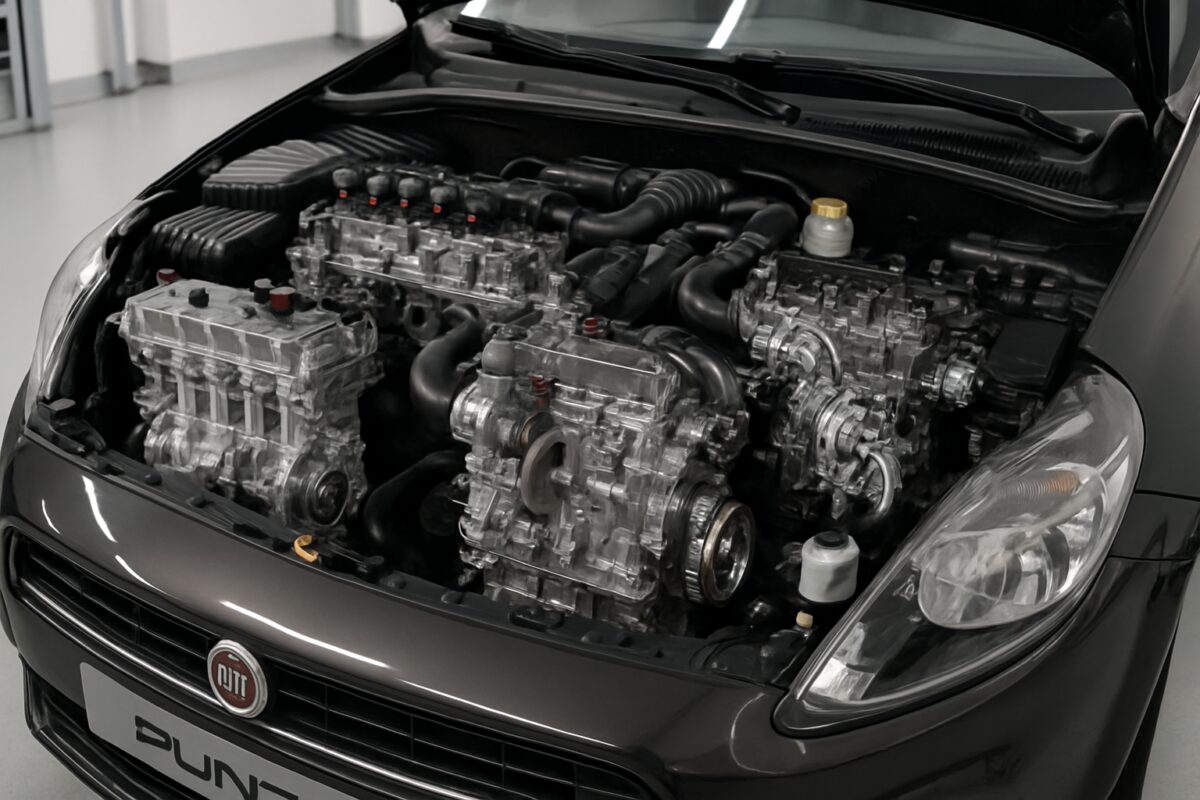
The Fiat Punto has established itself as a popular supermini in the British market, offering drivers a practical blend of efficiency and performance. Engine selection remains crucial for this vehicle, as it directly impacts running costs, reliability, and driving experience. The Punto lineup features diverse powerplants, from frugal petrols producing 69 horsepower to spirited turbocharged units delivering 145 horsepower, alongside efficient diesel variants generating up to 105 horsepower.
Comparison table of all engines
| Engine | Power output | Torque | Fuel consumption | Reliability |
|---|---|---|---|---|
| 1.2 Fire | 69 hp | 102 Nm | 45.6 mpg | Good |
| 1.4 Fire | 77 hp | 115 Nm | 42.8 mpg | Very Good |
| 1.4 T-Jet | 120-145 hp | 180-206 Nm | 38.2 mpg | Average |
| 1.3 MultiJet | 75-90 hp | 190-200 Nm | 64.2 mpg | Good |
| 1.9 MultiJet | 100-105 hp | 200-206 Nm | 54.3 mpg | Average |
Engine #1 overview – 1.2 Fire
The 1.2-litre Fire engine represents Fiat’s entry-level naturally aspirated inline-four petrol unit. This 1,242cc powerplant features a traditional multi-point fuel injection system and produces modest output figures. The engine operates without forced induction, relying on atmospheric pressure for air intake. It runs on standard unleaded petrol with electronic fuel injection managing the air-fuel mixture efficiently.
Pros
- Low purchase price and insurance costs
- Excellent fuel economy for city driving
- Simple maintenance requirements
- Reliable long-term operation
- Affordable replacement air filter and service parts
Cons
- Limited power output affects motorway performance
- Struggles with full passenger loads
- Noisy operation at higher revs
- Outdated technology compared to modern alternatives
Engine #2 overview – 1.4 Fire
The 1.4-litre Fire engine builds upon the smaller unit’s foundations whilst delivering enhanced performance. This naturally aspirated inline-four displaces 1,368cc and incorporates improved breathing characteristics. The powerplant maintains the same fuel injection principles but benefits from larger displacement and refined combustion chamber design. Standard unleaded petrol remains the preferred fuel type.
Pros
- Better acceleration than the 1.2-litre variant
- Adequate motorway cruising ability
- Proven reliability record
- Reasonable fuel consumption
- Wide availability of spark plugs and service components
Cons
- Higher road tax compared to smaller engines
- Increased insurance premiums
- Still lacks modern refinement
- Limited torque output affects flexibility
Engine #3 overview – 1.4 T-Jet
The 1.4 T-Jet represents Fiat’s turbocharged petrol offering, featuring forced induction technology. This 1,368cc inline-four employs a small turbocharger to boost power output significantly. The engine incorporates direct fuel injection alongside the turbocharging system, creating a potent combination. Premium unleaded fuel optimises performance, though standard grades remain acceptable for daily driving.
Pros
- Impressive power-to-weight ratio
- Strong mid-range torque delivery
- Responsive acceleration characteristics
- Modern turbocharged technology
Cons
- Higher maintenance costs due to complexity
- Potential turbocharger reliability issues
- Requires premium fuel for optimal performance
- More expensive oil filters and service intervals
- Carbon build-up concerns with direct injection
Engine #4 overview – 1.3 MultiJet
The 1.3 MultiJet diesel engine showcases Fiat’s common-rail technology expertise. This turbocharged inline-four displaces 1,248cc whilst delivering impressive torque figures. The MultiJet system enables multiple fuel injections per combustion cycle, improving refinement and efficiency. Diesel fuel powers this unit, with modern emissions control systems managing exhaust output.
Pros
- Outstanding fuel economy figures
- Excellent torque delivery at low revs
- Suitable for high-mileage drivers
- Modern common-rail technology
- Low CO2 emissions
Cons
- Increased service complexity
- Potential injector problems
- DPF regeneration requirements
- Higher initial purchase cost
- Expensive fuel filter replacements
Engine #5 overview – 1.9 MultiJet
The larger 1.9 MultiJet represents the range-topping diesel option. This turbocharged inline-four engine displaces 1,910cc and delivers substantial torque output. Advanced common-rail injection technology ensures smooth operation and reduced emissions. The powerplant features sophisticated turbocharging alongside comprehensive emissions control systems including diesel particulate filtration.
Pros
- Strong pulling power for loaded conditions
- Refined operation compared to smaller diesels
- Excellent long-distance cruising ability
- Robust construction for durability
Cons
- Higher purchase and insurance costs
- Complex emissions control systems
- Potential turbocharger maintenance issues
- Requires regular motorway driving
- Expensive injector servicing
Maintenance cost
| Engine | Recommended Interval | Estimated Cost | Cost per 10,000 miles |
|---|---|---|---|
| 1.2 Fire | 12,500 miles | £120-160 | £96-128 |
| 1.4 Fire | 12,500 miles | £135-175 | £108-140 |
| 1.4 T-Jet | 10,000 miles | £180-240 | £180-240 |
| 1.3 MultiJet | 12,500 miles | £165-215 | £132-172 |
| 1.9 MultiJet | 12,500 miles | £190-250 | £152-200 |
Professional tip: Always use manufacturer-approved engine oil specifications to maintain warranty coverage and optimal engine performance across all Punto variants.
Engine sound and character
Each Punto engine delivers distinct acoustic signatures reflecting their design philosophy. The Fire petrol units produce characteristic Italian engine notes, with the 1.2-litre offering a buzzy, economical soundtrack whilst the 1.4 variant adds deeper resonance. The T-Jet introduces turbocharger whistle alongside more aggressive exhaust notes during acceleration phases.
Diesel variants showcase modern refinement levels. The 1.3 MultiJet operates quietly at idle but develops a purposeful diesel rumble under load. The larger 1.9 unit provides smoother operation with less characteristic diesel clatter, particularly during warm-up periods.
Our AutoPartsPro mechanics note that proper exhaust manifold maintenance significantly affects engine character, particularly on turbocharged variants where heat cycling can cause gasket failures.
Who each engine is best for
| Engine | Best suited for |
|---|---|
| 1.2 Fire | New drivers, city commuters, budget-conscious owners |
| 1.4 Fire | Mixed driving conditions, small families, occasional motorway use |
| 1.4 T-Jet | Performance enthusiasts, spirited driving, weekend adventures |
| 1.3 MultiJet | High-mileage drivers, long-distance commuters, efficiency seekers |
| 1.9 MultiJet | Commercial use, heavy loads, extensive motorway driving |
Expert insight: Consider your annual mileage carefully when choosing between petrol and diesel variants. Diesel engines require regular motorway driving to maintain optimal particulate filter function.
Frequently asked questions
Which Fiat Punto engine offers the best fuel economy?
The 1.3 MultiJet diesel delivers exceptional fuel economy, achieving up to 64.2 mpg combined whilst providing adequate performance for most driving scenarios.
Are Fiat Punto engines reliable for high-mileage use?
Fire petrol engines demonstrate excellent reliability with proper maintenance, whilst MultiJet diesels require careful servicing but can achieve impressive longevity when properly maintained.
What’s the most affordable Punto engine to maintain?
The 1.2 Fire engine offers the lowest maintenance costs due to simple construction and widespread parts availability, making it ideal for budget-conscious motorists.
Should I choose petrol or diesel for my Punto?
Choose diesel if you cover over 12,000 miles annually and regularly use motorways. Petrol suits lower-mileage drivers and those primarily using urban routes.
How often should I service my Punto engine?
Follow manufacturer intervals: 12,500 miles for most engines, though turbocharged variants may benefit from 10,000-mile intervals to maintain optimal performance and reliability.

 Loading...