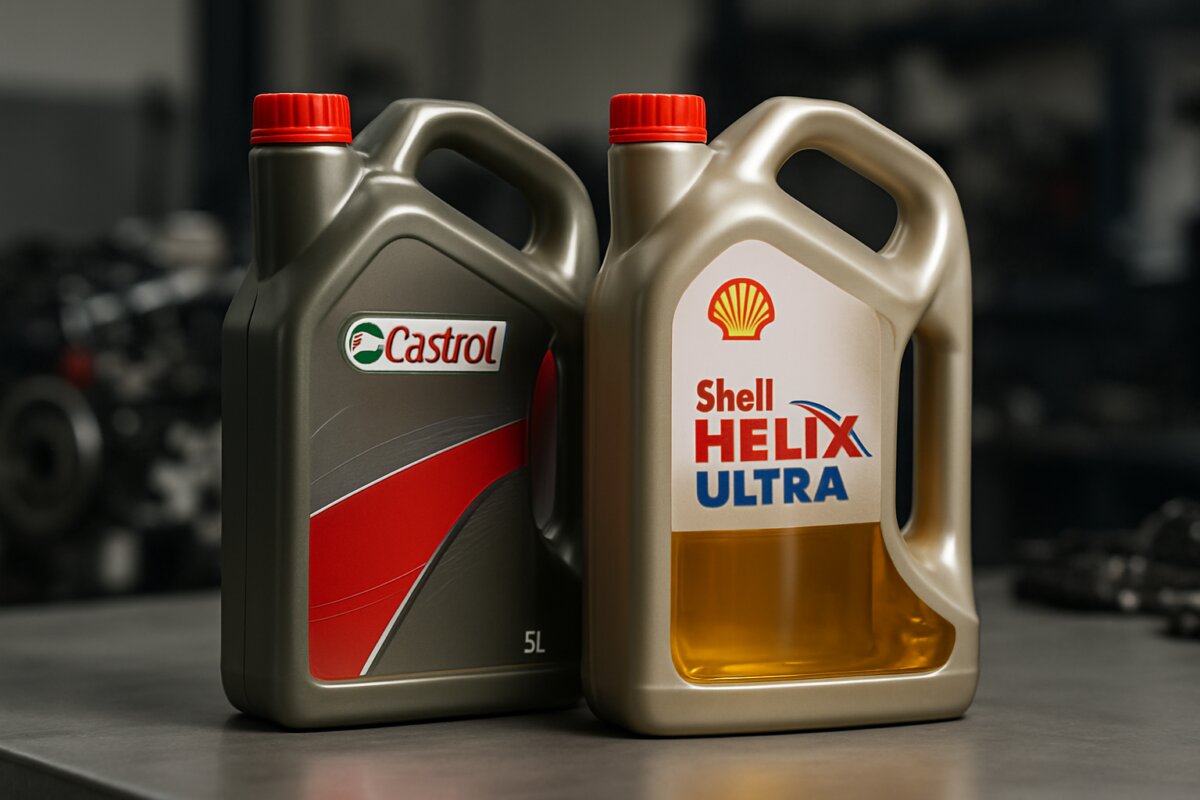
When comparing Castrol vs Shell, both manufacturers produce premium engine oil that meets industry standards, but they differ in formulation chemistry and performance characteristics. Castrol typically offers superior cold-start protection and is favoured for high-performance petrol engines, whilst Shell excels in fuel economy optimisation and thermal stability, making it ideal for diesel applications and long-distance motorway driving. The choice ultimately depends on your driving style, engine type, and manufacturer recommendations.
Quick comparison table
| Feature | Castrol | Shell |
|---|---|---|
| Price range | £25-£65 per 5L | £22-£60 per 5L |
| Durability | Up to 15,000 miles | Up to 18,000 miles |
| Performance focus | Cold-start protection | Fuel efficiency |
| Noise reduction | Excellent | Very good |
| Maintenance interval | 12 months/12,000 miles | 12 months/15,000 miles |
| Best use case | Sporty driving, cold climates | Motorway driving, diesels |
Castrol engine oil overview
Castrol has built its reputation on advanced synthetic technology since introducing the first synthetic motor oil in 1966. The brand’s formulations use a proprietary blend of synthetic base stocks combined with Titanium Fluid Strength Technology in their EDGE range, which creates a film that changes physical structure under pressure to reduce metal-to-metal contact.
The molecular structure of Castrol lubricants focuses on shear stability, meaning the oil maintains its protective viscosity even under extreme stress. This makes it particularly effective during cold starts when engine wear is most severe. The oil flows quickly to critical components like the camshaft and valve train, reducing dry-start wear by up to 75% compared to industry minimum standards.
Castrol’s formulations typically contain higher levels of zinc dialkyldithiophosphate (ZDDP), an anti-wear additive that creates a protective layer on metal surfaces. This chemistry particularly suits turbocharged petrol engines and performance applications where engine components operate under significant mechanical stress.
Typical pricing structure
Castrol MAGNATEC starts at approximately £25 for 5 litres, whilst the premium EDGE range costs between £45-£65 depending on viscosity grade. The GTX range sits in the middle at £30-£40 per 5-litre container. Specialist formulations for diesel particulate filters or high-mileage vehicles command premium pricing.
Advantages of Castrol lubricants
- Exceptional cold-start protection reduces wear during initial ignition
- Strong film strength maintains protection under high temperatures
- Wide range of specialist formulations for specific engine types
- Proven track record in motorsport applications
- Lower volatility reduces oil consumption in older engines
Disadvantages of Castrol products
- Generally more expensive than Shell equivalents
- Some formulations have shorter drain intervals
- Higher ZDDP content may not suit all modern catalytic converters
- Can be harder to find in rural petrol stations
Ideal drivers for Castrol
Castrol works brilliantly for enthusiastic drivers who frequently use their vehicle’s full performance envelope. If you own a turbocharged petrol engine, do lots of short journeys in cold weather, or drive a performance-oriented vehicle, Castrol’s protective qualities justify the premium price. Our mechanics at AutoPartsPro also recommend it for older engines with higher tolerances, as the robust film strength compensates for increased bearing clearances.
Professional tip: Always check your oil filter quality when using premium oils. A substandard filter negates the benefits of expensive lubricants by allowing contaminants to circulate.
Shell engine oil overview
Shell’s approach centres on PurePlus Technology, a process that converts natural gas into crystal-clear base oil through a gas-to-liquid synthesis method. This creates a base stock virtually free from impurities found in crude oil, resulting in exceptional oxidation stability and cleanliness. The Helix range represents Shell’s fully synthetic offering, whilst Helix HX7 provides a semi-synthetic alternative.
The chemistry behind Shell oils prioritises fuel economy through reduced internal friction. Their Active Cleansing Technology uses dispersants that prevent sludge formation even under severe operating conditions. This keeps critical engine components like piston rings and oil galleries free from deposits, maintaining efficiency over extended drain intervals.
Shell formulations generally contain lower levels of friction modifiers compared to Castrol, but compensate with superior base oil quality. This approach delivers measurable fuel economy improvements of 1-2% in controlled testing, which translates to approximately 30-40 miles of additional range per tank in typical driving conditions.
The brand’s diesel-specific formulations include additives that protect diesel particulate filters and work harmoniously with exhaust gas recirculation valves. Low-ash content prevents filter blocking whilst maintaining comprehensive engine protection.
Typical pricing structure
Shell Helix HX7 semi-synthetic costs around £22-£28 per 5 litres, making it one of the most affordable quality options. The fully synthetic Helix Ultra range sits between £40-£60 depending on specification. Shell often runs promotions through major retailers, making it competitively priced against equivalent Castrol products.
Advantages of Shell lubricants
- Superior base oil purity reduces deposits and extends engine life
- Demonstrable fuel economy improvements
- Extended drain intervals reduce maintenance frequency
- Excellent thermal stability in high-temperature operations
- Wide availability across UK forecourts
Disadvantages of Shell products
- Slightly less effective at cold-start protection than Castrol
- Fewer specialist formulations for niche applications
- Some mechanics report higher consumption in turbocharged applications
- Less proven in extreme motorsport environments
Ideal drivers for Shell
Shell suits drivers who rack up serious motorway miles and prioritise running costs. If you drive a modern diesel, complete primarily long journeys, or want to maximise service intervals, Shell’s cleanliness and stability characteristics align perfectly. Fleet operators particularly appreciate the fuel economy gains and extended drain capabilities. Our AutoPartsPro specialists frequently recommend Shell for commuters doing 20,000+ miles annually on motorways.
Professional tip: When switching oil brands, consider using an engine flush product to remove residual deposits. This prevents incompatibility between different additive packages that might cause temporary sludge formation.
Compatibility considerations for UK drivers
Both Castrol and Shell produce oils meeting ACEA (European) and API (American) specifications, but selecting the correct viscosity grade and specification remains critical. Your vehicle’s handbook specifies these requirements, typically found in the maintenance section.
Vehicle compatibility factors
Modern vehicles with variable valve timing systems require low-viscosity oils (0W-20, 5W-30) to ensure proper hydraulic operation of the timing control mechanisms. Using thicker grades can trigger fault codes and reduce performance. Vehicles equipped with diesel particulate filters absolutely require low-SAPS (Sulphated Ash, Phosphorus, and Sulphur) formulations to prevent filter contamination.
Both manufacturers produce oils meeting BMW Long-Life, Mercedes-Benz 229.x, and VW 504/507 specifications. However, some performance variants demand specific approvals. The BMW M-series, for instance, requires oils meeting the stringent LL-01 specification, which both brands offer but in different product lines.
Model year considerations
Pre-2000 vehicles generally used mineral or semi-synthetic 10W-40 or 15W-40 grades. These engines often benefit from the higher ZDDP content in Castrol formulations, as they lack roller followers and rely on flat-tappet camshaft designs that need extra anti-wear protection. The valve stem seals in older engines also appreciate the thicker oil film.
Vehicles from 2000-2010 transitioned to thinner grades (5W-30, 5W-40) to meet emissions regulations. Both brands offer excellent options here, though Shell’s cleansing properties help remove accumulated deposits if the vehicle has a questionable service history.
Post-2010 vehicles increasingly specify ultra-low viscosity grades (0W-20, 0W-30) to maximise fuel economy. Shell’s low-friction formulations often deliver better results in these applications, particularly when combined with modern fuel filters and injection systems.
OEM specifications and approvals
Major manufacturers conduct extensive testing before approving oils for warranty purposes. Ford WSS-M2C913-D, Renault RN0700/0710, and PSA B71 2296 represent common European specifications. Always verify that your chosen oil carries the specific approval listed in your handbook, not just meets the general ACEA classification.
Some manufacturers, particularly German premium brands, maintain proprietary approval systems. Using non-approved oil, even if it meets general specifications, can void warranty coverage on engine-related claims. Both Castrol and Shell maintain comprehensive approval databases on their websites.
Installation and service notes
When performing oil changes, proper drain-down time matters. Allow at least 15 minutes for complete drainage, as modern 0W grades flow very slowly when cold. Inspect the oil sump drain plug for wear, replacing the copper washer each service to prevent weeping.
Pre-fill the new oil filter where possible to reduce dry-start time. This applies particularly to horizontally-mounted filters on some Ford and Vauxhall engines. Torque the filter to hand-tight plus three-quarters turn rather than using excessive force that might split the housing on next removal.
Final verdict and buying recommendation
After decades of experience in our AutoPartsPro workshops, the professionals on our team have formed clear opinions based on thousands of oil analyses and engine teardowns. Neither brand produces inferior oil, but specific applications favour one over the other.
Choose Castrol EDGE or MAGNATEC if you own a high-performance petrol engine, do frequent short journeys in cold climates, or drive enthusiastically. The superior cold-start protection and film strength justify the premium price for these use cases. Turbocharged hot hatches, performance saloons, and older engines with higher mileage particularly benefit from Castrol’s protective chemistry. The oil’s resistance to shear breakdown makes it ideal for track day enthusiasts who subject their engines to sustained high-RPM operation.
Select Shell Helix Ultra or HX7 for modern diesel engines, high-mileage motorway driving, or when maximising fuel economy matters. The exceptional base oil quality and cleansing properties keep engines pristine over extended intervals, whilst the fuel economy gains deliver measurable savings for high-mileage drivers. Fleet vehicles, diesel particulate filter-equipped cars, and anything covering 15,000+ miles annually suit Shell’s formulation philosophy.
For mixed driving patterns in moderate climates with petrol engines, either brand performs excellently when matched to correct specifications. In these cases, price and availability often decide the matter. Both manufacturers honour their warranties when oils carry appropriate approvals, so you cannot go wrong choosing based on current promotions.
One consideration that our mechanics emphasise: consistency matters more than brand choice. Frequently switching between different oil chemistries can cause additive incompatibilities. Once you’ve selected a brand that works well in your engine, stick with it unless specific circumstances demand a change.
Remember that even the finest oil cannot compensate for neglected service intervals. A £25 semi-synthetic changed every 6,000 miles protects better than a £60 fully synthetic left for 20,000 miles. Whatever you choose, maintain rigorous service discipline and always pair premium oils with quality filters from our oil filter range.
Frequently asked questions
Can I mix Castrol and Shell oils in an emergency?
Yes, you can mix them temporarily without immediate damage, as both meet industry base standards. However, you’ll dilute the beneficial additive packages and should perform a complete oil change at your earliest opportunity to restore proper protection levels and chemistry balance.
Which oil brand reduces engine noise better?
Castrol typically delivers quieter operation, particularly the MAGNATEC range designed for reduced valve train noise. Its higher film strength dampens mechanical sounds more effectively. However, noise reduction also depends heavily on correct viscosity grade selection and the condition of components like your timing chain tensioner.
Do Castrol and Shell oils actually improve fuel economy?
Shell demonstrates more consistent fuel economy improvements, typically 1-2% in controlled testing. Castrol prioritises protection over friction reduction, so economy gains prove smaller. Real-world results vary based on driving style, but Shell’s formulation chemistry specifically targets reduced internal friction and measurable consumption benefits.
Which brand offers better protection for turbocharged engines?
Castrol edges ahead for turbocharged applications due to superior film strength under high temperatures and mechanical stress. The Titanium technology maintains protection when turbocharger bearings reach extreme operating temperatures. Shell performs admirably but focuses more on cleanliness than ultimate film strength in severe conditions encountered near the turbocharger.
How often should I change premium synthetic oils?
Despite extended capability claims, change fully synthetic oils every 10,000-12,000 miles or annually, whichever comes first. Even premium lubricants accumulate combustion byproducts and moisture that degrade protective properties. Severe service conditions like frequent cold starts, dusty environments, or trailer towing warrant 6,000-mile intervals regardless of oil quality.

 Loading...