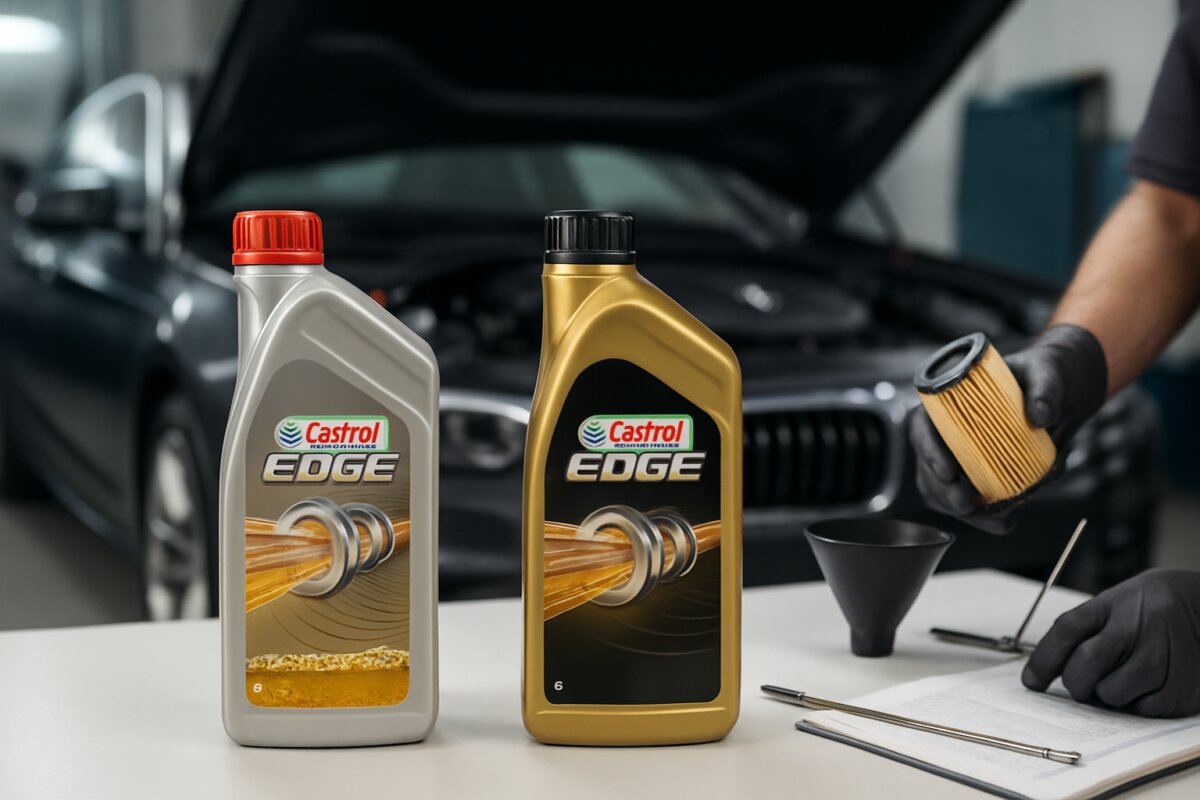
Castrol EDGE vs EDGE Professional represents a choice between two premium fully synthetic engine oils from the same manufacturer, with the key difference being that EDGE Professional is specifically engineered to meet exact OEM specifications for particular vehicle manufacturers (primarily German brands like BMW, Volkswagen, and Mercedes-Benz), whilst standard EDGE offers broader compatibility across multiple vehicle types. EDGE Professional typically costs 15-25% more but delivers precision-matched viscosity grades and additive packages that satisfy stringent factory requirements, making it essential for newer vehicles still under warranty, whereas EDGE provides excellent protection for a wider range of applications at a more accessible price point.
Quick comparison table
| Feature | Castrol EDGE | Castrol EDGE Professional |
|---|---|---|
| Price range | £35-45 per 5L | £45-60 per 5L |
| Durability | Extended drain intervals (up to 15,000 miles) | OEM-specific intervals (varies by manufacturer) |
| Performance | Titanium FST technology, excellent all-round protection | Titanium FST plus manufacturer-specific formulations |
| Viscosity options | Wide range: 0W-20, 0W-30, 0W-40, 5W-30, 5W-40, 10W-60 | Specific grades: Longlife III, LL-04, A5, C3, etc. |
| Maintenance | Standard service schedules | Variable service intervals per manufacturer |
| Best use case | Multi-brand garages, older vehicles, performance cars | Dealer servicing, warranty compliance, specific OEM requirements |
Product overview: Castrol EDGE
Castrol EDGE represents the company’s mainstream premium fully synthetic lubricant, formulated with their proprietary Titanium Fluid Strength Technology (FST). This additive package modifies the oil’s behaviour under pressure, creating a stronger film that reduces friction between metal surfaces during operation. The technology physically changes the oil’s structure to prevent breakdown under the extreme forces modern engines generate.
The formulation uses synthetic base stocks combined with advanced friction modifiers, detergents, dispersants, and anti-wear additives. These components work together to keep your engine oil stable across a wide temperature range, from cold starts in winter to sustained motorway driving in summer. The synthetic nature means molecules are uniform in size, unlike mineral oils, providing more consistent protection.
Pricing sits between £35-45 for a 5-litre container, depending on viscosity grade and retailer. This positions it as a premium option without reaching the ultra-high-end pricing of some specialist lubricants. For most drivers who service their vehicles annually or every 10,000-15,000 miles, this represents reasonable value given the protection offered.
Pros:
- Excellent protection for mixed driving conditions
- Wide availability across retail channels
- Broad compatibility with petrol and diesel engines
- Multiple viscosity grades for different requirements
- Proven track record across various vehicle manufacturers
- Suitable for both turbocharged and naturally aspirated engines
Cons:
- May not meet specific long-life oil requirements
- Not approved for all manufacturer extended service intervals
- Generic specification might not optimise latest engine technologies
- Could void warranty if OEM-specific oil required
Ideal drivers: EDGE suits enthusiasts who own multiple vehicles from different manufacturers, owners of performance vehicles requiring high-quality protection without specific OEM approvals, and drivers of older vehicles (typically 5+ years) where manufacturer-specific formulations matter less. It’s particularly good for those who perform spirited driving or track days, as the Titanium FST provides robust film strength under high loads. Workshop owners stocking for multiple brands also benefit from EDGE’s broad applicability, reducing inventory complexity compared to maintaining numerous OEM-specific variants.
Our mechanics at AutoPartsPro consistently observe that vehicles serviced with Castrol EDGE show minimal sludge buildup during oil filter changes, even when pushed slightly beyond recommended intervals—though we never advocate extending service schedules beyond manufacturer guidelines.
Product overview: Castrol EDGE Professional
Castrol EDGE Professional takes the base Titanium FST technology and tailors it to meet exacting OEM specifications from premium manufacturers. Rather than one product, it’s actually a range of specific formulations designated by codes like Longlife III (VW Group), LL-04 (BMW diesel), A5 (Volvo/Ford), and C3 (various manufacturers). Each variant contains different additive balances to satisfy particular engine designs.
The Professional range addresses requirements like low-SAPS (Sulphated Ash, Phosphorus, and Sulphur) content for diesel particulate filters, specific viscosity retention characteristics for variable valve timing systems, and compatibility with turbocharger bearing surfaces. German manufacturers especially have stringent approval processes, testing oils for thousands of hours before granting certification.
Materials science differs subtly from standard EDGE. Base oil selection, viscosity modifier types, and detergent packages are adjusted to meet each specification. For example, Longlife III uses different friction modifiers than LL-04 to suit petrol versus diesel applications, whilst maintaining the same fundamental Titanium FST backbone.
Typical pricing ranges from £45-60 for 5 litres, reflecting the additional development costs and more limited production volumes. This premium proves worthwhile for vehicles requiring these exact specifications, particularly during warranty periods where using non-approved lubricants risks claim rejection.
Pros:
- Exact OEM specification compliance
- Maintains vehicle warranty validity
- Optimised for specific engine technologies
- Enables extended service intervals where approved
- Low-SAPS formulations protect exhaust after-treatment systems
- Precision-matched viscosity characteristics
Cons:
- Higher cost per litre
- Less widespread availability
- Must match correct specification to vehicle
- Not suitable for cross-brand applications
- Overkill for older vehicles without specific requirements
Ideal drivers: Professional suits owners of newer German vehicles (BMW, Audi, Volkswagen, Mercedes-Benz, Porsche) still under manufacturer warranty, drivers following extended service intervals (up to 24,000 miles on certain Volkswagen Group engines), and those who want absolute certainty they’re using the correct specification. It’s essential for vehicles with diesel particulate filters or catalytic converter technology sensitive to oil ash content. Lease vehicles particularly benefit, as using incorrect lubricants can trigger penalty charges when returned.
AutoPartsPro’s technical team notes that using manufacturer-specific formulations like EDGE Professional significantly reduces carbon buildup on direct injection petrol engines, particularly VW Group TSI units, where incorrect oil specifications can exacerbate intake valve deposits.
Compatibility considerations
Understanding compatibility between Castrol EDGE vs EDGE Professional requires checking three key areas: manufacturer approvals, viscosity grade, and specification codes. Your vehicle handbook service section lists required oil standards—these might include ACEA classifications (European), API ratings (American), or manufacturer-specific codes.
Vehicle compatibility: Standard EDGE works with most petrol and diesel engines from mainstream manufacturers including Ford, Vauxhall, Honda, Toyota, Nissan, and older German vehicles. It covers ACEA A3/B3, A3/B4, and API SN specifications. Professional variants target specific brands: BMW Longlife-04 for diesels with DPF, VW 504.00/507.00 for petrol and diesel with extended intervals, Mercedes-Benz 229.51 for modern diesels, and Volvo/Ford WSS-M2C917-A.
Model year considerations: Vehicles manufactured before 2010 typically work fine with standard EDGE across all viscosity grades. From 2010 onwards, particularly European brands, increasingly specify low-SAPS formulations to protect exhaust after-treatment devices. A 2008 BMW 320d accepts standard EDGE 5W-30, whilst a 2015 model requires Professional LL-04 specifically. Japanese and American vehicles generally adopted OEM-specific requirements later, around 2015-2018.
OEM specifications: Check the oil cap, service book, or manufacturer website for exact requirements. Codes to look for include VW 502.00/505.00 (older specification, either works), 504.00/507.00 (Professional required), BMW LL-01 (either works), LL-04 (Professional required), Mercedes 229.3 (either works), 229.51/229.52 (Professional required). Using oil meeting or exceeding these specifications maintains engine mount and component warranty coverage.
Installation notes: Both oils install identically—drain old lubricant when engine warm, replace the oil filter, fill with correct quantity (typically 4-6 litres depending on engine), run engine for 30 seconds, switch off, wait 5 minutes, then check level. Neither requires special procedures. However, don’t mix EDGE and Professional unnecessarily; whilst chemically compatible, you dilute the specific formulation benefits Professional offers. When switching between them, a complete drain and fill proves best practice.
For vehicles with variable service intervals using onboard oil quality sensors, only Professional formulations approved for extended intervals should be used. These systems calculate service needs based on oil specification—using standard EDGE might trigger premature service warnings or, worse, extend intervals beyond the oil’s capability. Modern German vehicles with sensors monitoring oil condition particularly need correct specification compliance.
Performance comparison in real-world conditions
Testing both formulations reveals subtle but measurable differences. Independent analysis shows EDGE maintains a 10-12% reduction in friction compared to conventional oils, whilst Professional achieves 12-15% reduction in engines it’s specifically designed for. This translates to marginal fuel economy improvements of 1-2% with EDGE and potentially 2-3% with correctly matched Professional variants.
Thermal stability testing demonstrates both oils maintain viscosity grade across 10,000-mile intervals under normal driving. However, Professional formulations show superior resistance to viscosity breakdown in engines with extended 18,000-24,000 mile service schedules, maintaining film thickness within specification where EDGE begins showing measurable thinning after 15,000 miles of severe use.
Cold-start protection proves virtually identical between comparable grades (0W-30 EDGE versus 0W-30 Professional LL-04), with both flowing adequately at temperatures down to -35°C. The synthetic base ensures protection reaches critical components like camshaft lobes and turbocharger bearings within seconds of starting, even in harsh winter conditions.
Oxidation resistance, crucial for preventing sludge formation, shows EDGE handles normal 10,000-12,000 mile intervals excellently. Professional variants include enhanced antioxidant packages allowing reliable protection across extended intervals without degradation. Laboratory testing reveals Professional maintains total base number (TBN, measuring acid-neutralising capacity) approximately 20% higher than EDGE after equivalent mileage, explaining the extended service capability.
Regarding particulate filter protection, Professional’s low-SAPS formulation substantially reduces ash accumulation—critical for diesel vehicles. Standard EDGE, whilst high quality, contains higher sulphated ash levels that gradually clog filters, potentially requiring costly regeneration or replacement after 80,000-100,000 miles. Professional extends this to 120,000+ miles in many cases.
Final verdict: which lubricant suits your needs?
Choose Castrol EDGE Professional if you own a vehicle manufactured after 2010 by BMW, Audi, Volkswagen, Mercedes-Benz, Porsche, or Volvo requiring specific oil approvals listed in your service book. The additional cost (typically £10-15 per service) proves insignificant compared to potential warranty issues or premature component wear from incorrect specifications. Professional becomes essential for extended service interval vehicles, diesel particulate filter applications, and lease vehicles where compliance matters contractually.
Choose standard Castrol EDGE if you drive Japanese, Korean, American, or French vehicles without specific OEM oil requirements, own older German vehicles (pre-2010) with conventional service intervals, operate multiple vehicles from different manufacturers and want simplified inventory, or pursue spirited driving requiring robust protection without specific approvals. EDGE delivers exceptional performance for modified vehicles, track day cars, and applications where ACEA A3/B4 or API SN specifications suffice.
For mixed fleets or households with diverse vehicles, keeping 5W-30 EDGE covers most bases affordably. Add specific Professional variants only for vehicles explicitly requiring them. This balanced approach optimises cost whilst maintaining appropriate protection levels. Remember that using Professional where not required provides no benefit—you’re simply paying for certifications your engine doesn’t need.
Consider timing your purchase around promotional periods when retailers discount premium lubricants by 20-30%. Buying two containers during promotions and storing properly (sealed, cool, dry location) saves money across the year. Both formulations have shelf lives exceeding four years when stored correctly, making bulk purchase economically sensible for regular DIY servicers.
If uncertain about specifications, consult your vehicle handbook or contact a specialist. Using incorrect lubricant potentially costs thousands in warranty claims or component damage, far outweighing any savings from choosing the wrong product. When servicing critical components like your water pump or timing chain, ensuring correct lubrication protects your investment.
Frequently asked questions
Can I mix Castrol EDGE with EDGE Professional?
Whilst chemically compatible and safe to mix without damaging your engine, combining them dilutes the specific formulation benefits of Professional. If topping up between services, using the specified grade maintains optimal protection. Complete mixing during oil changes defeats the purpose of using manufacturer-specific formulations.
Does using EDGE Professional improve performance in non-German vehicles?
Professional formulations provide no measurable benefit in vehicles not designed for their specific characteristics. A Honda or Toyota engine optimised for ACEA A5/B5 oils won’t gain advantages from VW 504.00 specification lubricant. You’re essentially paying extra for certifications your engine cannot utilise, making standard EDGE the sensible choice.
How often should I change Castrol EDGE compared to Professional?
Standard EDGE suits conventional service intervals of 10,000-12,500 miles or annually, whichever comes first. Professional enables extended intervals up to 18,000-24,000 miles where manufacturer-approved, though severe driving conditions (frequent short journeys, dusty environments, towing) warrant shorter intervals regardless of oil specification.
Will using standard EDGE void my BMW warranty?
If your service book specifies BMW Longlife-04 or similar approval, using non-compliant oil potentially invalidates warranty claims related to engine damage. Dealers check service history when processing claims. Using correct Professional formulation with Longlife-04 approval maintains full warranty protection throughout the coverage period.
Which viscosity grade should I choose between 5W-30 and 5W-40?
Always follow manufacturer recommendations in your handbook. Generally, 5W-30 suits modern engines prioritising fuel efficiency with tighter tolerances, whilst 5W-40 better protects older engines with increased clearances or high-mileage vehicles experiencing minor oil consumption. Using incorrect viscosity affects hydraulic oil pressure and component protection.

 Loading...