If your car juddering when idle leaves you concerned, you’re not alone. That unsettling vibration or rattle whilst stationary often signals underlying mechanical issues requiring attention. From worn engine components to faulty sensors, multiple culprits can cause this annoying problem. Understanding the root causes helps you address them promptly before minor issues escalate into expensive repairs.
Failing engine mounts
Engine mounts serve as cushions between your engine and chassis, absorbing vibrations during operation. When these rubber-and-metal components deteriorate, your engine transfers excessive movement directly to the bodywork, creating noticeable juddering at idle.
The symptoms typically worsen when you engage the transmission into drive or reverse. You might feel the steering wheel shaking or hear clunking sounds when accelerating from a standstill. Visual inspection often reveals cracked rubber or separated metal portions on the engine mount assemblies.
According to Autopartspro’s specialists, engine mount failure ranks amongst the most common causes of idle vibration in vehicles exceeding 80,000 miles. The constant stress from engine torque eventually breaks down even high-quality mounts. Diesel engines, which produce more torque than petrol variants, tend to wear mounts faster.
Replacement costs vary depending on accessibility. Front mounts typically require less labour than rear or transmission mounts. Some vehicles feature hydraulic mounts filled with fluid that can leak, requiring complete replacement rather than repair. Ignoring failed mounts can lead to damaged exhaust systems or fractured coolant hoses due to excessive engine movement.
Vacuum leaks in the intake system
Your engine relies on precise air-fuel ratios controlled by vacuum pressure. When cracks develop in vacuum hoses or gaskets, unmetered air enters the combustion chambers, causing erratic idle behaviour and juddering.
Common leak points include the intake manifold gasket, brake booster hose, PCV valve connections, and throttle body seals. The engine management system struggles to compensate for these leaks, resulting in rough running, increased fuel consumption, and occasional stalling.
You can identify vacuum leaks by listening for hissing sounds around the engine bay whilst running. Spraying carburettor cleaner near suspected areas causes temporary idle changes when the aerosol gets sucked into the leak. Professional mechanics use smoke machines to pinpoint elusive leaks in complex intake systems.
Autopartspro technicians emphasise checking the intake manifold gasket on higher-mileage vehicles, particularly those with plastic manifolds prone to warping. Temperature cycling causes these components to expand and contract, eventually compromising seal integrity. Addressing vacuum leaks promptly prevents potential damage to oxygen sensors and catalytic converters.
Malfunctioning idle control valve
The idle control valve regulates airflow when your throttle is closed, maintaining stable engine speed during idling. Carbon deposits accumulate inside this valve over time, restricting its movement and causing erratic idle behaviour.
Symptoms include fluctuating RPM at traffic lights, stalling when decelerating, and pronounced juddering whilst stationary. Cold starts might be particularly problematic, with the engine struggling to maintain consistent revs until reaching operating temperature.
Cleaning the idle control valve with specialist solvents often restores proper function without replacement. Remove the valve, spray the pintle and bore thoroughly, and allow it to dry completely before reinstalling. However, severely worn valves with damaged actuators require replacement.
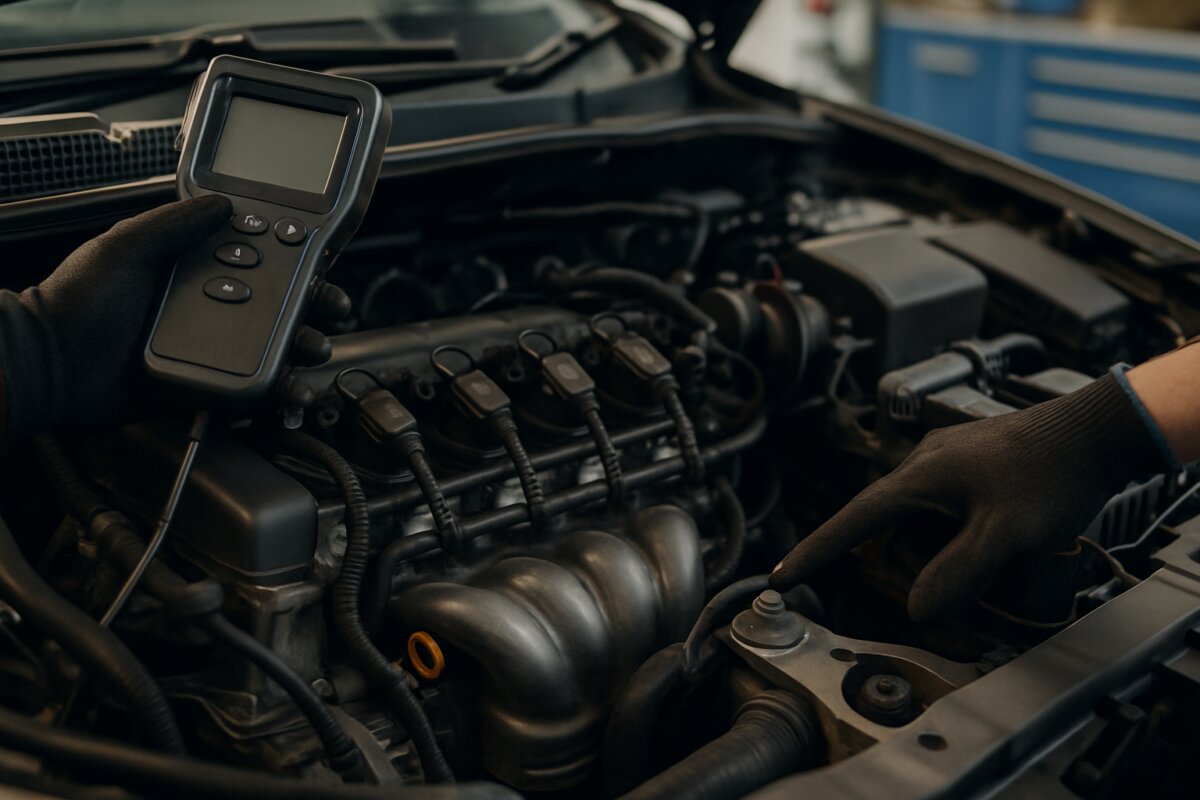
Our specialists note that modern drive-by-wire systems incorporate idle control within the electronic throttle body itself. These systems rarely suffer from carbon buildup but can fail electronically. Diagnostic scanners reveal fault codes pointing to idle control malfunctions, though intermittent faults prove frustrating to diagnose. Regular use of quality fuel filters helps prevent contamination-related idle issues.
Worn spark plugs and ignition components
Misfiring cylinders create uneven power delivery, manifesting as juddering at idle. Spark plugs deteriorate gradually, with electrode gaps widening and deposits building up on ceramic insulators, compromising ignition efficiency.
Beyond plugs themselves, faulty ignition coils or damaged ignition leads prevent adequate spark delivery. Modern coil-on-plug systems eliminate leads but introduce individual coil failures that affect specific cylinders. You might notice the check engine light illuminating alongside rough running.
Diagnostic trouble codes pinpoint misfiring cylinders, though swapping components between cylinders confirms whether faults follow the part. Examining removed spark plugs reveals engine condition through electrode wear patterns and deposit colours. Oil fouling suggests worn piston rings or valve stem seals requiring deeper investigation.
According to Autopartspro’s workshop experience, platinum and iridium plugs last considerably longer than copper variants but eventually require replacement. Manufacturers specify intervals between 30,000 and 100,000 miles depending on plug type. Premature failure often indicates deeper engine problems like coolant leaks into cylinders or incorrect fuel mixture.
Clogged fuel system components
Restricted fuel delivery prevents consistent combustion, causing idle instability and juddering. The fuel pump might struggle to maintain adequate pressure, whilst dirty injectors spray irregular fuel patterns into cylinders.
Contaminated fuel leaves varnish deposits inside injectors, partially blocking the precision nozzles. This creates lean combustion in affected cylinders, producing rough running and potential engine damage. The fuel pressure regulator can also malfunction, causing pressure fluctuations that affect idle quality.
Professional injector cleaning services use ultrasonic equipment and flow testing to restore proper operation. Severely clogged injectors require replacement, though costs vary significantly between port and direct injection systems. Fuel system cleaners added to your tank provide preventative maintenance but cannot remedy severe blockages.
Top tip: Always use reputable fuel stations and add quality fuel system cleaner every 5,000 miles to prevent injector deposits and maintain optimal engine performance throughout your vehicle’s service life.
Faulty mass air flow sensor
The mass air flow sensor measures incoming air volume, enabling the ECU to calculate correct fuel delivery. When contaminated or failing, this sensor provides inaccurate readings that disrupt the air-fuel mixture, causing poor idle and juddering.
Symptoms often include hesitation during acceleration, reduced fuel economy, and rough idling when cold. The check engine light might illuminate with codes related to mixture adaptation or sensor circuit faults. Some vehicles enter limp mode if sensor readings fall outside acceptable parameters.
Cleaning MAF sensors with specialist electronics-safe cleaner sometimes restores function, though replacement proves necessary for failed units. Never use standard contact cleaner or carburettor spray, as these damage delicate sensing elements. A dirty air filter accelerates MAF contamination by allowing particles past the filtration media.
Warning signs your car has a problem
Recognising early symptoms allows you to address issues before they escalate. Pay attention to these indicators that your vehicle needs professional attention:
- Excessive vibration through steering wheel or seat – more pronounced than normal engine operation
- Fluctuating RPM needle – engine speed varies noticeably whilst foot is off accelerator
- Check engine light illumination – indicates ECU has detected faults requiring diagnostic investigation
- Unusual noises from engine bay – rattling, ticking, or grinding sounds during idle
- Stalling at traffic lights – engine cuts out when coming to complete stop
- Increased fuel consumption – inefficient combustion wastes petrol without delivering power
- Difficulty starting – engine cranks longer than usual or requires multiple attempts
- Strong exhaust smell – incomplete combustion produces noticeable fumes from tailpipe
Expert advice: Document when symptoms occur – cold starts, hot engine, with accessories on – as this information helps mechanics diagnose problems faster, potentially saving you diagnostic fees and workshop time.
How to fix the problems
Addressing idle juddering requires systematic diagnosis followed by appropriate repairs. This table outlines common solutions based on identified causes:
| Problem | Solution | Difficulty Level | Approximate Cost |
|---|---|---|---|
| Worn engine mounts | Replace damaged mounts with OEM or uprated alternatives | Moderate | £150-£400 |
| Vacuum leaks | Replace cracked hoses and failed gaskets | Easy to Moderate | £20-£200 |
| Dirty idle control valve | Clean or replace valve assembly | Easy | £15-£150 |
| Faulty spark plugs | Replace full set with correct specification plugs | Easy to Moderate | £40-£200 |
| Clogged fuel injectors | Professional cleaning or replacement | Difficult | £100-£600 |
| Failed MAF sensor | Clean sensor element or fit replacement unit | Easy | £10-£250 |
For those comfortable with basic maintenance, several fixes fall within DIY capability. Start with simple checks before progressing to complex repairs:
- Inspect and replace air filter – clogged filters restrict airflow and contaminate sensors
- Check all vacuum hoses – look for cracks, splits, or disconnected connections
- Clean throttle body and idle valve – removes carbon deposits affecting air control
- Test spark plugs – examine condition and replace if worn beyond service limits
- Scan for diagnostic codes – inexpensive OBD readers identify system faults
- Inspect engine mounts visually – look for separated rubber or excessive movement
This preventative maintenance schedule helps avoid idle problems developing:
| Maintenance Item | Recommended Interval | Related Component |
|---|---|---|
| Spark plug replacement | 30,000-100,000 miles | Ignition system |
| Air filter renewal | 12,000-20,000 miles | Intake system |
| Fuel filter change | 20,000-40,000 miles | Fuel delivery |
| Throttle body cleaning | 30,000-50,000 miles | Air control |
| Engine mount inspection | Every major service | Engine support |
When to see a mechanic
Whilst some fixes suit home mechanics, certain situations demand professional expertise. Seek qualified assistance when experiencing these scenarios:
If diagnostic codes appear related to multiple sensors simultaneously, underlying electrical faults might affect various systems. Chasing individual codes wastes time and money without addressing root causes. Professional workshops possess advanced diagnostic equipment that monitors live data streams, revealing intermittent faults invisible to basic code readers.
When juddering accompanies loss of power or excessive smoke, serious engine damage might be developing. Continuing to drive risks catastrophic failure requiring complete engine replacement. Warning lights for oil pressure or temperature alongside rough running demand immediate professional attention.
Complex repairs involving timing components, cylinder head work, or fuel injection system overhauls require specialist tools and knowledge. Incorrect timing belt installation destroys engines, whilst improper injector fitting causes expensive damage. The modest cost of professional labour protects against far greater expenses from DIY mistakes.
Autopartspro mechanics recommend annual inspections for vehicles exceeding five years old. Preventative checks identify worn components before they fail, avoiding inconvenient breakdowns and expensive emergency repairs. Established service history enhances resale value and provides peace of mind.
Frequently asked questions
Why does my car judder only when cold?
Cold juddering typically indicates worn engine mounts, faulty idle control, or incorrect fuel mixture. The engine runs richer when cold, amplifying any combustion irregularities. Temperature-sensitive sensor faults also cause cold-specific problems that disappear once warmed.
Can low engine oil cause juddering at idle?
Insufficient oil allows increased internal friction and reduced hydraulic valve lifter performance, potentially causing rough running. However, juddering more commonly stems from ignition or fuel delivery issues. Always maintain correct oil level using manufacturer-specified grades.
Will cleaning throttle body stop my car juddering?
If carbon deposits restrict the throttle or idle control passages, cleaning often resolves juddering. However, this addresses only one potential cause. Persistent vibration after cleaning indicates other components require attention, such as mounts or ignition parts.
How much does fixing idle juddering typically cost?
Costs range from £20 for simple fixes like vacuum hose replacement to £600+ for multiple injector replacements or extensive engine work. Accurate diagnosis prevents unnecessary part replacement, minimising expenses whilst ensuring effective repairs.
Is it safe to drive with juddering at idle?
Whilst not immediately dangerous, continued driving risks further damage. Misfiring damages catalytic converters, whilst severe vibration from failed mounts can fracture exhaust components or hoses. Address symptoms promptly to prevent escalating repair costs.
Final recommendation
Car juddering when idle rarely resolves itself and typically worsens without intervention. Our specialists at Autopartspro recommend beginning with systematic visual inspection and basic maintenance before progressing to component replacement. Many cases stem from accumulated neglect rather than catastrophic failure, meaning regular servicing prevents most idle problems developing.
Start by checking your oil filter condition and ensuring proper fluid levels throughout the vehicle. Replace worn spark plugs and clean intake components as first steps. If symptoms persist, professional diagnostic equipment identifies hidden faults quickly, saving money versus replacing parts speculatively.
Remember that quality replacement parts deliver better longevity than economy alternatives. Investing in proper components from established suppliers ensures reliable repairs that last. Browse our comprehensive range at Autopartspro for everything from basic service items to specialist engine components, all backed by our quality guarantee and technical support team ready to assist with your repair project.

 Loading...