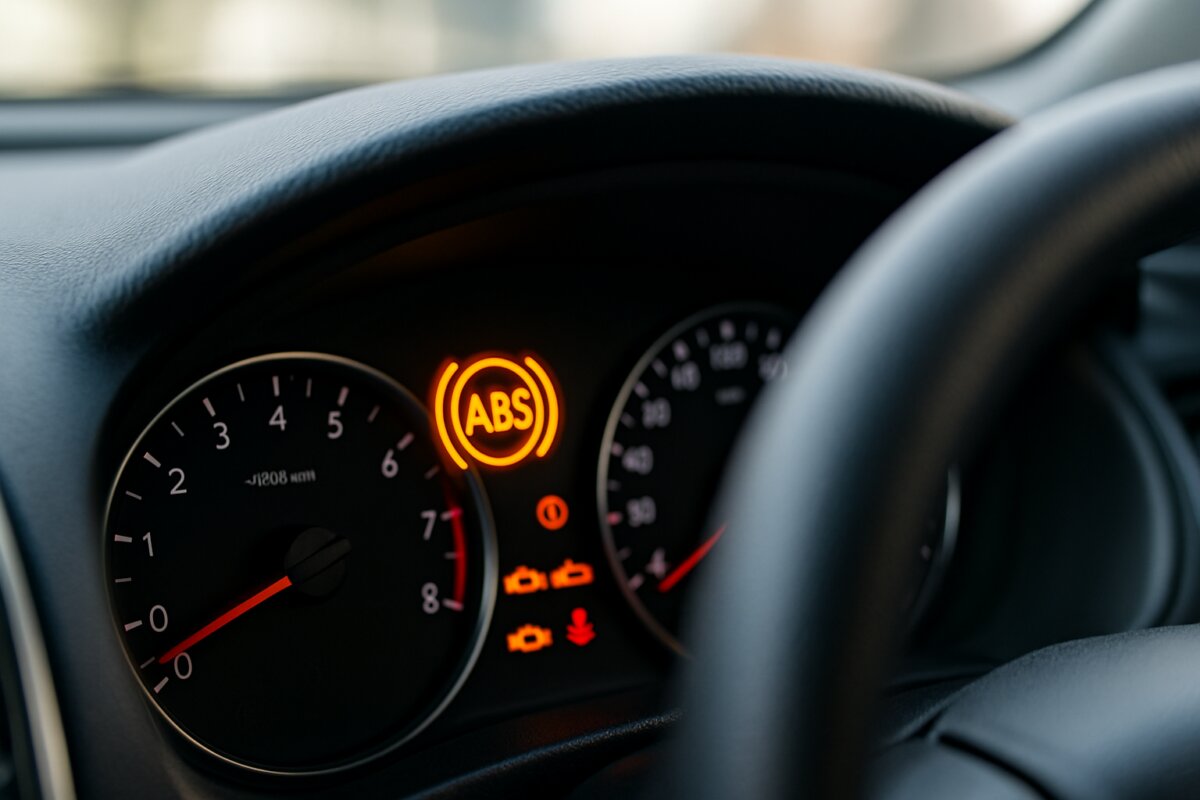
When your ABS light is on, it signals a problem with your anti-lock braking system that needs immediate attention. This safety-critical system prevents wheel lockup during emergency braking, and a warning light means you’ve lost this protection. Understanding what triggers this dashboard warning, how to diagnose it, and what repairs cost will help you make informed decisions about your vehicle’s safety.
Faulty ABS sensor causing false readings
The most common culprit behind an illuminated ABS warning light is a damaged or dirty ABS sensor. These sensors sit near each wheel hub and monitor rotational speed constantly. When road debris, brake dust, or corrosion builds up on the sensor tip, it can’t read the magnetic pulses from the reluctor ring properly.
Our mechanics at AutoPartsPro frequently see sensors fail after exposure to salt and moisture during winter months. The sensor wiring harness is particularly vulnerable where it connects to the chassis, as vibration and water ingress can cause intermittent faults. A single faulty sensor will trigger the entire ABS system to shut down as a safety precaution.
Physical damage is another issue we encounter regularly. Sensors mounted on the wheel hub assembly can get struck by road debris or damaged during brake repairs if technicians aren’t careful. Even a slight crack in the sensor housing allows moisture penetration, leading to complete failure.
Tip: Check your ABS sensors during every brake service. A quick visual inspection and cleaning can prevent expensive diagnostic sessions later.
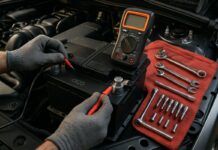
Testing involves checking resistance values with a multimeter and examining the sensor gap between the tip and the ABS ring. Manufacturers specify precise gap measurements, typically between 0.5mm and 1.5mm. Too large a gap means the sensor can’t detect the magnetic field changes accurately.
Damaged ABS ring creating signal disruption
The ABS reluctor ring works alongside the sensor to generate speed data. This toothed metal ring, also called a tone ring or pulse wheel, sits on the hub bearing or CV joint. When teeth break off or the ring corrodes, the sensor receives irregular signals that confuse the ABS module.
We’ve seen numerous cases where customers replaced sensors unnecessarily because the actual problem was a damaged tone ring. Rust is particularly problematic on older vehicles, as it changes the magnetic properties of the ring material. In severe cases, chunks of the ring simply fall away, leaving gaps in the tooth pattern.
Some manufacturers integrate the reluctor ring into sealed bearing assemblies, which means replacing the entire hub unit rather than just the ring. This design prevents water and contaminant intrusion but increases repair costs substantially. Other vehicles use separate rings that press onto the CV joint or driveshaft.
Impact damage from potholes or kerb strikes can bend the ring out of alignment. Even a 2mm deviation throws off the sensor readings enough to trigger a fault code. During inspection, technicians rotate the wheel slowly whilst watching the ring for wobble or runout.
Low brake fluid affecting ABS operation
Your ABS shares brake fluid with the conventional hydraulic brake system. When fluid levels drop below the minimum mark, air enters the hydraulic circuits and compromises ABS performance. The system’s pressure sensors detect this condition and illuminate the warning light.
Worn brake pads naturally cause fluid levels to decrease as caliper pistons extend further to compensate. This gradual drop is normal, but sudden fluid loss indicates leakage from calipers, wheel cylinders, or brake lines. Our experience shows that corroded brake lines are particularly common on vehicles over seven years old.
Moisture contamination degrades brake fluid over time, lowering its boiling point and creating internal corrosion. When fluid absorbs too much water, it becomes compressible and affects the precise hydraulic pressure the ABS needs to function correctly. We recommend fluid replacement every two years regardless of mileage.
The master cylinder reservoir contains separate chambers for front and rear circuits. A leak in one circuit may not be immediately obvious during casual inspection but will trigger the ABS warning system. Always check both chambers and inspect the underside of the reservoir cap for fluid residue.
Malfunctioning ABS pump or hydraulic unit
The ABS pump serves as the system’s heart, rapidly modulating brake pressure to individual wheels during anti-lock events. Internal pump motor failure or stuck solenoid valves will definitely trigger the warning light. These units contain numerous electromechanical components that wear out over time.
Contaminated brake fluid accelerates internal wear within the hydraulic control unit. Metal particles and debris can jam the precision solenoid valves that regulate pressure to each wheel circuit. Once these valves stick open or closed, the entire module typically requires replacement rather than repair.
Our specialists at AutoPartsPro have noticed that ABS pumps on vehicles doing frequent short journeys fail sooner than those covering longer distances. The pump motor struggles with cold, thick fluid and doesn’t reach optimal operating temperature. This puts additional strain on the motor brushes and commutator.
Electrical faults in the pump motor circuit are equally problematic. Corroded relay contacts or damaged wiring prevent the pump from receiving adequate voltage. When the ABS module commands a pump activation and doesn’t receive feedback confirmation, it stores a fault code and illuminates the warning lamp.
Tip: If you hear unusual grinding or buzzing from under the bonnet during braking, your ABS pump may be struggling and needs immediate diagnostic attention.
Failed ABS control module software or hardware
The ABS control module is essentially a computer that processes sensor data and controls pump operation. Like any electronic component, it can fail due to water damage, vibration, or internal circuit board deterioration. Module failures often present intermittent symptoms initially before becoming permanent.
Software corruption occasionally occurs, particularly after jump-starting a vehicle incorrectly or during battery replacement without proper voltage support. Some modules can be reprogrammed, whilst others require complete replacement. Modern vehicles with integrated stability control use more complex modules that control multiple systems simultaneously.
Location matters enormously for module longevity. Manufacturers mount these units in various positions, and those placed low near the wheel arches face greater exposure to road salt and moisture. We’ve replaced numerous modules on certain vehicle models purely because of poor placement decisions during original design.
Communication faults between the ABS module and other vehicle systems can also trigger warnings. The module exchanges data with the engine control unit, transmission controller, and instrument cluster via the CAN bus network. Damaged wiring or corroded connectors anywhere in this network create false fault codes.
Warning signs your car has a problem
Beyond the obvious dashboard light, several symptoms indicate ABS system trouble that requires investigation:
- Pulsating brake pedal: Feeling unusual vibration or pulsation through the brake pedal during normal braking, not just emergency stops
- Longer stopping distances: Noticing your vehicle requires more distance to stop than previously, particularly on wet surfaces
- Wheels locking under braking: Experiencing wheel lockup during moderate to heavy braking, causing skidding or loss of steering control
- Unusual noises: Hearing grinding, clicking, or humming sounds from the wheel area during braking or vehicle startup
- Illuminated traction control light: Seeing both ABS and traction control warnings simultaneously, as they share components
How to fix the problems
| Problem | Diagnostic method | Repair solution | Estimated cost |
|---|---|---|---|
| Faulty ABS sensor | Scan for fault codes, test sensor resistance, visual inspection | Replace sensor and clean mounting area | £45-£120 per sensor |
| Damaged reluctor ring | Visual inspection with wheel removed, check for missing teeth | Replace tone ring or complete hub assembly | £80-£300 per wheel |
| Low brake fluid | Check reservoir level, inspect for leaks | Top up fluid, repair leaks, replace worn components | £20-£200 depending on leak source |
| Failed ABS pump | Listen for pump operation, check valve function, pressure test | Replace hydraulic control unit | £300-£1,200 |
| ABS module failure | Scan for codes, test communication networks, voltage checks | Replace or reprogram module | £200-£800 |
The repair approach depends entirely on accurate diagnosis. Modern diagnostic scanners read live data from ABS sensors, showing exact wheel speeds and valve positions. This information helps technicians pinpoint failures quickly without replacing parts unnecessarily.
When to see a mechanic
You should schedule an immediate inspection when the ABS warning light appears. Whilst your conventional brakes continue working, you’ve lost anti-lock functionality that prevents skidding. This becomes particularly dangerous in wet conditions or emergency situations where maximum braking control is critical.
Don’t ignore intermittent ABS lights that appear and disappear. These indicate developing problems that will worsen over time. Our technicians find that addressing issues early typically costs less than waiting until complete system failure occurs. A loose wiring connector might cost nothing to repair today but could cause module damage if moisture enters the circuit.
If both the ABS and main brake warning lights illuminate simultaneously, stop driving immediately. This combination indicates a serious brake system fault that compromises your ability to stop safely. Have the vehicle recovered to a workshop rather than attempting to drive it.
Annual inspections should include ABS system checks even without warning lights. Preventative maintenance catches deteriorating sensors, corroding wiring, and contaminated fluid before they cause failures. Regular brake rotor and pad replacement also provides opportunities to inspect ABS components thoroughly.
Choose workshops with proper diagnostic equipment capable of reading manufacturer-specific ABS codes. Generic code readers miss crucial live data and module-specific information that experienced technicians need for accurate diagnosis. AutoPartsPro supplies parts to professional garages throughout the UK who maintain this equipment properly.
Additional repair considerations
Some repairs require component calibration after installation. Modern ABS systems with integrated stability control need electronic configuration to match vehicle specifications. Without proper calibration, the new parts won’t function correctly despite being mechanically sound.
| Component | Average lifespan | Common failure causes |
|---|---|---|
| ABS sensors | 80,000-120,000 miles | Corrosion, physical damage, wiring faults |
| Reluctor rings | 100,000+ miles | Rust, impact damage, manufacturing defects |
| ABS pump | 150,000+ miles | Fluid contamination, motor wear, valve sticking |
| Control module | 200,000+ miles | Water damage, circuit board failure, software corruption |
Quality replacement parts make an enormous difference to repair longevity. Original equipment manufacturer specifications ensure proper fit and electrical characteristics. Cheap aftermarket sensors often use inferior materials that fail prematurely, leading to repeat repairs and additional diagnostic fees.
Frequently Asked Questions (FAQ)
Can I drive with the ABS light on?
Yes, your standard brakes still work, but you’ve lost anti-lock protection. Avoid heavy braking and wet conditions until repaired. Schedule a diagnostic inspection within a few days to prevent potential safety issues during emergency stops.
Will disconnecting the battery reset the ABS light?
Temporarily perhaps, but the light returns if the underlying fault remains. Battery disconnection doesn’t repair actual component failures. Proper diagnosis identifies the root cause rather than masking symptoms with temporary resets that waste time.
How much does ABS sensor replacement cost?
Expect £45-£120 per sensor for the part, plus £50-£100 labour depending on accessibility. Front sensors typically take 30-45 minutes to replace, whilst rear sensors may require additional time on certain vehicle configurations with complex suspension designs.
Does the ABS light fail an MOT test?
Absolutely. An illuminated ABS warning light is an automatic MOT failure under current regulations. The system must function correctly without stored fault codes. Testers activate the system and verify proper operation during the brake performance assessment.
Can dirty sensors cause the ABS light to come on?
Yes, accumulated brake dust and road grime interfere with sensor operation frequently. Cleaning the sensor tip and reluctor ring often resolves issues without parts replacement. Regular maintenance prevents debris buildup that triggers false warnings.
Final recommendation
The ABS light is on for legitimate reasons that demand professional attention. Our experience at AutoPartsPro shows that early intervention prevents minor sensor issues escalating into expensive module replacements. Don’t gamble with your safety by ignoring this warning or attempting temporary fixes that address symptoms rather than causes.
Invest in proper diagnosis before replacing parts. Many ABS problems result from simple wiring faults or contaminated fluid rather than component failure. Quality replacement parts from reputable suppliers ensure repairs last, avoiding the frustration and expense of repeated failures. Your braking system is too important for shortcuts.
When you need replacement components, choose parts that meet original specifications. AutoPartsPro stocks comprehensive ABS system components from trusted manufacturers, backed by warranties that protect your investment. Whether you’re a DIY enthusiast or professional technician, using the correct parts the first time saves money and ensures the safety systems protecting you and your passengers work exactly as designed.

 Loading...