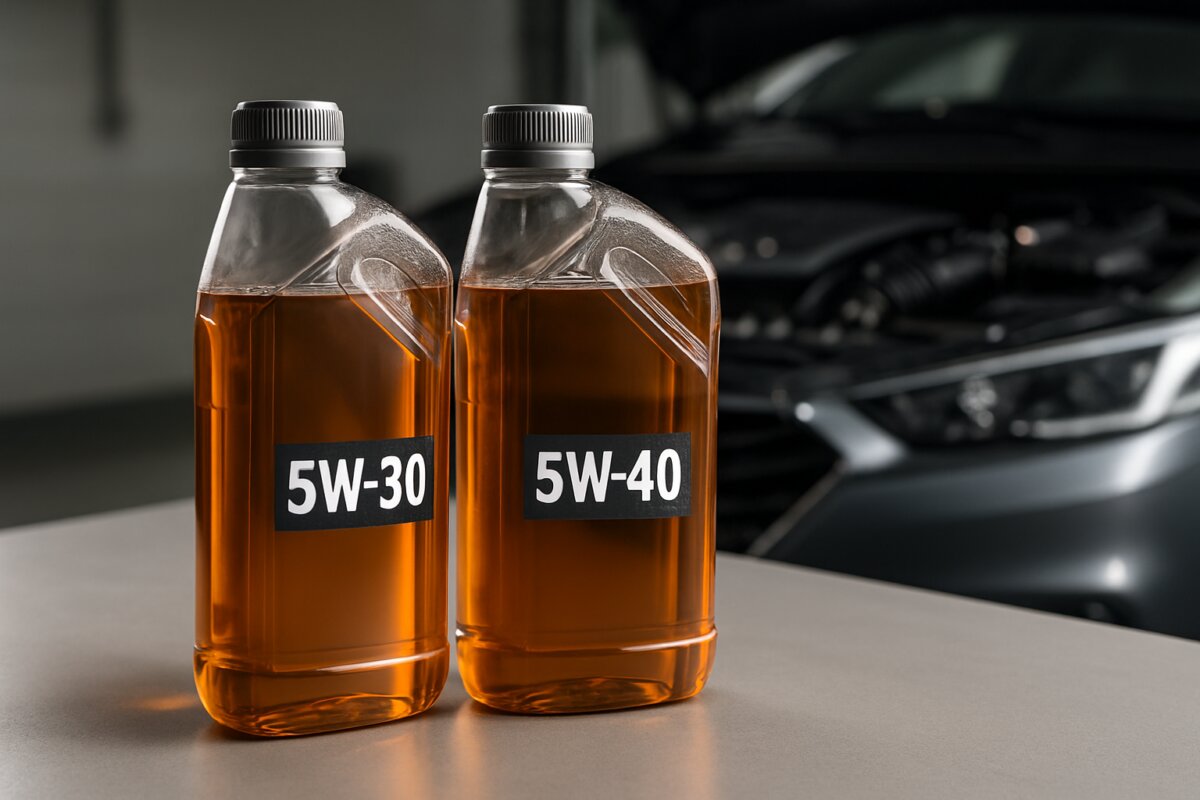
The primary difference between 5w40 vs 5w30 engine oils lies in their high-temperature viscosity: 5w30 flows more easily at operating temperature (rated at 30), making it ideal for fuel efficiency and newer engines, whilst 5w40 maintains thicker protection (rated at 40), better suited for older engines, high-mileage vehicles, or warmer climates. Both oils share the same winter viscosity rating (5w), meaning they perform identically during cold starts. Your choice should depend on your vehicle manufacturer’s specifications, driving conditions, and engine age. Most modern petrol engines in the UK benefit from 5w30, whilst diesel engines and performance vehicles often require the added protection of 5w40.
Quick comparison table
Understanding the key differences between these two popular engine oil grades helps you make an informed decision for your vehicle’s needs.
| Attribute | 5w30 | 5w40 |
|---|---|---|
| Price range | £25-£45 per 5L | £30-£55 per 5L |
| Viscosity at operating temp | Lower (thinner) | Higher (thicker) |
| Fuel economy | Better | Slightly lower |
| Engine protection | Excellent for new engines | Superior for worn engines |
| Cold start performance | Identical | Identical |
| Oil change interval | 10,000-15,000 miles | 10,000-15,000 miles |
| Best climate | Moderate to cold | Warmer climates |
| Ideal for | Daily driving, new engines | Performance, older engines |
Understanding viscosity ratings
Before diving into each oil type, you need to grasp what those numbers actually mean. The Society of Automotive Engineers (SAE) developed this grading system to standardise oil thickness measurements.
The first number (5w) represents the oil’s flow characteristics at cold temperatures. The ‘w’ stands for winter. A lower number means the oil remains fluid even when freezing, which is crucial for protecting your engine during those frigid British mornings. Both 5w30 and 5w40 share this rating, so they perform identically when you turn the ignition on a cold day.
The second number (30 or 40) indicates viscosity at 100°C, your engine’s normal operating temperature. Higher numbers mean thicker oil that maintains its protective film better under extreme heat and pressure. This is where the two oils diverge significantly.
Top tip: Never mix different viscosity grades without checking your handbook. Whilst it won’t immediately damage your engine, it dilutes the protective properties you’re paying for.
5w30 overview
This lighter-weight lubricant has become the standard recommendation for most modern petrol engines manufactured after 2000. Its thinner consistency at operating temperature allows it to circulate more quickly through narrow passages in contemporary engine designs.
The formulation typically includes synthetic or semi-synthetic base stocks blended with detergent additives, anti-wear compounds, and viscosity modifiers. These components work together to keep your engine clean whilst reducing friction between moving parts. Major brands like Castrol, Mobil 1, and Shell offer 5w30 variants ranging from £25 to £45 for a 5-litre container.
Modern engines feature tighter tolerances and smaller oil filter passages. The reduced viscosity of 5w30 means your oil pump doesn’t work as hard, which translates to measurable fuel economy improvements of 1-2% compared to thicker alternatives.
How 5w30 works in your engine
When you start your vehicle, this oil immediately begins flowing through the oil pump to critical components. Its lower viscosity allows it to reach the camshaft, crankshaft bearings, and valve train within seconds, significantly reducing wear during that vulnerable startup period.
Once your engine reaches normal temperature, the oil maintains a protective barrier between metal surfaces without being so thick that it creates unnecessary drag. This balance between protection and efficiency makes it perfect for stop-start driving conditions common in UK cities.
Pros of 5w30
- Improved fuel economy due to reduced internal friction
- Better cold-start protection in British winters
- Ideal for engines with variable valve timing systems
- Meets most manufacturer specifications for modern vehicles
- Widely available and competitively priced
- Reduces strain on your battery during cold starts
Cons of 5w30
- May thin out excessively in extreme heat or spirited driving
- Not suitable for engines with worn bearings or seals
- Can increase oil consumption in high-mileage engines
- Less protection for turbocharged engines under boost
- May not meet specifications for certain performance vehicles
Ideal drivers for 5w30
This viscosity grade suits commuters who rack up motorway miles, city drivers navigating stop-start traffic, and anyone operating a vehicle manufactured within the last decade. If your handbook specifies 5w30, stick with it. Vehicle manufacturers spend millions testing the optimal lubricant for their engines.
Drivers of hybrid vehicles particularly benefit from 5w30 because these powertrains cycle the engine on and off frequently. The quick flow characteristics mean protection arrives immediately every time the petrol engine fires up.
5w40 overview
This heavier-duty formulation provides a thicker protective cushion between engine components once everything heats up. European manufacturers, particularly German brands like BMW, Mercedes-Benz, and Volkswagen, often specify 5w40 for their diesel and performance petrol engines.
The robust additive package in quality 5w40 oils includes enhanced detergents to handle the soot produced by diesel combustion, along with superior anti-wear compounds like zinc dialkyldithiophosphate (ZDDP). You’ll typically invest £30 to £55 for a 5-litre container, reflecting the more expensive base stocks and additives.
This grade excels in engines that generate significant heat, whether from turbocharging, high compression ratios, or sustained high-speed operation. The thicker film at operating temperature prevents metal-to-metal contact even when oil temperatures soar beyond 100°C.
How 5w40 works in your engine
Despite its thicker nature at operating temperature, 5w40 flows just as readily as 5w30 when cold thanks to that identical 5w rating. Once warmed up, the robust viscosity modifiers keep the oil from thinning out excessively, maintaining a protective barrier even under extreme pressure.
In turbocharged engines, where the turbocharger can push oil temperatures well above normal, this extra thickness prevents the oil film from breaking down. The same principle applies to engines with worn tolerances, where slightly thicker oil compensates for increased clearances.
Pros of 5w40
- Superior protection for turbocharged and supercharged engines
- Maintains film strength at high temperatures
- Better suited for towing and heavy loads
- Reduces oil consumption in older engines
- Excellent for performance driving and track days
- Compensates for wear in high-mileage engines
- Preferred specification for many diesel engines
Cons of 5w40
- Slightly reduced fuel economy compared to 5w30
- Higher purchase price
- May be too thick for some modern petrol engines
- Can increase engine load at startup if used incorrectly
- Not suitable for vehicles specifically requiring 5w30
Ideal drivers for 5w40
This viscosity grade is perfect for enthusiasts who enjoy spirited driving, owners of turbocharged diesel vehicles, and anyone with a high-mileage engine showing signs of wear. If you’ve noticed increased oil consumption or your engine has covered more than 100,000 miles, 5w40 might extend its service life.
Drivers who regularly tow caravans or trailers should also consider 5w40, as the additional load generates more heat that thinner oils struggle to handle. The same applies if you frequently drive in warmer climates or subject your vehicle to track days.
Compatibility considerations
Getting the viscosity wrong can affect your warranty, fuel economy, and potentially your engine’s longevity. Here’s what you need to verify before making your choice.
Vehicle compatibility
Your owner’s manual contains the definitive answer. Manufacturers test extensively to determine which viscosity provides optimal protection and performance for your specific engine design. Some vehicles approve multiple grades, giving you flexibility based on climate and driving style.
Most Ford and Vauxhall petrol engines from 2005 onwards specify 5w30. Meanwhile, BMW, Mercedes-Benz, Volkswagen, and Audi diesel engines typically require 5w40. Japanese manufacturers like Toyota and Honda predominantly use 5w30 across their range.
Model year considerations
Pre-2000 engines often used thicker oils like 10w40 or even 15w40. If you own a classic or older vehicle, neither 5w30 nor 5w40 may be ideal unless the engine has been rebuilt to modern tolerances. The thinner modern oils can leak past worn seals and consume oil excessively.
Conversely, engines built after 2010 increasingly demand low-viscosity lubricants for emissions compliance. Using 5w40 in an engine designed for 5w30 can trigger warning lights and affect variable valve timing systems that depend on precise oil flow rates.
OEM specifications
Beyond viscosity, check for manufacturer-specific approvals. Volkswagen requires VW 504.00/507.00 certification for many engines. BMW has Longlife-04 specifications. These standards encompass more than just thickness—they mandate specific additive packages and performance criteria.
Using oil without the correct approval voids your warranty and may cause premature wear. Your oil sump and internal components are engineered around specific lubricant properties, so don’t deviate from manufacturer recommendations without good reason.
Top tip: Check your oil dipstick weekly rather than relying solely on dashboard warnings. Catching low oil levels early prevents catastrophic damage regardless of which grade you use.
Installation notes
When switching between viscosity grades, perform a complete oil change rather than topping up. Mixing reduces the effectiveness of both oils. Always replace your oil filter simultaneously to remove contaminants and ensure clean oil circulates through your engine.
Pay attention to fill capacity. Overfilling causes foaming and aeration, whilst underfilling starves components of lubrication. Most engines hold between 4 and 6 litres, but turbocharged variants and diesels often require more due to additional turbocharger hose lines and larger filter housings.
Expert opinion from AutoPartsPro specialists
Our workshop team has serviced thousands of vehicles across all makes and models, giving us unique insight into real-world oil performance. Senior technician Michael Patterson notes: “We see far more engine problems from extended service intervals than from choosing between 5w30 and 5w40. Both grades work brilliantly when fresh, but breakdown products from combustion contaminate any oil over time.”
He continues: “For customers unsure which grade to choose, we always recommend checking the handbook first. If both are approved, consider your driving style. Gentle motorway cruising suits 5w30, whilst aggressive acceleration and frequent short trips favour 5w40’s extra protection. We’ve noticed that vehicles using the correct specification maintain cleaner engine tappet assemblies and exhibit less sludge buildup.”
Diagnostic specialist Emma Chen adds: “Modern engines equipped with sensors throughout the oiling system can detect incorrect viscosity. We’ve diagnosed several cases where using 5w40 in engines calibrated for 5w30 triggered reduced power modes because oil pressure readings fell outside expected parameters. The computer thought something was wrong, even though the engine was adequately lubricated.”
Final verdict
Your decision between 5w40 and 5w30 should primarily follow manufacturer recommendations found in your vehicle handbook. This isn’t an area for experimentation—engineers specify oil grades based on extensive testing of bearing clearances, oil pump capacity, and filter flow rates.
Choose 5w30 if you drive a modern petrol engine manufactured after 2005, prioritise fuel economy, mostly cover motorway miles, or live in cooler regions. This grade offers excellent all-round protection for engines designed around its flow characteristics. It’s particularly suitable for hybrid vehicles, naturally aspirated engines, and any application where the manufacturer explicitly requires it.
Opt for 5w40 when your handbook specifies it, you own a turbocharged diesel, your engine has covered substantial mileage, or you regularly drive in demanding conditions. The extra viscosity at operating temperature provides enhanced protection for worn engines, high-performance applications, and vehicles subjected to towing or track use. It’s the sensible choice for German diesel engines and older turbocharged petrol units.
For high-mileage vehicles experiencing oil consumption, upgrading from 5w30 to 5w40 can reduce usage, but only if your manufacturer lists both as acceptable alternatives. Never exceed the viscosity range specified in your handbook, as this can affect your water pump drive belt, timing chain tensioners, and variable valve timing actuators that depend on precise oil pressure.
Whichever grade you choose, maintain regular service intervals. Quality 5w30 changed every 10,000 miles outperforms premium 5w40 left in the engine for 20,000 miles. Check your oil level fortnightly, watch for leaks around the rocker gasket and sump, and address any consumption issues promptly. Your engine represents a significant investment—proper lubrication is the cheapest insurance policy you can buy.
Frequently asked questions
Can I mix 5w30 and 5w40 oils?
Whilst both oils are compatible and won’t cause immediate damage, mixing them creates an intermediate viscosity that may not meet your engine’s requirements. You’ll dilute the protective properties of each. Always perform a complete oil change rather than mixing grades.
Will using 5w40 instead of 5w30 damage my engine?
Using thicker oil than specified won’t immediately damage your engine, but it can reduce fuel economy, affect variable valve timing systems, and potentially trigger warning lights. Some engines tolerate the difference better than others, but manufacturer specifications exist for valid engineering reasons.
How often should I change 5w30 or 5w40 oil?
Most manufacturers recommend intervals between 10,000 and 15,000 miles for synthetic and semi-synthetic oils, or annually, whichever comes first. Severe driving conditions like frequent short trips, towing, or dusty environments warrant more frequent changes around 7,500 miles.
Does 5w40 improve performance in older engines?
Yes, if your older engine has developed increased bearing clearances or consumes 5w30 excessively. The thicker film at operating temperature compensates for wear and reduces oil consumption. However, check your handbook first, as some older engines require even thicker grades like 10w40.
Which oil is better for cold British winters?
Both 5w30 and 5w40 perform identically in cold conditions thanks to their shared 5w winter rating. They flow equally well at freezing temperatures, protecting your engine during cold starts. The difference only manifests once your engine reaches normal operating temperature.

 Loading...