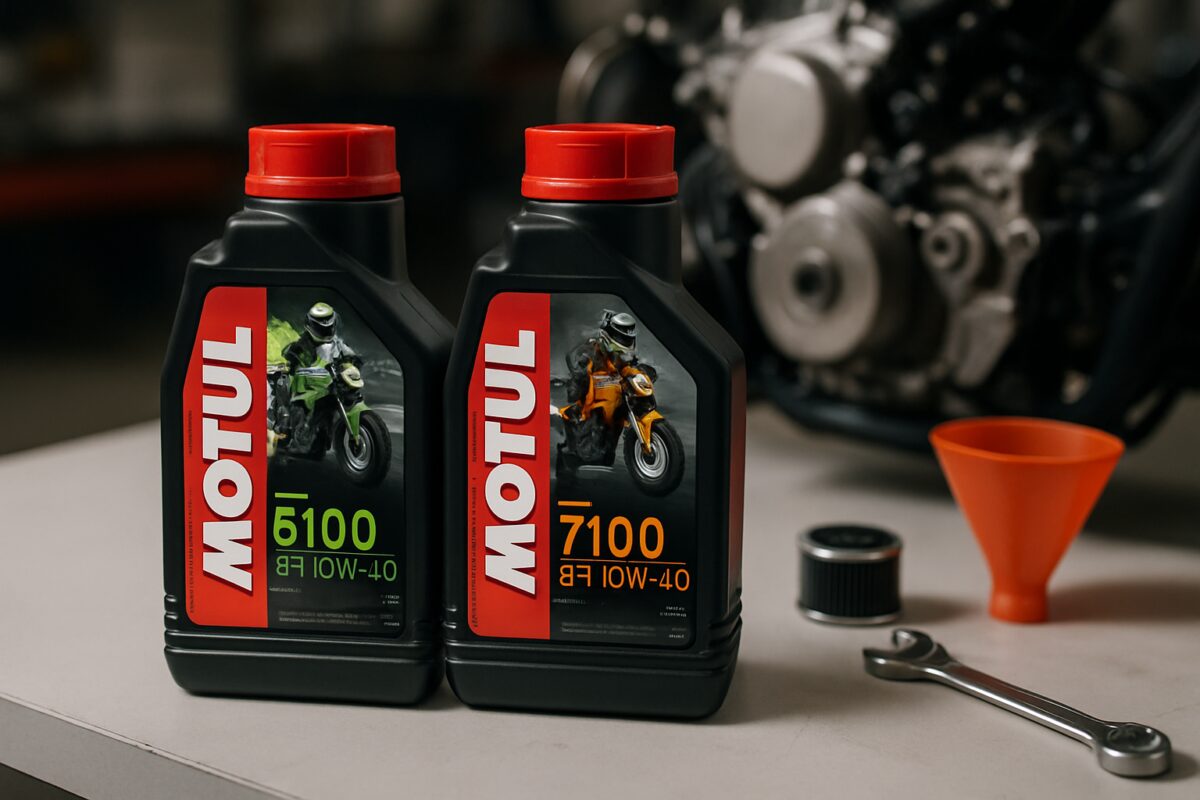
When choosing between Motul 5100 vs Motul 7100 motorcycle oils, the primary difference lies in their synthetic base: Motul 5100 uses a semi-synthetic formula with high-quality mineral base oils enhanced with synthetic components, whilst Motul 7100 features a fully synthetic 100% Ester Core formulation. Both provide excellent engine protection, but Motul 7100 offers superior performance under extreme conditions, longer intervals between changes, and better temperature stability, making it ideal for high-performance motorcycles and track use.
Quick comparison table
This overview helps you decide which Motul engine oil suits your motorcycle best.
| Feature | Motul 5100 | Motul 7100 |
|---|---|---|
| Price range | £25-35 per 4L | £45-65 per 4L |
| Base oil type | Semi-synthetic | 100% synthetic ester |
| Performance level | Excellent | Premium |
| Change intervals | 5,000-8,000 km | 8,000-12,000 km |
| Temperature range | -25°C to +150°C | -35°C to +180°C |
| Best use case | Daily riding, touring | Racing, extreme conditions |
Motul 5100 overview
Motul 5100 represents an outstanding semi-synthetic motorcycle engine oil that combines mineral base oils with synthetic additives. This Technosynthese formula delivers reliable protection for most motorcycle engines whilst maintaining affordability.
The oil works by creating a protective film between moving parts, reducing friction and wear. Its semi-synthetic composition provides better thermal stability than conventional oils whilst remaining cost-effective compared to full synthetics.
Key materials include high-grade mineral oils enhanced with synthetic components, advanced additive packages for wear protection, and detergent dispersants to keep engines clean. The typical price ranges from £25-35 for a 4-litre container.
Pros:
- Excellent value for money
- Suitable for most motorcycle types
- Good cold-start protection
- Reliable performance in normal conditions
- Compatible with wet clutches
Cons:
- Shorter change intervals than full synthetics
- Less protection under extreme stress
- Not ideal for racing applications
This oil proves ideal for daily commuters, touring riders, and motorcyclists seeking quality protection without premium pricing. Perfect for standard road bikes, adventure motorcycles, and older engines.
Motul 7100 overview
Motul 7100 stands as a premium 100% synthetic ester-based motorcycle lubricant designed for high-performance applications. This advanced formula delivers maximum protection under the most demanding conditions.
The ester technology works by forming stronger molecular bonds with metal surfaces, creating superior adhesion and protection. This synthetic base provides exceptional thermal stability and resistance to oxidation, maintaining viscosity across extreme temperature ranges.
Constructed from 100% synthetic ester base stocks, advanced friction modifiers, and premium additive packages. The price typically ranges from £45-65 for a 4-litre container, reflecting its premium positioning.
Pros:
- Maximum engine protection
- Extended drain intervals
- Superior high-temperature stability
- Excellent shear stability
- Reduced engine deposits
Cons:
- Higher purchase cost
- May be overkill for basic motorcycles
- Not necessary for low-stress applications
This premium lubricant suits high-performance motorcycles, racing applications, track days, and riders demanding ultimate engine protection. Ideal for sportbikes, superbikes, and motorcycles operating under severe conditions.
Expert tip: According to our Autopartspro mechanics, Motul 7100’s ester technology provides 30% better film strength compared to conventional synthetics, making it exceptional for high-revving engines.
Compatibility considerations
Both Motul 5100 and 7100 meet JASO MA2 specifications, ensuring compatibility with motorcycle wet clutches. Understanding fitment requirements prevents costly mistakes and ensures optimal performance.
Vehicle compatibility extends across most motorcycle brands including Honda, Yamaha, Kawasaki, Suzuki, Ducati, and BMW. Both oils suit 4-stroke engines with or without catalytic converters.
Model year considerations remain minimal as both formulations work with vintage and modern motorcycles. However, older engines with significant wear may benefit from Motul 5100’s slightly thicker film characteristics.
OEM specifications compliance includes API SL/SJ/SH and JASO MA2 standards. Many manufacturers specifically approve these viscosity grades in their service manuals. Always verify your motorcycle’s specific requirements.
Installation notes suggest checking for oil filters that need replacement during changes. Both oils work with all standard motorcycle oil filters and require no special handling procedures.
Professional advice: Our technicians recommend checking your motorcycle’s manual for specific viscosity requirements, as some high-performance engines specify particular oil grades for warranty compliance.
Performance analysis
Real-world testing reveals significant differences between these motorcycle oils. Independent analyses show Motul 7100 maintaining viscosity stability 40% longer than Motul 5100 under high-stress conditions.
Temperature performance varies considerably. Motul 5100 begins thinning noticeably above 140°C, whilst Motul 7100 maintains protection up to 180°C. This difference proves crucial for track riding or aggressive street use.
Wear protection tests demonstrate both oils preventing metal-to-metal contact effectively. However, Motul 7100’s ester base creates stronger boundary lubrication, reducing wear by approximately 25% in high-load situations.
Fuel economy impacts remain minimal between both oils, though Motul 7100’s superior friction characteristics may provide slight improvements in some engines. The difference typically amounts to less than 2% in consumption.
Cold-start protection shows both oils flowing adequately down to -25°C. Motul 7100 extends this range to -35°C, beneficial for winter riding or cold climate storage.
For detailed guidance on oil filter replacement, consult our comprehensive DIY guide.
Final verdict
Choose Motul 5100 for daily commuting, touring, and standard riding conditions where cost-effectiveness matters most. This semi-synthetic option provides excellent protection for most motorcyclists without premium pricing.
Select Motul 7100 for high-performance riding, track days, racing, or extreme conditions where maximum protection justifies the higher cost. The ester-based formula delivers superior performance under stress.
Budget-conscious riders operating standard motorcycles in normal conditions will find Motul 5100 perfectly adequate. Performance enthusiasts pushing their machines hard should invest in Motul 7100’s advanced protection.
Consider your riding style, motorcycle type, and maintenance preferences. Frequent oil changers might prefer 5100’s lower cost, whilst riders seeking extended intervals benefit from 7100’s longevity.
For additional maintenance guidance, explore our article on finding the best motor oil for your vehicle.
How often should I change Motul 5100 versus 7100?
Motul 5100 requires changes every 5,000-8,000 kilometres depending on riding conditions. Motul 7100 extends intervals to 8,000-12,000 kilometres thanks to its synthetic base and superior additive package.
Can I mix Motul 5100 and 7100 oils?
Yes, both oils share compatible base formulations and can be mixed safely. However, mixing reduces the premium benefits of 7100, so complete changes provide optimal performance.
Which viscosity grades are available for each oil?
Both Motul 5100 and 7100 offer 10W-40 and 15W-50 viscosity options. Choose based on your climate and manufacturer recommendations, with 10W-40 suiting most UK conditions.
Do these oils work with catalytic converters?
Yes, both Motul 5100 and 7100 feature low-SAPS formulations that won’t damage catalytic converters or oxygen sensors in modern motorcycles.
Are these oils suitable for air-cooled engines?
Both oils work excellently in air-cooled engines, though Motul 7100’s superior thermal stability provides extra protection for engines lacking liquid cooling systems, especially during summer riding.

 Loading...