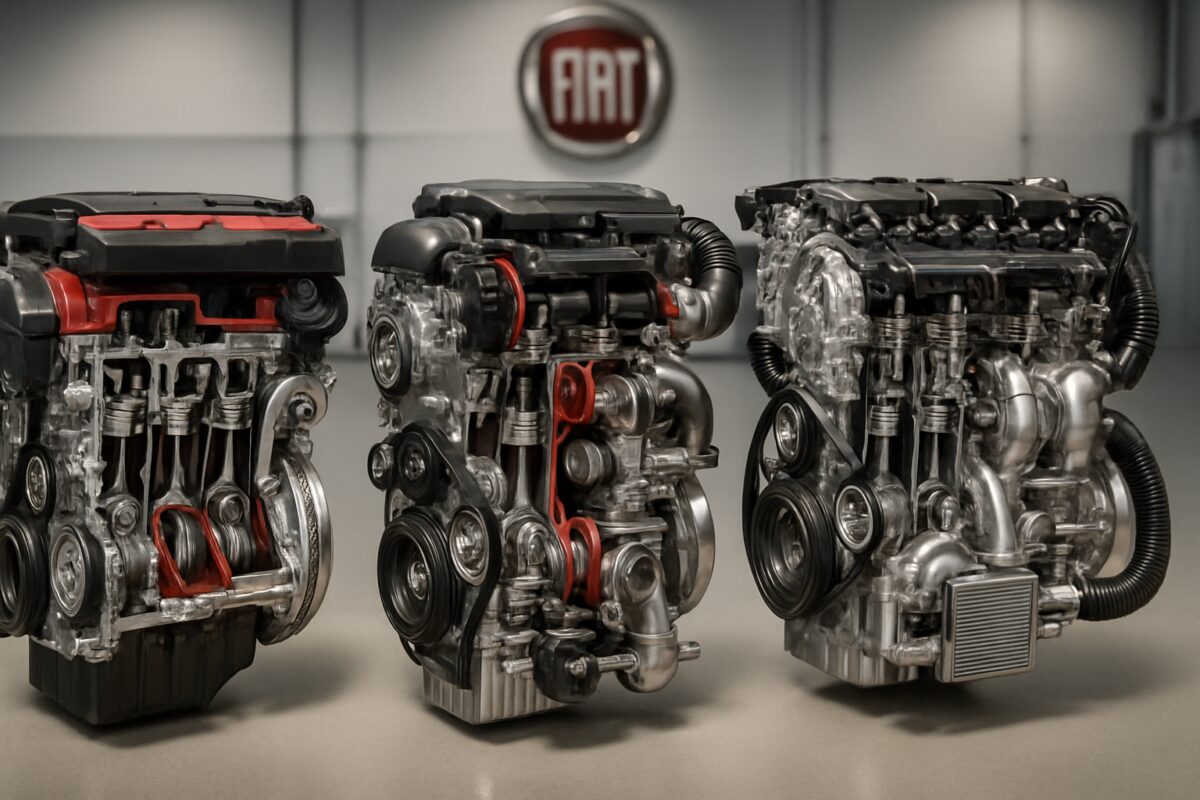
The Fiat Tipo represents excellent value in the compact family car segment, offering practical motoring without breaking the bank. Your choice of powerplant significantly impacts daily driving experience, fuel costs, and long-term reliability. From economical naturally aspirated units to turbocharged performance variants, the Tipo lineup delivers between 95-120 horsepower with torque ranging from 127-206 Nm across petrol and diesel configurations.
Comparison table of all engines
| Engine | Power output | Torque | Fuel consumption | Reliability |
|---|---|---|---|---|
| 1.4 Fire | 95 hp | 127 Nm | 6.5L/100km | Good |
| 1.4 T-Jet | 120 hp | 206 Nm | 6.8L/100km | Average |
| 1.6 E.torQ | 110 hp | 152 Nm | 6.2L/100km | Very Good |
| 1.3 MultiJet | 95 hp | 200 Nm | 4.8L/100km | Excellent |
| 1.6 MultiJet | 120 hp | 320 Nm | 4.5L/100km | Very Good |
Engine #1 overview
The 1.4-litre Fire represents Fiat’s tried-and-tested naturally aspirated petrol solution. This inline-four configuration displaces 1368cc and features multi-point fuel injection technology. Built without forced induction, this unit prioritises simplicity and cost-effectiveness over outright performance.
Pros
- Proven reliability with minimal complex components
- Low maintenance costs and widely available service parts
- Adequate power for city driving and light motorway use
- Smooth operation with minimal vibration
Cons
- Limited torque delivery requires frequent gear changes
- Poor fuel economy compared to modern alternatives
- Dated technology lacks modern efficiency features
- Struggles with fully loaded vehicle or steep inclines
Engine #2 overview
The 1.4 T-Jet brings turbocharged performance to the Tipo range through forced induction technology. This compact four-cylinder unit delivers impressive power-to-weight ratios whilst maintaining reasonable fuel consumption figures. Direct injection and variable valve timing enhance both efficiency and responsiveness.
Pros
- Strong torque delivery from low rpm provides excellent driveability
- Modern technology includes intercooling and electronic management
- Responsive acceleration suitable for overtaking manoeuvres
- Compact size reduces engine bay packaging constraints
Cons
- Turbocharger complexity increases potential repair costs
- Premium fuel recommended for optimal performance
- Higher service intervals demand quality oil filters
- Carbon build-up issues require periodic cleaning
Engine #3 overview
Representing Fiat’s latest naturally aspirated petrol technology, the 1.6 E.torQ combines displacement with modern engineering. This four-cylinder powerplant features dual variable valve timing and optimised combustion chambers for improved efficiency. Electronic throttle control enhances response whilst reducing emissions.
Pros
- Excellent balance between performance and fuel economy
- Reliable naturally aspirated design minimises complexity
- Smooth power delivery across the rev range
- Lower maintenance requirements than forced induction alternatives
Cons
- Higher purchase price compared to entry-level engines
- Limited availability in certain market regions
- Requires quality spark plugs for optimal ignition
- Performance falls short of turbocharged competitors
Engine #4 overview
The 1.3 MultiJet diesel represents Fiat’s small-displacement compression ignition solution. This turbocharged four-cylinder unit features common-rail fuel injection and variable geometry turbocharging. Advanced emission control systems include diesel particulate filtration for Euro 6 compliance.
Pros
- Outstanding fuel efficiency ideal for high-mileage drivers
- Strong low-end torque perfect for city driving
- Proven MultiJet technology ensures reliability
- Lower CO2 emissions reduce road tax obligations
Cons
- Diesel particulate filter requires regular regeneration cycles
- Higher noise levels compared to petrol alternatives
- Premium diesel fuel costs more than standard petrol
- Complex emission systems increase maintenance complexity
Engine #5 overview
The larger 1.6 MultiJet diesel delivers enhanced performance whilst maintaining excellent efficiency. This turbocharged unit provides substantial torque output through advanced common-rail injection technology. Variable geometry turbocharging optimises power delivery across different engine speeds and loads.
Pros
- Exceptional torque output ideal for towing and motorway driving
- Superior fuel economy reduces running costs significantly
- Refined operation with minimal diesel clatter
- Strong resale values due to diesel popularity
Cons
- Higher initial purchase price than petrol equivalents
- Complex turbocharger systems require specialist maintenance
- Emission control systems demand quality fuel filters
- Cold-weather starting can prove problematic
Maintenance cost
| Engine | Recommended Interval | Estimated Cost | Cost per 10,000 miles |
|---|---|---|---|
| 1.4 Fire | 15,000 miles | £180-220 | £120-147 |
| 1.4 T-Jet | 10,000 miles | £220-280 | £220-280 |
| 1.6 E.torQ | 12,000 miles | £200-250 | £167-208 |
| 1.3 MultiJet | 12,000 miles | £280-340 | £233-283 |
| 1.6 MultiJet | 12,000 miles | £320-380 | £267-317 |
Service costs vary significantly between petrol and diesel variants, with compression ignition engines requiring more expensive consumables and specialist knowledge. Regular air filter replacement ensures optimal performance across all powerplant options.
AutoPartsPro mechanics recommend checking engine oil levels every 1,000 miles, particularly on turbocharged variants where oil consumption can increase under spirited driving conditions.
Engine sound and character
Each Tipo powerplant delivers distinct acoustic signatures that reflect their engineering philosophies. The naturally aspirated petrol engines produce smooth, refined notes that remain unobtrusive during normal driving. Turbocharged variants add subtle whistling sounds under acceleration, creating more engaging auditory feedback.
Diesel engines naturally generate more mechanical noise, though modern sound deadening materials significantly reduce cabin intrusion. The smaller 1.3 MultiJet operates with typical diesel characteristics, whilst the larger 1.6-litre unit provides smoother operation at higher speeds. Performance enthusiasts often appreciate the distinctive turbo spool-up sounds during acceleration phases.
Our technicians note that proper engine mount condition significantly affects perceived noise and vibration levels, regardless of powerplant choice.
Who each engine is best for
| Engine | Best for | Driving profile | Annual mileage |
|---|---|---|---|
| 1.4 Fire | Budget-conscious owners | City commuting, light loads | Under 8,000 miles |
| 1.4 T-Jet | Performance enthusiasts | Spirited driving, weekend trips | 8,000-15,000 miles |
| 1.6 E.torQ | Daily commuters | Mixed urban/motorway use | 10,000-18,000 miles |
| 1.3 MultiJet | Efficiency seekers | Regular short journeys | 12,000-20,000 miles |
| 1.6 MultiJet | Long-distance drivers | Motorway cruising, towing | Over 18,000 miles |
Consider your typical journey patterns when selecting powerplant options. Short urban trips favour naturally aspirated petrol engines, whilst extensive motorway driving benefits from diesel torque characteristics. Turbocharged variants excel during mixed driving conditions but require more frequent servicing intervals.
Which Tipo engine offers the best fuel economy?
The 1.6 MultiJet diesel achieves exceptional efficiency at 4.5L/100km, making it ideal for high-mileage drivers seeking minimal fuel costs.
Are turbocharged Tipo engines reliable long-term?
Modern turbocharger technology proves reliable with proper maintenance, though service costs increase due to additional complexity requiring quality turbocharger hoses and regular inspections.
What’s the most affordable Tipo engine to maintain?
The 1.4 Fire offers lowest maintenance costs due to simple naturally aspirated design and widely available service parts.
Can Tipo diesel engines handle short journeys effectively?
Short trips prevent proper diesel particulate filter regeneration, potentially causing expensive repairs. Petrol engines suit urban driving better.
Which Tipo engine provides the best performance?
The 1.6 MultiJet diesel delivers strongest torque output at 320 Nm, whilst the 1.4 T-Jet offers sportiest petrol performance characteristics.

 Loading...