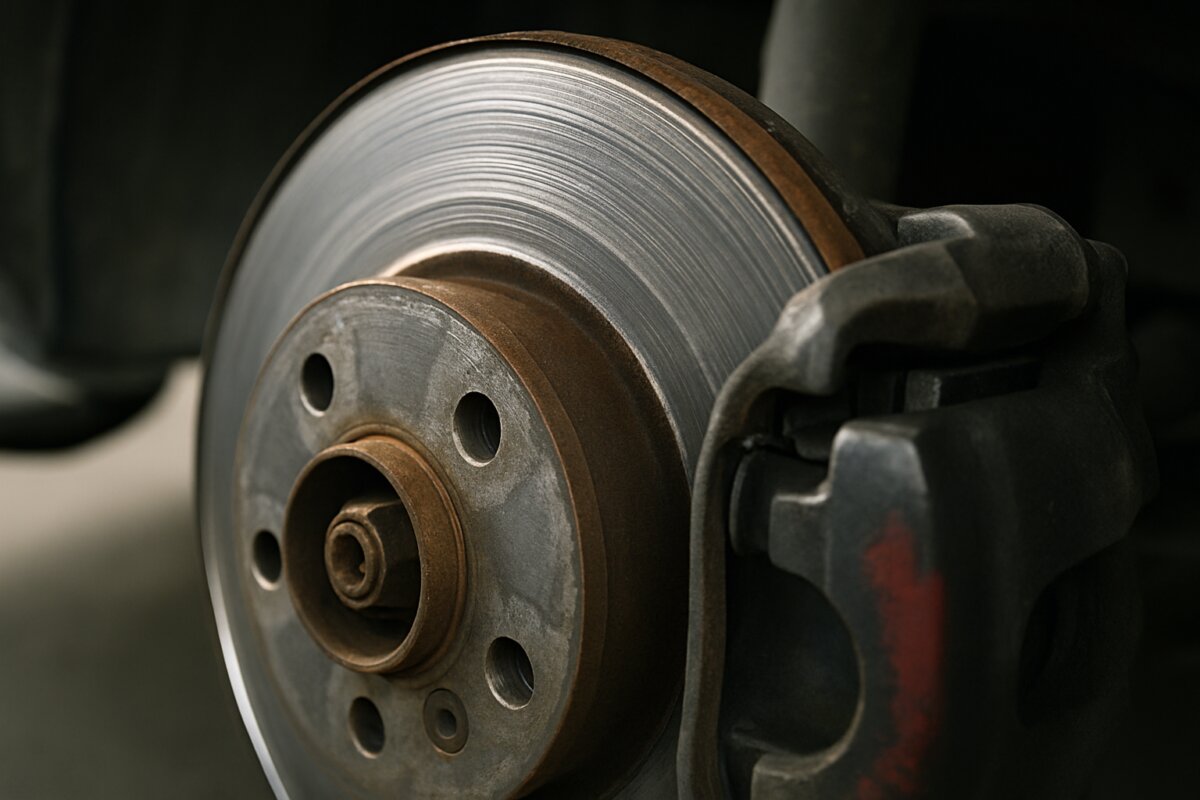
Brake discs lipped refers to a raised edge or ridge that forms around the outer circumference of a brake disc as it wears down over time. This lip develops because the brake pads only make contact with a specific area of the disc surface, leaving an unworn edge that protrudes beyond the normal friction zone. Lipped brake discs pose serious safety risks by reducing braking efficiency, causing uneven pad wear, and potentially failing your MOT test. When the lip exceeds acceptable limits—typically around 1mm—the discs must be replaced immediately to maintain safe stopping distances and pass vehicle inspections.
What causes brake disc lipping
The lipping phenomenon occurs naturally through the normal operation of your braking system. Every time you press the brake pedal, the brake calipers squeeze the pads against the disc surface, creating friction that slows your vehicle. This repeated contact gradually wears away the material where the pads make contact.
The outer edge of the disc remains untouched because brake pads don’t extend to the full diameter of the rotor. Over thousands of brake applications, the working surface becomes progressively thinner whilst the outer edge stays at its original thickness. This creates the distinctive lip profile that mechanics look for during inspections.
Several factors accelerate lip formation on your brake rotors:
- High mileage vehicles with original discs still fitted
- Aggressive driving habits involving frequent hard braking
- Stop-start city driving that constantly engages the brakes
- Corrosion around the disc edges from road salt and moisture
- Poor quality brake components that wear unevenly
- Delayed replacement of worn brake pads
According to Autopartspro’s experienced mechanics, lipping becomes noticeable after approximately 40,000 to 60,000 miles on most vehicles, though this varies significantly based on driving style and conditions. Commercial vehicles and those regularly towing heavy loads may develop pronounced lips much sooner.
How to identify lipped brake discs
You don’t need specialist equipment to spot lipped discs on your vehicle. A simple visual inspection through the wheel spokes often reveals the telltale ridge. The lip appears as a shiny or rusty raised edge along the outer circumference of the disc, clearly distinguishing the worn central area from the unworn edge.
Running your finger carefully across the disc surface (with the engine off and wheels chocked) allows you to feel the step between the worn friction surface and the unworn lip. Be cautious though—brake discs can have sharp edges that might cut your skin.
Professional technicians use a micrometer or digital caliper to measure the exact lip height. They take readings at multiple points around the disc to check for uneven wear patterns that might indicate problems with the brake caliper or mounting hardware.
Common symptoms accompanying lipped discs
Your vehicle often displays warning signs when brake discs develop significant lipping:
- Squealing or grinding noises during braking, especially when slowing from high speeds
- Vibration through the brake pedal or steering wheel under moderate to heavy braking
- Increased stopping distances compared to when the brakes were new
- Uneven brake pad wear with the outer edges showing more material remaining
- Pulsating sensation through the pedal even at low speeds
Autopartspro specialists emphasise that these symptoms shouldn’t be ignored. They often indicate that your braking system has deteriorated beyond the point of simple pad replacement and requires comprehensive attention including new discs.
The dangers of driving with lipped brake discs
Operating a vehicle with excessively lipped brake discs creates multiple safety hazards. The raised edge interferes with proper brake pad seating, reducing the effective contact area between pad and disc. This diminishes the friction available to slow your vehicle, particularly dangerous in emergency stopping situations.
When new brake pads are fitted to heavily lipped discs, the pads can catch on the lip during installation or operation. This causes uneven bedding-in and prevents the pads from making full contact with the disc surface. The result is compromised braking performance and accelerated pad wear.
The lip also traps heat in the disc, reducing the ability of the brake fluid and components to dissipate thermal energy effectively. Under repeated heavy braking—such as descending a steep hill—this can lead to brake fade where stopping power dramatically decreases.
Professional tip: Always replace brake discs and pads together as a matched set. Fitting new pads to lipped discs wastes money because the pads won’t bed in properly and will wear unevenly from the start, requiring premature replacement.
Impact on related braking components
Lipped discs don’t just affect stopping power—they damage other parts of your braking system. The uneven surface forces brake pads to wear at irregular angles, creating tapered or stepped profiles that further reduce braking efficiency.
Caliper pistons can become strained as they attempt to compensate for the uneven disc surface. This places additional stress on the hydraulic seals and can lead to premature caliper failure, requiring expensive repairs beyond simple disc replacement.
The ABS sensor may also be affected. Severe lipping can cause the disc to run out of true, creating irregular signals to the anti-lock braking system. This might trigger dashboard warning lights or cause the ABS to activate unnecessarily during normal braking.
MOT testing standards for brake disc lipping
The UK MOT test includes specific criteria for brake disc condition. Examiners check for excessive wear, scoring, and lipping during the inspection. Whilst there’s no explicitly stated maximum lip measurement in the MOT manual, examiners apply the principle that discs must not be “excessively worn.”
In practice, most MOT testers consider a lip greater than 1mm as cause for failure. However, even smaller lips may result in failure if the examiner determines they compromise braking effectiveness or if the disc thickness has worn below the manufacturer’s minimum specification.
MOT failure reasons related to brake discs
| Defect Category | Description | MOT Result |
|---|---|---|
| Excessive lipping | Lip height exceeds acceptable limits | Major failure |
| Below minimum thickness | Disc worn thinner than manufacturer specification | Major failure |
| Severe scoring or cracking | Deep grooves or visible cracks in friction surface | Major failure |
| Contamination | Oil, grease, or brake fluid on disc surface | Major failure |
Our technical team at Autopartspro advises getting your brakes inspected well before your MOT is due. This allows time to source quality replacement parts and have the work completed without the pressure of a looming test deadline.
When to replace lipped brake discs
Don’t wait until your MOT test to address lipped discs. Replace them when the lip becomes noticeable to touch or reaches approximately 1mm in height. Most manufacturers recommend disc replacement at every second brake pad change, which typically aligns with when lipping becomes problematic.
Check your vehicle’s service manual for the minimum disc thickness specification. This measurement, usually stamped on the disc itself, represents the absolute minimum safe thickness. If your discs are at or near this limit, replacement is mandatory regardless of lip size.
Professional mechanics use this replacement decision matrix:
- Measure the current disc thickness and compare to minimum specification
- Assess the lip height using a micrometer at multiple points
- Inspect for cracks, scoring, or heat damage on the friction surface
- Evaluate the overall condition of related components like calipers and pads
- Consider the vehicle’s mileage and service history
Disc thickness specifications by vehicle type
| Vehicle Category | Typical New Disc Thickness | Typical Minimum Thickness | Discard When Below |
|---|---|---|---|
| Small hatchback | 9-11mm | 7-9mm | Minimum specification |
| Medium saloon/estate | 12-14mm | 10-12mm | Minimum specification |
| Large SUV/4×4 | 22-28mm | 20-26mm | Minimum specification |
| Performance vehicle | 25-32mm | 23-30mm | Minimum specification |
The replacement process explained
Replacing lipped brake discs isn’t overly complicated for someone with mechanical experience, but requires proper tools and safety precautions. The job typically takes one to two hours per axle depending on vehicle design and whether components are seized.
The basic procedure involves removing the wheel, unbolting the caliper and bracket, sliding off the old disc, fitting the new disc, and reassembling everything with proper torque specifications. However, complications arise with corroded fasteners, seized caliper slides, or damaged wheel hub threads.
Autopartspro’s workshop specialists follow this detailed process:
- Safely lift and support the vehicle on axle stands (never just a jack)
- Remove the road wheel to access the brake assembly
- Clean the caliper mounting area and check slider pins for proper movement
- Remove caliper mounting bolts and support the caliper without straining the brake hose
- Take off the caliper bracket if required for disc removal
- Clean the hub face thoroughly to ensure the new disc sits perfectly flat
- Fit the new disc and secure with a wheel bolt temporarily
- Install new brake pads with appropriate anti-squeal compound
- Refit the caliper and bracket with new mounting hardware
- Torque all fasteners to manufacturer specifications
- Pump the brake pedal several times to seat the pads before driving
Parts you’ll need for a complete job
A thorough brake disc replacement requires more than just the rotors. Quality installations include fresh hardware to ensure everything functions correctly and lasts longer. Budget for these components when planning your repair:
- Matched pair of brake discs for the axle
- Complete set of brake pads for both wheels
- New caliper mounting bolts and guide pin boots
- Anti-squeal shims or paste depending on pad design
- Copper grease for threads and slider pins
- Fresh brake fluid for topping up the reservoir
Always replace discs in axle pairs—never just one side. Mismatched friction surfaces cause uneven braking forces that pull the vehicle to one side and increase wear on the newer disc.
Choosing the right replacement brake discs
Not all brake discs are created equal. The market offers several types, each suited to different driving needs and budgets. Standard solid discs work perfectly for normal road driving, whilst ventilated designs with internal cooling vanes handle higher temperatures better.
Performance options include grooved or drilled discs that improve initial bite and help clear brake dust and gases. However, these designs typically wear faster than plain discs and may not be necessary for everyday motoring.
Material quality matters significantly. Premium discs use higher-grade cast iron with better metallurgy that resists warping and provides more consistent performance across their lifespan. Budget options may look identical but can develop problems like judder or premature wear within months.
Disc types and their applications
Standard solid discs suit smaller, lighter vehicles with modest performance requirements. They’re cost-effective and durable for typical urban and motorway driving patterns. Most city cars and small hatchbacks use this design on the rear axle.
Ventilated discs feature internal vanes that pump air through the disc as it rotates, dramatically improving heat dissipation. These work best for heavier vehicles, frequent motorway driving, or anywhere sustained braking is common. The front axle of most modern cars uses ventilated designs.
Drilled and grooved discs look impressive and do offer genuine benefits for track use or spirited driving. The holes and grooves help clear water, dust, and hot gases from between pad and disc. However, they’re noisier, more expensive, and wear faster than plain alternatives.
Cost considerations for brake disc replacement
The total expense varies widely based on vehicle type, parts quality, and whether you do the work yourself or pay a garage. Budget around £100-£200 for parts to replace both front discs and pads on a typical family car using quality aftermarket components.
Labour charges at independent garages typically range from £80-£150 per axle, whilst main dealers often charge significantly more. Mobile mechanics sometimes offer better value, though they may lack specialist equipment for seized components or require multiple visits.
Remember that delaying replacement costs more in the long run. Driving on excessively worn discs damages pads, calipers, and potentially the master cylinder, turning a straightforward disc replacement into a major brake system overhaul.
Preventing premature disc lipping
Whilst lipping is inevitable with normal use, you can slow its progression through smart driving habits and proper maintenance. Gentle, progressive braking rather than harsh last-minute stops reduces the thermal stress and mechanical wear that accelerates lip formation.
Regular cleaning helps too. Road salt and grime accelerate corrosion around disc edges, making lips more pronounced and potentially weakening the disc structure. Washing your wheels periodically—particularly in winter—removes these contaminants before they cause lasting damage.
Keep your entire braking system properly maintained. Seized caliper sliders cause uneven pad pressure that creates irregular wear patterns. Free-moving calipers distribute braking forces evenly across the disc surface, promoting uniform wear and extending disc life.
Don’t ignore squealing or grinding noises from your brakes. These sounds often indicate worn brake pads with exposed metal backing plates. Continuing to drive with metal-on-metal contact rapidly destroys disc surfaces, creating grooves and accelerating lip formation that forces premature replacement.
Professional expertise from Autopartspro
Our experienced technicians see hundreds of brake jobs annually, giving them unique insights into what works and what doesn’t. They consistently observe that vehicles maintained with quality parts and regular inspections experience fewer brake-related failures and lower overall maintenance costs.
The team notes that many drivers underestimate how quickly brake components deteriorate once they reach the warning stage. A disc that’s borderline acceptable can become dangerously worn within just a few thousand miles, particularly if driving conditions are demanding.
They also emphasise the false economy of fitting cheap brake parts. Low-quality discs may save £30 initially but often need replacing again within 18 months, whilst premium components easily last three years or 40,000 miles. Factor in labour costs for repeated replacements, and the budget option becomes significantly more expensive.
Quality matters especially with safety-critical components. Autopartspro stocks brake discs from reputable manufacturers that meet or exceed original equipment specifications. These parts undergo rigorous testing to ensure they deliver consistent performance across their service life, something generic imports simply cannot guarantee.
Legal obligations and insurance implications
UK law requires that your brakes are maintained in good working order at all times—not just for the MOT test. Driving with defective brakes is an offence that can result in penalty points, fines, and potentially having your vehicle removed from the road by police or DVSA enforcement officers.
More seriously, an accident caused by brake failure due to neglected maintenance could void your insurance coverage. If investigators determine that excessively worn discs contributed to a collision, your insurer might refuse to pay out, leaving you personally liable for all damages and injuries.
Keep records of all brake maintenance work. Receipts showing regular inspections and timely replacement of worn components provide evidence that you’ve maintained your vehicle responsibly. This documentation can prove invaluable if questions arise following an incident.
Understanding brake disc lipping and addressing it promptly protects both your safety and your wallet. The distinctive raised edge that develops as discs wear creates multiple problems—from reduced stopping power to MOT failures—that worsen rapidly if ignored. Measuring disc thickness against manufacturer specifications and inspecting for excessive lipping during routine maintenance allows you to plan replacements before they become urgent. When the time comes, choosing quality components from trusted suppliers like Autopartspro ensures your braking system delivers reliable performance for years to come. Regular attention to your brakes isn’t just good maintenance practice—it’s an essential investment in the safety of everyone who travels in or near your vehicle.
Frequently Asked Questions (FAQ)
Can I just machine down the lip on my brake discs instead of replacing them?
No, machining removes material that reduces the disc below its minimum safe thickness. Modern discs are manufactured with tight tolerances and little excess material, making skimming impractical and potentially dangerous.
Will lipped brake discs definitely fail an MOT test?
Not automatically, but they likely will if the lip exceeds 1mm or if the examiner determines braking efficiency is compromised. Examiners have discretion to fail discs they consider excessively worn.
How long do brake discs typically last before developing problematic lipping?
Most discs develop noticeable lips between 40,000 and 60,000 miles, though driving style significantly affects this. Aggressive drivers or those in stop-start traffic may see lipping much sooner.
Can I fit new brake pads to lipped discs temporarily?
You physically can, but it’s inadvisable. New pads won’t bed in properly on lipped surfaces, resulting in poor braking performance and rapid uneven pad wear that wastes money.
Do rear brake discs lip at the same rate as front discs?
No, front brakes handle approximately 70% of braking force, so front discs wear faster and develop lips sooner. Rear discs typically last longer but still require periodic inspection and replacement.

 Loading...