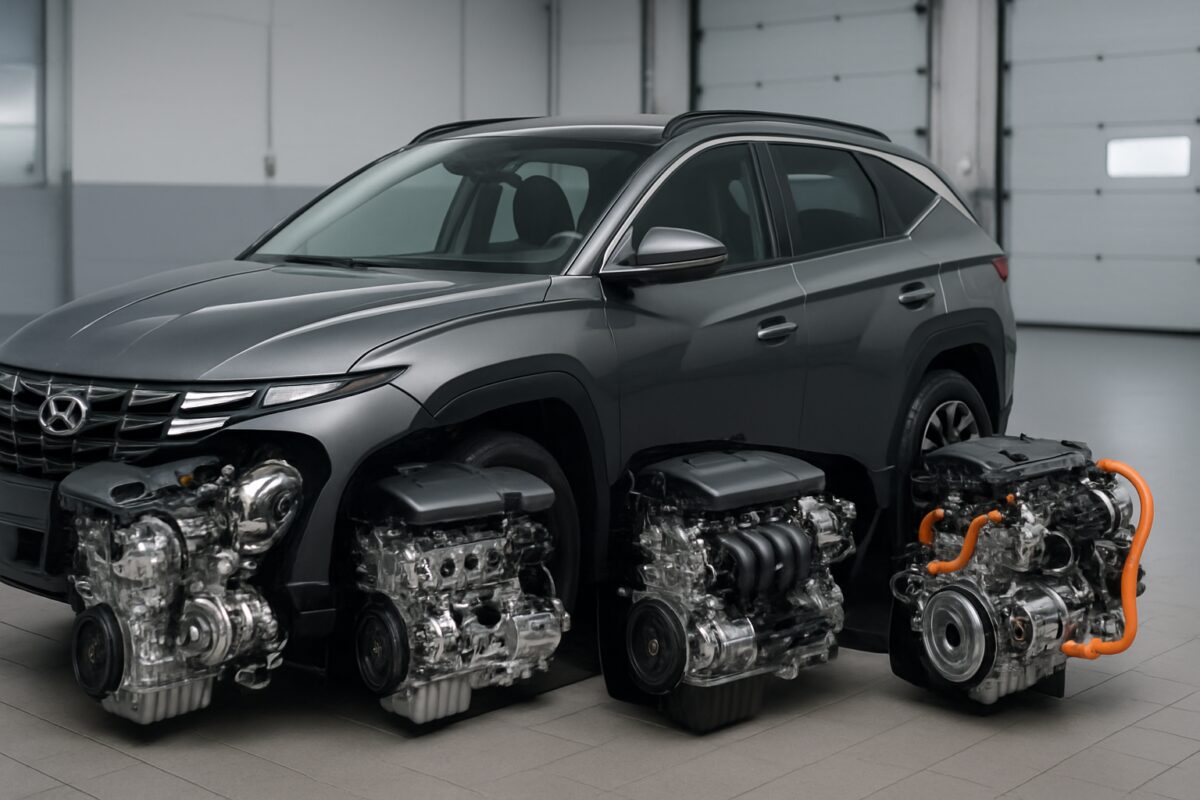
The Hyundai Tucson sits firmly in the competitive compact SUV segment, offering families a blend of practicality and performance. The engine choice is crucial for this vehicle as it determines fuel economy, driving dynamics, and long-term reliability. From efficient petrol units to robust diesel powerplants and modern hybrid systems, the Tucson lineup delivers 150-230 horsepower with torque figures ranging from 192-420 Nm across various configurations.
Comparison table of all engines
| Engine | Power output | Torque | Fuel consumption | Reliability |
|---|---|---|---|---|
| 1.6 T-GDI Petrol | 150 hp | 253 Nm | 8.2-9.1 l/100km | Good |
| 2.0 Petrol | 165 hp | 192 Nm | 8.5-9.5 l/100km | Very Good |
| 2.0 CRDi Diesel | 185 hp | 416 Nm | 5.8-6.5 l/100km | Excellent |
| 1.6 Hybrid | 230 hp combined | 350 Nm | 5.2-5.8 l/100km | Good |
Engine #1 overview
The 1.6 T-GDI petrol engine represents Hyundai’s turbocharged approach to compact SUV power. This inline-4 configuration features a 1591cc displacement with direct injection technology. The turbocharged unit runs on unleaded petrol with multi-point fuel injection, delivering smooth power delivery throughout the rev range. Our mechanics at AutoPartsPro note this engine’s responsive nature makes it ideal for urban driving conditions.
Pros
- Excellent throttle response thanks to turbocharging
- Decent fuel economy for a petrol engine
- Smooth operation with minimal vibrations
- Good power-to-weight ratio
- Relatively affordable maintenance costs
Cons
- Turbo lag noticeable at low RPM
- Premium fuel recommended for optimal performance
- Carbon build-up issues with direct injection
- Higher emissions compared to diesel alternatives
Engine #2 overview
The naturally aspirated 2.0-litre petrol engine offers traditional reliability without turbocharging complexity. This inline-4 powerplant displaces 1999cc and features multi-port fuel injection. Running on standard unleaded petrol, this atmospheric engine provides linear power delivery. According to our AutoPartsPro specialists, this engine excels in long-term durability thanks to its simpler design.
“The naturally aspirated 2.0 petrol engine might seem outdated, but its simplicity translates to fewer potential failure points and lower maintenance costs over time.”
Pros
- Exceptional reliability record
- No turbo-related maintenance concerns
- Linear power delivery
- Lower insurance premiums
- Accepts regular unleaded fuel
Cons
- Higher fuel consumption than turbocharged alternatives
- Limited torque at low RPM
- Less responsive than turbocharged engines
- Higher CO2 emissions
Engine #3 overview
The 2.0 CRDi diesel engine stands as the workhorse of the Tucson lineup. This inline-4 turbocharged diesel displaces 1995cc with common rail direct injection technology. The advanced fuel system delivers impressive torque figures whilst maintaining excellent fuel economy. Our AutoPartsPro technicians consistently recommend this unit for high-mileage drivers.
Pros
- Outstanding fuel economy
- Massive torque output for towing
- Excellent long-distance performance
- Lower CO2 emissions than petrol engines
- Strong resale value
Cons
- Higher purchase price than petrol variants
- DPF regeneration requirements
- More expensive servicing
- Potential injector issues in older models
Engine #4 overview
The 1.6 hybrid system combines a turbocharged petrol engine with an electric motor for optimal efficiency. This sophisticated powertrain features a 1580cc T-GDI engine paired with a 44.2kW electric motor. The system operates on petrol with regenerative braking technology. AutoPartsPro’s hybrid specialists note this represents the future of efficient SUV motoring.
“Hybrid technology in the Tucson delivers the best of both worlds – petrol convenience with diesel-like economy figures.”
Pros
- Exceptional fuel economy
- Instant torque from electric motor
- Reduced emissions
- Sophisticated driving experience
- Government incentives available
Cons
- Higher initial purchase cost
- Complex system requiring specialist knowledge
- Battery degradation over time
- Reduced boot space due to hybrid components
Maintenance cost
| Engine | Recommended Interval | Estimated Cost | Cost per 10,000 miles |
|---|---|---|---|
| 1.6 T-GDI Petrol | 10,000 miles | £280-350 | £280-350 |
| 2.0 Petrol | 10,000 miles | £220-280 | £220-280 |
| 2.0 CRDi Diesel | 12,000 miles | £350-450 | £291-375 |
| 1.6 Hybrid | 10,000 miles | £320-420 | £320-420 |
Maintenancing your Tucson requires attention to specific components. Regular oil filter changes are crucial for all engines, whilst diesel variants need periodic DPF cleaning. The hybrid system requires specialised coolant for the electric components.
Engine sound and character
Each Tucson engine delivers a distinct acoustic signature. The 1.6 T-GDI produces a sporty growl under acceleration with minimal turbo whistle. The naturally aspirated 2.0 petrol offers a smooth, refined note that’s barely audible at cruising speeds.
The diesel 2.0 CRDi exhibits typical compression ignition characteristics – a slight rattle at idle that smooths out under load. Modern sound deadening keeps cabin noise to acceptable levels. The hybrid system operates almost silently in electric mode, transitioning seamlessly to petrol power when required.
Who each engine is best for
| Engine | Best for |
|---|---|
| 1.6 T-GDI Petrol | Performance enthusiasts seeking responsive acceleration |
| 2.0 Petrol | Budget-conscious owners prioritising reliability |
| 2.0 CRDi Diesel | Long-distance drivers and towing applications |
| 1.6 Hybrid | Daily commuters focused on fuel economy |
Choosing the right engine depends on your driving patterns. Urban drivers benefit from hybrid efficiency, whilst rural users appreciate diesel torque. The naturally aspirated petrol suits those wanting simple, reliable motoring without complexity.
Frequently asked questions (FAQ)
Which Tucson engine is most reliable?
The naturally aspirated 2.0 petrol engine has the best long-term reliability record due to its simple design and fewer complex components.
Do Tucson diesel engines have DPF problems?
Early 2.0 CRDi engines can experience DPF blockages if used primarily for short journeys. Regular motorway driving helps prevent this issue.
Is the Tucson hybrid worth the extra cost?
For high-mileage drivers, the hybrid pays back its premium through fuel savings. Low-mileage users may not recoup the additional investment.
What’s the best Tucson engine for towing?
The 2.0 CRDi diesel offers superior torque characteristics for towing caravans or trailers, making it the preferred choice for heavy loads.
How often should I service my Tucson engine?
Most Tucson engines require servicing every 10,000-12,000 miles, though severe driving conditions may necessitate more frequent maintenance intervals.
Proper maintenance keeps your Tucson running smoothly for years. Quality replacement parts from AutoPartsPro ensure your engine receives the best care possible, whether you’re changing air filters or major components. Regular attention to your chosen powerplant will reward you with reliable, efficient motoring throughout your ownership experience.

 Loading...