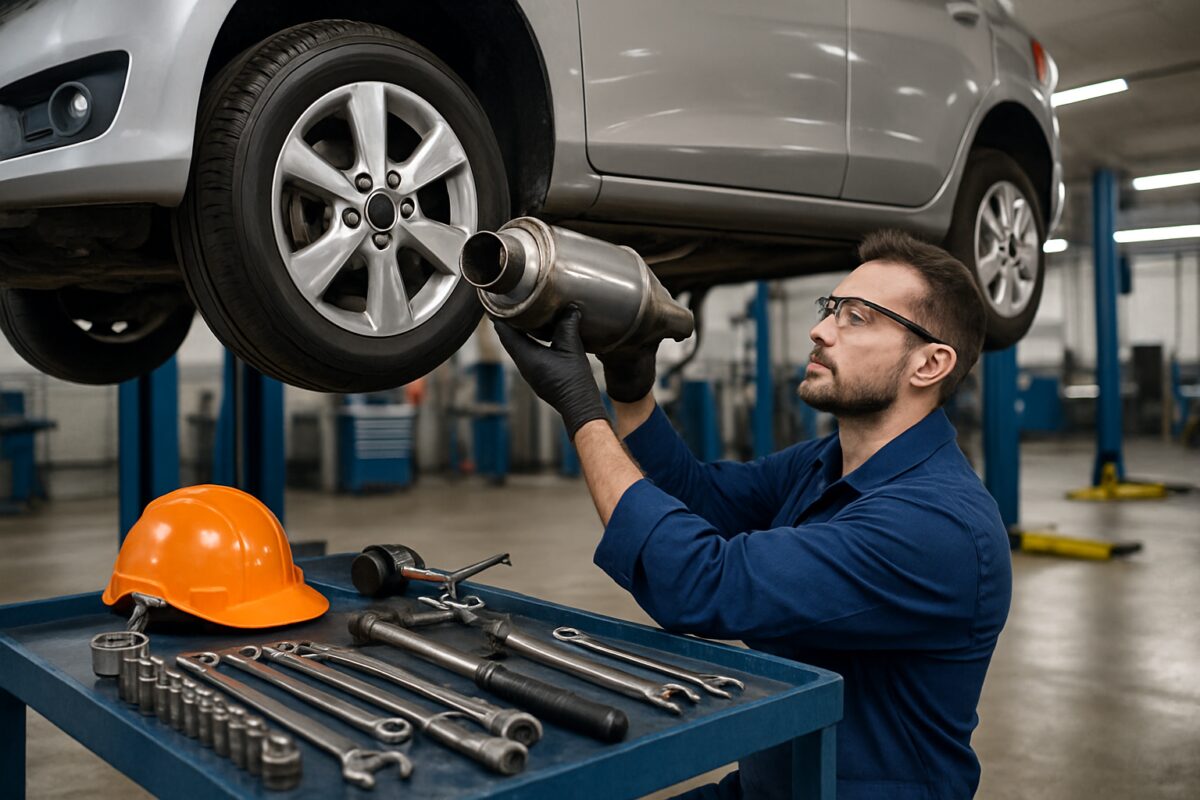
To replace a catalytic converter, you’ll need a vehicle-specific catalytic converter, basic hand tools, and safety equipment. The process involves lifting the vehicle, removing the old converter, installing the new one with proper gaskets, and checking for exhaust leaks. Most drivers should expect replacement every 80,000 to 120,000 miles depending on driving conditions.
Tools & parts required
Before starting this job, you’ll need specific parts and tools to ensure proper installation and safety.
Parts needed:
- Catalytic converter (vehicle specific)
- Replacement gaskets
- Exhaust clamps
- High-temperature sealant
Tools required:
- Socket set (various sizes)
- Spanner set
- Jack and axle stands
- Cutting tool (if welded)
- Wire brush
- Safety gloves
- Eye protection
Always ensure the catalytic converter matches your engine type and emission standards. Check your vehicle’s registration document for the correct Euro emission standard before purchasing.
Safety precautions
Working underneath a vehicle requires proper safety measures. Never work under a car supported only by a jack.
- Use proper axle stands on level ground
- Allow exhaust system to cool completely
- Work in a well-ventilated area
- Wear safety gloves and eye protection
- Keep a battery disconnect tool nearby
Step-by-step instructions
Follow these detailed steps to replace your catalytic converter safely and effectively.
Step 1: Prepare the vehicle
Park on level ground and allow the exhaust system to cool for at least two hours. Jack up the vehicle and secure it with axle stands. Never rely solely on a jack for support.
Step 2: Locate the catalytic converter
The converter sits between the exhaust manifold and rear silencer. On most vehicles, it’s positioned under the passenger compartment. Some cars have multiple converters – check your service manual for exact locations.
Step 3: Remove oxygen sensors
Carefully disconnect the O2 sensor wiring harnesses. Use a proper oxygen sensor socket to remove the sensors from the old converter. These sensors typically thread into the converter housing.
Step 4: Disconnect the old converter
Remove the bolts connecting the converter to the exhaust manifold and rear exhaust pipe. If the converter is welded in place, you’ll need to cut it out with an angle grinder or pipe cutter.
Step 5: Install the new converter
Position the new converter with fresh gaskets at both ends. Thread the oxygen sensors back into their ports with anti-seize compound. Tighten all connections to manufacturer specifications using a torque wrench.
Step 6: Test the installation
Lower the vehicle and start the engine. Listen for exhaust leaks and check that the engine runs smoothly. The diagnostic system may need time to adapt to the new converter.
Common mistakes to avoid
Several errors can cause premature converter failure or installation problems.
- Installing the converter backwards (check flow direction arrows)
- Reusing old gaskets or clamps
- Over-tightening connections (can crack housing)
- Failing to use anti-seize on oxygen sensor threads
- Not checking for upstream engine problems
Our mechanics at AutopartsPro always recommend addressing the root cause of converter failure before installation. Simply replacing a failed converter without fixing engine misfires or oil consumption will lead to repeated failures.
When should you replace it?
Several symptoms indicate catalytic converter replacement is necessary:
- Failed MOT emissions test
- Rattling noise from underneath the car
- Reduced acceleration and power
- Black smoke from exhaust
- Strong sulphur smell
- Check engine light illuminated
Most converters last between 80,000 and 120,000 miles. However, engine problems like misfiring spark plugs or faulty injectors can cause premature failure.
Related maintenance you can do at the same time
While the exhaust system is accessible, consider these additional maintenance tasks:
- Replace the air filter for optimal engine breathing
- Check and replace oxygen sensors if showing high mileage
- Inspect exhaust manifold gaskets for leaks
- Clean or replace the mass airflow sensor
- Check engine oil condition and change if dirty
This approach maximises your time investment and helps prevent future converter problems.
Frequently asked questions
How long does catalytic converter replacement take?
Professional installation typically takes 1-2 hours for bolt-on converters, or 3-4 hours if welding is required for universal-fit units.
Can I drive with a faulty catalytic converter?
You can drive short distances, but the vehicle will fail MOT testing and may cause engine damage through increased back-pressure.
How much does catalytic converter replacement cost?
Replacement costs range from £200-£800 for the part, plus £150-£300 labour, depending on vehicle type and converter specification.
Will my car run better after replacement?
Yes, a functioning converter reduces exhaust back-pressure, typically improving acceleration, fuel economy, and overall engine performance significantly.
How can I prevent premature converter failure?
Regular servicing, prompt repair of engine misfires, using quality fuel, and avoiding short journeys help maximise converter lifespan effectively.
Professional installation ensures proper fitment and optimal performance from your new catalytic converter. Using vehicle-specific parts and following correct torque specifications prevents common installation issues that lead to premature failure or exhaust leaks.

 Loading...