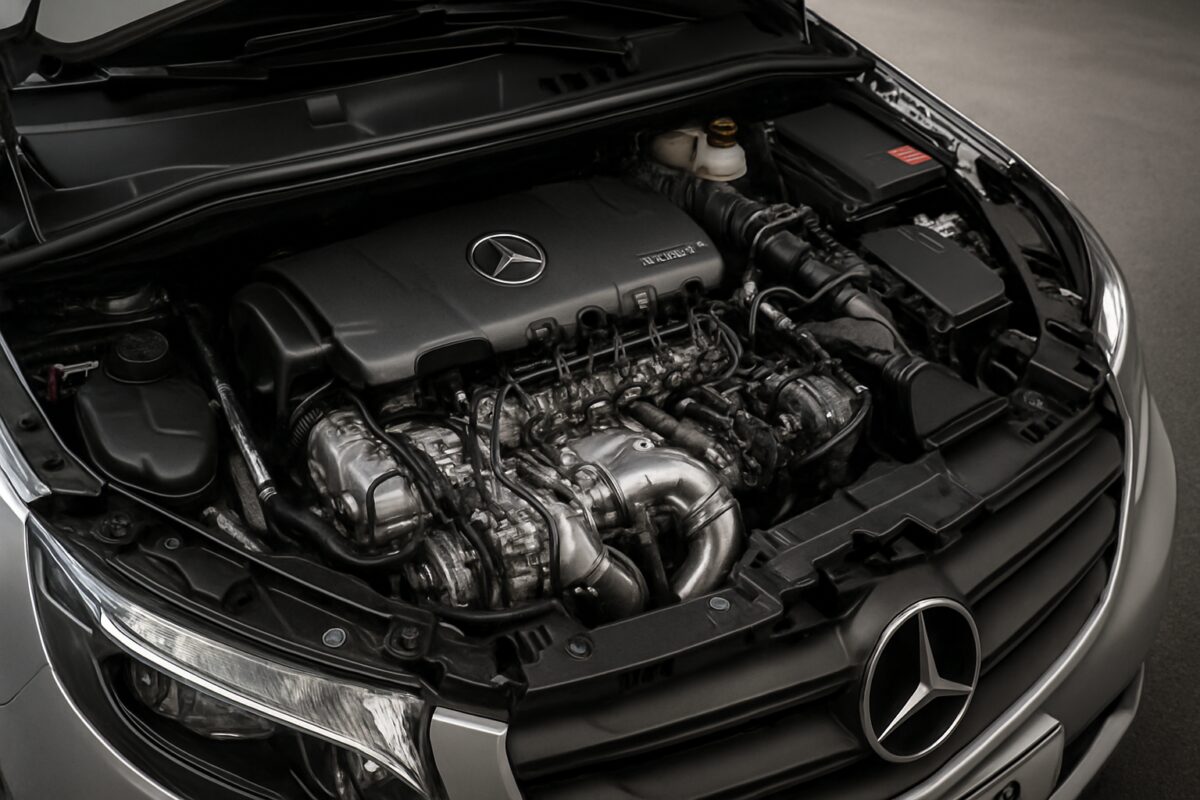
The Mercedes-Benz Vito has established itself as a premium commercial vehicle in the UK market, competing against rivals like the Ford Transit Custom and Volkswagen Crafter. The engine lineup forms the heart of this versatile van, determining everything from payload capacity to running costs. Mercedes offers a comprehensive range of diesel powertrains, with outputs spanning from 114 to 190 horsepower and torque figures reaching up to 440 Nm, ensuring there’s a suitable option for every business application.
Comparison table of all engines
| Engine | Power output | Torque | Fuel consumption | Reliability |
|---|---|---|---|---|
| OM622 1.6 CDI | 88-114 hp | 230-270 Nm | 42-45 mpg | Good |
| OM651 2.1 CDI | 136-163 hp | 330-380 Nm | 38-42 mpg | Excellent |
| OM654 2.0 CDI | 136-190 hp | 330-440 Nm | 40-44 mpg | Excellent |
Engine 1 overview
The OM622 1.6 CDI represents Mercedes-Benz’s entry-level diesel offering for the Vito range. This four-cylinder turbocharged common-rail diesel unit displaces 1,598cc and features a single turbocharger with intercooler. The engine utilises direct injection technology with piezoelectric injectors operating at pressures up to 2,000 bar, ensuring efficient combustion and reduced emissions to meet Euro 6 standards.
Pros
- Outstanding fuel economy figures reaching 45 mpg
- Lower purchase price and insurance costs
- Adequate power for light commercial duties
- Compact dimensions allow better payload capacity
- Simple maintenance requirements
Cons
- Limited torque output restricts towing capability
- Struggles with heavy loads on motorway inclines
- Higher engine noise levels compared to larger units
- Less refined driving experience
- Reduced resale value potential
Engine 2 overview
The OM651 2.1 CDI stands as the workhorse of the Vito lineup. This four-cylinder turbocharged diesel displaces 2,143cc and incorporates advanced BlueTEC technology with selective catalytic reduction (SCR) and AdBlue injection. The engine features a variable geometry turbocharger and sophisticated fuel filter system to maintain optimal performance throughout its service life.
Pros
- Balanced performance and economy combination
- Proven reliability across Mercedes commercial range
- Strong mid-range torque delivery
- Acceptable refinement levels for commercial use
- Good parts availability and service network
Cons
- AdBlue consumption adds to running costs
- Complexity of emissions system increases service requirements
- Higher purchase premium over smaller engines
- DPF regeneration cycles can affect urban efficiency
- Timing chain tensioner issues on high-mileage examples
Engine 3 overview
The OM654 2.0 CDI represents Mercedes-Benz’s latest generation diesel technology. This four-cylinder turbocharged unit displaces 1,950cc and features modular construction with aluminium crankcase and advanced thermal management. The engine incorporates twin-dosing SCR technology, variable geometry turbocharging, and sophisticated electronic control systems to optimise performance while meeting stringent Euro 6d-TEMP emissions standards.
Pros
- Class-leading refinement and quietness
- Strong performance across entire rev range
- Advanced emissions technology ensures compliance
- Modular design reduces service complexity
- Future-proof technology with upgrade potential
Cons
- Highest purchase price in the range
- Complex electronics require specialist diagnostic equipment
- Premium fuel and engine oil requirements
- Limited independent service options initially
- Sophisticated systems may reduce long-term durability
Maintenance cost
| Engine | Recommended Interval | Estimated Cost | Cost per 10,000 miles |
|---|---|---|---|
| OM622 1.6 CDI | 15,500 miles | £280-350 | £180 |
| OM651 2.1 CDI | 15,500 miles | £320-420 | £220 |
| OM654 2.0 CDI | 15,500 miles | £380-480 | £260 |
Our AutoPartsPro specialists note that Mercedes-Benz has extended service intervals significantly, reducing maintenance frequency but increasing individual service costs. The particulate filter cleaning and AdBlue top-ups represent additional expenses that operators must factor into their budgets.
Tip: Regular short journeys prevent proper DPF regeneration cycles. Schedule weekly motorway runs of at least 20 minutes to maintain optimal exhaust system performance.
Engine sound and character
The acoustic signature varies considerably across the Vito engine range. The 1.6 CDI produces a typical small-displacement diesel note with pronounced combustion noise at idle and under load. The 2.1 CDI offers improved refinement with less intrusive noise levels, though it remains audibly commercial in character. Mercedes’ engineering team has worked extensively on noise, vibration, and harshness reduction with the 2.0 CDI, achieving passenger car-like refinement levels.
The driving characteristics differ markedly between units. The smaller 1.6 requires frequent gear changes to maintain momentum, whilst the 2.1 provides adequate mid-range flexibility for most commercial applications. The flagship 2.0 CDI delivers effortless performance with strong low-end torque and smooth power delivery throughout the rev range. All engines benefit from Mercedes’ refined transmission calibration and chassis tuning.
Who each engine is best for
| Engine | Best For | Typical Applications |
|---|---|---|
| OM622 1.6 CDI | Budget-conscious owners, light delivery duties | Urban deliveries, courier services, low-mileage operations |
| OM651 2.1 CDI | Mixed-use operators, medium payload requirements | Regional distribution, tradespeople, moderate towing |
| OM654 2.0 CDI | Premium operators, heavy-duty applications | Long-distance haulage, passenger transport, frequent towing |
AutoPartsPro’s technical experts recommend the 2.1 CDI for most UK operators, offering the optimal balance of performance, economy, and reliability. Fleet managers should consider their typical loading patterns and duty cycles when selecting appropriate powertrains, as proper engine cooling becomes crucial under sustained high-load conditions.
Tip: Consider future business expansion when selecting engine specifications. Upgrading to higher-output variants later proves more expensive than specifying adequate power initially.
Frequently asked questions
Which Mercedes Vito engine offers the best fuel economy?
The 1.6 CDI delivers superior fuel consumption figures, achieving up to 45 mpg in optimal conditions with careful driving techniques.
How reliable are Mercedes Vito diesel engines long-term?
Mercedes diesel engines demonstrate excellent longevity, with proper maintenance enabling 300,000+ mile service life in commercial applications.
What’s the towing capacity difference between Vito engines?
Towing capacity ranges from 2,000kg with the 1.6 CDI up to 2,800kg with higher-output 2.0 CDI variants.
Do Mercedes Vito engines require AdBlue fluid?
All Euro 6 Vito engines require regular AdBlue replenishment, typically every 6,000-10,000 miles depending on driving patterns and engine load.
Which Vito engine provides the best resale value?
The 2.1 CDI variants typically retain value best, offering proven reliability and widespread market acceptance amongst commercial buyers.

 Loading...