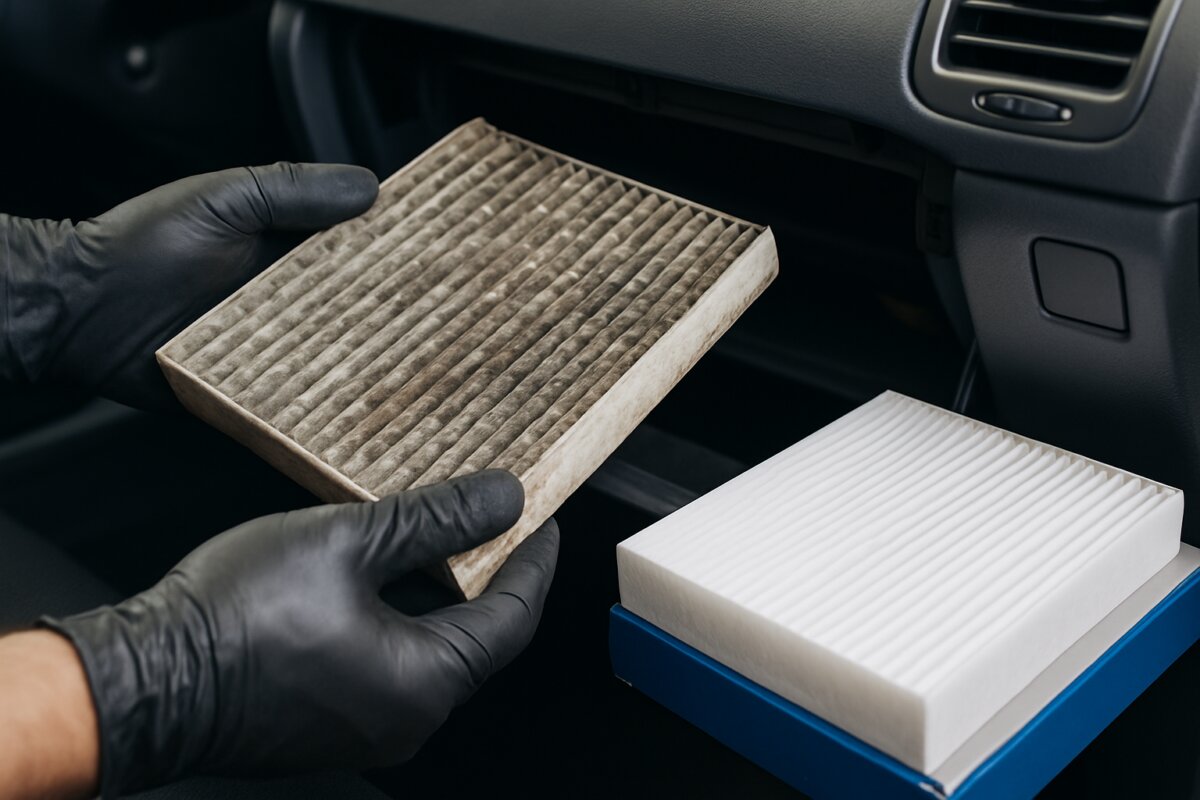
Cabin air filter replacement should occur every 12,000 to 15,000 miles or annually, whichever comes first. This essential component filters pollen, dust, and pollutants from entering your vehicle’s interior through the ventilation system. Most drivers can replace it themselves in 10-20 minutes with basic tools, and replacement filters typically cost between £10 and £30. Regular changes maintain healthy air quality, protect your HVAC system, and ensure optimal heating and cooling performance.
Why your cabin air filter matters more than you think
Many motorists overlook the cabin filter when maintaining their vehicles, yet this small component plays a massive role in your driving experience. The filter acts as a barrier between the outside environment and your car’s interior, trapping microscopic particles before they reach your lungs.
According to our specialists at Autopartspro, a clogged cabin filter can reduce HVAC efficiency by up to 40%. This means your heating struggles in winter and your air conditioning works harder in summer, potentially leading to premature blower motor failure.
Beyond comfort, there’s a health aspect. A saturated filter becomes a breeding ground for bacteria and mould, circulating unpleasant odours and allergens throughout your vehicle. If you notice musty smells when switching on the ventilation, your filter has likely reached the end of its service life.
How often should you replace your cabin air filter
The replacement interval depends on several factors, including your driving environment and manufacturer recommendations. Here’s what influences the lifespan of this crucial filtration component.
Standard replacement intervals
Most vehicle manufacturers recommend changing the pollen filter every 12 months or 12,000-15,000 miles. However, our mechanics at Autopartspro consistently advise that these are guidelines rather than absolute rules.
Urban drivers face heavier pollution exposure, which accelerates filter saturation. If you regularly navigate congested city streets, consider reducing the interval to 10,000 miles. Similarly, those driving on dusty rural roads should inspect their filters more frequently.
Environmental factors affecting replacement frequency
- Heavy traffic areas: Diesel particulates and exhaust fumes clog filters faster in urban environments
- Rural and agricultural zones: Pollen, seeds, and harvest dust significantly reduce filter lifespan
- Coastal regions: Salt air and sand particles create additional strain on filtration media
- Spring season: High pollen counts during blooming periods accelerate blockage
Warning signs that replacement is overdue
Your vehicle will communicate when the filter needs attention. Reduced airflow from the vents represents the most obvious indicator. If you need to crank the fan speed higher than normal to feel adequate air movement, the filter is likely restricting flow.
Strange odours when activating the climate control system signal bacterial growth on the filter media. Increased window fogging, especially during damp weather, suggests the filter can’t properly dehumidify incoming air. Some modern vehicles feature dashboard warning lights specifically for cabin filter maintenance.
Step-by-step cabin filter replacement guide
Changing your pollen filter ranks among the easiest maintenance tasks. Most drivers can complete the job without professional assistance, saving both time and money on labour costs.
Tools and materials needed
The beauty of this maintenance procedure lies in its simplicity. You’ll rarely need more than basic household items to complete the replacement.
- New cabin filter (match your vehicle’s make, model, and year)
- Screwdriver (Phillips or flathead, depending on your vehicle)
- Vacuum cleaner with hose attachment
- Torch or mobile phone light
- Damp cloth for cleaning the housing
Locating your cabin filter
Filter location varies by manufacturer, but three common positions exist. Check your owner’s manual for specific guidance, though most filters hide in accessible locations.
Behind the glovebox represents the most common placement. You’ll typically need to remove the glovebox by releasing side pins or clips. Some gloveboxes simply flex backwards when you squeeze the sides together.
Under the dashboard on the passenger side offers another frequent location. This position usually requires removing a plastic cover panel held by clips or screws. Under the bonnet near the base of the windscreen represents the third typical spot, though this proves less common in modern vehicles.
Removal and installation process
- Switch off your engine and remove the key from the ignition for safety
- Access the filter housing by removing the glovebox, panel, or bonnet cover as required
- Note the airflow direction arrow on the old filter before removal – this proves crucial for proper installation
- Release any clips or tabs securing the filter housing cover
- Slide out the old filter, taking care not to scatter accumulated debris into the ventilation system
- Vacuum the filter housing cavity to remove dust and debris
- Wipe down the housing with a damp cloth to capture remaining particles
- Insert the new filter, ensuring the airflow arrow points in the correct direction (typically towards the vehicle interior)
- Secure the housing cover and clips
- Reinstall any panels or the glovebox
Our lead technician recommends photographing the old filter’s orientation before removal. This simple step prevents incorrect installation, which could allow unfiltered air into your cabin or restrict airflow entirely.
Cost breakdown for cabin filter replacement
Understanding the financial aspects helps you budget for this regular maintenance item. Prices vary based on filter quality, vehicle type, and whether you choose professional installation.
DIY replacement costs
| Filter Type | Price Range | Features |
|---|---|---|
| Standard particulate filter | £8-£15 | Basic dust and pollen filtration |
| Activated carbon filter | £15-£30 | Odour elimination, superior pollutant removal |
| HEPA filter | £25-£45 | Medical-grade filtration, removes 99.97% of particles |
| Antibacterial filter | £20-£35 | Treats filter media to prevent microbial growth |
When purchasing online from retailers like Autopartspro, you’ll find competitive pricing across all filter grades. Our mechanics strongly recommend activated carbon variants for most drivers, as the modest price premium delivers significant benefits in air quality and odour control.
Professional replacement costs
| Service Provider | Labour Cost | Total Cost (including filter) |
|---|---|---|
| Independent garage | £15-£30 | £25-£60 |
| Franchise dealer | £40-£70 | £60-£100 |
| Fast-fit centre | £20-£35 | £35-£65 |
| Mobile mechanic | £25-£40 | £40-£75 |
Labour charges seem excessive considering the straightforward nature of this task. A competent DIY enthusiast can complete the job in roughly 15 minutes once familiar with the process, making self-service the economical choice.
Choosing the right replacement filter
Not all cabin filters perform equally. Understanding the different types helps you select the optimal option for your needs and driving conditions.
Standard particulate filters represent the basic option. These trap dust, pollen, and larger particles effectively but offer limited protection against odours and chemical pollutants. They suit rural drivers in low-pollution areas adequately.
Activated carbon filters incorporate a charcoal layer that absorbs gases and neutralises odours. Our Autopartspro specialists consider these the sweet spot for most UK drivers, balancing performance and affordability. They effectively combat diesel fumes, industrial emissions, and agricultural odours.
HEPA filters provide hospital-grade filtration, capturing particles as small as 0.3 microns. These benefit allergy sufferers and those with respiratory conditions significantly. The increased density does create marginally more resistance to airflow, though modern HVAC systems compensate easily.
Electrostatic filters use charged fibres to attract particles. Whilst effective, they typically cost more and aren’t universally available for all vehicle models. Antibacterial variants feature treated media that inhibits mould and bacteria growth, extending the period between musty smell development.
Common mistakes to avoid during replacement
Even this simple maintenance task has pitfalls that can compromise performance or damage components. Our experienced technicians have witnessed these errors repeatedly.
Installation errors
Installing the filter backwards represents the most frequent mistake. The airflow direction arrow must point towards the cabin interior, not towards the outside air intake. Reversed installation allows debris to bypass the filter entirely or creates excessive resistance that strains the blower motor resistor.
Forcing a filter into the housing damages both the filter and the plastic housing. If the filter doesn’t slide in smoothly, you’ve either purchased the wrong size or haven’t aligned it properly with the guide rails. Never trim a filter to make it fit – this creates gaps that allow unfiltered air through.
Neglecting housing maintenance
Simply swapping filters without cleaning the housing wastes the opportunity for thorough maintenance. Leaves, debris, and dust accumulate in the cavity, potentially restricting airflow even with a new filter. A quick vacuum and wipe-down takes minimal extra time but maximises the benefit of replacement.
Some drivers attempt to clean and reuse old filters. Whilst this seems economical, it proves counterproductive. Washing damages the filter media structure, and dried filters never regain their original filtration efficiency. The modest cost of replacement filters makes reuse a false economy.
Impact on vehicle systems and fuel economy
A neglected cabin filter affects more than just air quality. The ripple effects touch multiple vehicle systems and even your wallet.
When the filter clogs, the blower motor works harder to push air through the restriction. This increased electrical load marginally impacts fuel economy, though the effect remains small – typically less than 1% in most vehicles. More concerning is the accelerated wear on the blower motor itself.
Our Autopartspro mechanics regularly see failed blower motors in vehicles with severely clogged cabin filters. The motor’s lifespan decreases substantially when forced to operate under continuous high load. Replacing a blower motor costs £80-£200 plus labour, dwarfing the expense of regular filter changes.
Climate control performance suffers noticeably. Restricted airflow means longer times to demist windows, reduced heating efficiency in winter, and inadequate cooling in summer. The air conditioning pipe system must work harder to achieve the same cabin temperature, potentially leading to premature compressor wear.
Seasonal considerations for UK drivers
British weather patterns create specific challenges for cabin filtration systems. Adapting your maintenance schedule to seasonal demands optimises performance year-round.
Spring brings the highest pollen counts, particularly affecting hay fever sufferers. Consider replacing your filter at winter’s end if you’re sensitive to allergens. A fresh activated carbon filter before pollen season provides maximum protection during the most challenging months.
Autumn presents different challenges. Falling leaves and seed pods can overwhelm filters quickly, especially if you park under trees. Inspect your filter after autumn if you notice reduced airflow or musty smells. The damp British autumn also encourages mould growth on saturated filters.
Winter demands efficient demisting capability for safety. A clogged filter hampers your vehicle’s ability to clear condensation from windows, creating dangerous visibility issues. If your windscreen fogs persistently despite running the climate control at full blast, check the cabin filter before winter weather arrives.
Expert insights from Autopartspro mechanics
Our service technicians have accumulated decades of combined experience with cabin filtration systems across all vehicle makes. Their professional observations reveal patterns that many motorists overlook.
“We’ve noticed that drivers who regularly use recirculation mode actually extend their cabin filter life,” explains our lead diagnostic specialist. “By recycling interior air rather than constantly filtering outside air, the filter encounters fewer pollutants. However, don’t use recirculation exclusively – fresh air exchange remains important for preventing CO2 buildup.”
The team also emphasises checking the filter housing seal. “A degraded housing gasket allows unfiltered air to bypass the filter entirely,” notes our senior technician. “We’ve seen cases where customers replaced filters regularly but still experienced poor air quality due to a £2 seal that had perished.”
Premium filters justify their cost for certain drivers. “If you commute through heavy traffic daily or suffer from allergies, the upgrade to activated carbon or HEPA filtration delivers tangible benefits,” our parts specialist advises. “However, for low-mileage rural drivers, standard filters changed regularly perform adequately.”
Advanced filtration technologies
The automotive filtration market continues evolving, introducing innovative technologies that enhance air quality beyond traditional particulate capture.
Some manufacturers now offer filters with ionisation capabilities. These electrically charge particles, causing them to clump together for easier capture. Whilst more expensive, they provide superior fine particle removal without significantly increasing airflow restriction.
Photocatalytic filters represent cutting-edge technology. These use titanium dioxide activated by light to break down organic pollutants at a molecular level. They’re particularly effective against volatile organic compounds (VOCs) and nitrogen oxides commonly found in traffic pollution.
Multi-layer composite filters combine different media types in a single unit. A typical construction includes a pre-filter for large particles, an activated carbon layer for odours, a HEPA layer for fine particulates, and an antibacterial treatment on the cabin-facing surface. These comprehensive filters cost more but deliver premium air quality.
Maintaining your entire ventilation system
The cabin filter represents just one component of your vehicle’s climate control system. Comprehensive maintenance extends beyond filter replacement.
The ventilation ducting can harbour mould and bacteria even with regular filter changes. Professional duct cleaning services use antimicrobial fogging treatments to sanitise the entire system. Whilst not necessary annually, this service benefits vehicles that develop persistent musty odours despite new filters.
The evaporator core, hidden behind the dashboard, also accumulates moisture and can grow mould. Many drivers mistake evaporator odours for filter issues. If replacing the cabin filter doesn’t eliminate smells, the evaporator may require cleaning with specialised antibacterial sprays.
Don’t forget the exterior air intake grille. Located at the base of the windscreen, this area collects leaves and debris that can partially block airflow before air even reaches the filter. Regular clearing of this area, especially in autumn, prevents unnecessary strain on your ventilation system. Similar maintenance applies to other filtration components like your air filter which serves the engine.
Environmental benefits of regular replacement
Maintaining your cabin filter contributes to broader environmental responsibility beyond personal comfort and health.
A functioning filtration system allows you to use recirculation mode effectively, which reduces the energy required to heat or cool incoming air. This modest efficiency gain translates to fractionally lower fuel consumption and emissions over time.
Modern cabin filters also prevent particulates from re-entering the atmosphere. Whilst the primary purpose involves protecting occupants, the filter simultaneously prevents dust stirred up by your vehicle from dispersing into surrounding air when ventilation fans operate.
Proper disposal matters too. Many local councils accept cabin filters in general waste, but check your area’s specific guidelines. Some recycling programmes accept the plastic frames separately from the filter media. Never burn old filters, as the synthetic media releases harmful fumes.
Vehicle-specific considerations
Whilst the general principles remain consistent, certain vehicles present unique challenges or advantages regarding cabin filter maintenance.
Performance and luxury vehicles often feature more sophisticated filtration systems. BMW, Mercedes-Benz, and Audi commonly specify activated carbon filters as standard equipment. These vehicles may also include air quality sensors that automatically switch to recirculation mode when external pollution levels spike.
Electric and hybrid vehicles deserve special attention to cabin filtration. Without engine noise masking ventilation sounds, a restricted filter becomes more noticeable through increased fan noise. Additionally, the energy required to operate the blower motor directly impacts electric range, making efficiency important.
Commercial vehicles and vans used for trade purposes require more frequent filter replacement. Construction dust, workshop fumes, and constant operation in urban traffic accelerate filter saturation significantly. Professional drivers should inspect filters every 6,000 miles rather than following standard intervals.
Classic and older vehicles may lack cabin filters entirely. Aftermarket filter kits are available for many popular models, representing a worthwhile upgrade for regular drivers of vintage vehicles. The improvement in air quality and HVAC performance justifies the modest installation effort.
Troubleshooting persistent issues
Sometimes replacing the filter doesn’t resolve ventilation problems. Understanding alternative causes helps you diagnose issues accurately.
Problems unrelated to the cabin filter
- Blocked ventilation ducts: Foreign objects or collapsed ducting restrict airflow downstream from the filter
- Failed blower motor: Worn motor bearings or electrical faults prevent proper fan operation regardless of filter condition
- Stuck blend doors: Malfunctioning climate control actuators prevent airflow direction changes even with adequate fan speed
- Refrigerant leaks: Air conditioning performance issues often stem from refrigerant loss rather than filtration problems
- Damaged ducting: Cracked or separated ducts leak conditioned air before reaching cabin vents
If you’ve replaced the filter but still experience poor performance, these systems warrant investigation. Professional diagnostic equipment can identify issues that aren’t immediately obvious during visual inspection.
Making filter replacement part of routine maintenance
Integrating cabin filter changes into your regular service schedule ensures you never forget this important task. Smart scheduling saves time and optimises vehicle performance.
Many drivers coordinate filter replacement with oil changes. Since both occur annually for typical mileage patterns, this pairing creates a convenient reminder. When you service your engine oil, simply add the cabin filter to your parts order.
Seasonal replacement works well for high-mileage drivers or those in demanding environments. Changing filters at spring and autumn transitions addresses both pollen season and leaf-fall challenges whilst never allowing filters to exceed six months of service.
Dashboard reminder stickers provide a simple solution. Note the mileage or date of replacement on a small sticker placed where you’ll see it regularly. When approaching the next service interval, you’ll have an unmistakable prompt to order a replacement filter.
Digital calendar reminders suit the modern approach. Set an annual recurring notification on your smartphone with links to your preferred parts supplier. This method ensures you’ll never forget, even if you’ve recently changed vehicles.
Maintaining fresh cabin filtration shouldn’t feel like a chore but rather a straightforward task that significantly enhances your driving experience. The minimal investment of time and money yields disproportionate returns in comfort, health, and system longevity. Whether you tackle the job yourself or delegate to a professional, consistent attention to this often-overlooked component protects both you and your vehicle’s ventilation system from unnecessary strain and expense. Stock up on quality filters from trusted suppliers, mark your calendar for regular intervals, and breathe easier knowing you’re maximising your vehicle’s air quality with every journey.
Frequently Asked Questions (FAQ)
Can I drive without a cabin air filter?
Technically yes, but it’s inadvisable. Without filtration, dust and debris enter the HVAC system, potentially damaging the blower motor and evaporator whilst exposing you to pollutants and allergens constantly.
How do I know if my car has a cabin filter?
Most vehicles manufactured after 2000 include cabin filters as standard equipment. Check your owner’s manual or look behind the glovebox and under the dashboard for the filter housing location.
Will a clogged cabin filter affect my MOT?
No, cabin filters aren’t part of the MOT inspection criteria. However, severely restricted airflow affecting windscreen demisting capability could potentially raise safety concerns during assessment.
Can I wash and reuse my cabin filter?
Washing damages the filter media structure and reduces filtration efficiency significantly. Given the modest replacement cost, purchasing new filters proves more effective and economical than attempting to clean used ones.
Why does my car smell musty even with a new filter?
The odour likely originates from the evaporator core or ventilation ducting rather than the filter itself. Professional antibacterial treatment of the entire HVAC system addresses persistent smells effectively.

 Loading...