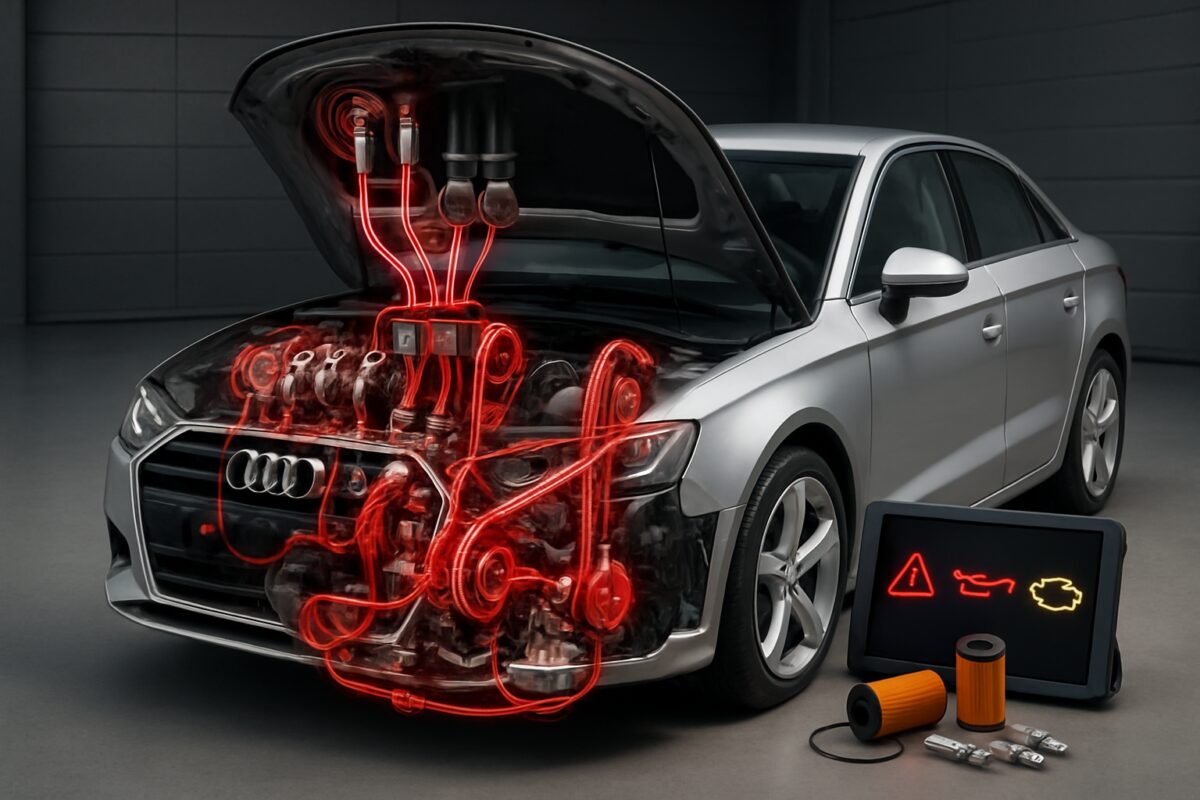
The Audi A3 remains one of Britain’s most popular compact premium cars, but like any vehicle, it has its share of common issues that owners should be aware of. Understanding these problems and their solutions can help you maintain your A3 properly and avoid costly surprises down the road.
Carbon build-up in direct injection engines
Direct injection engines in the Audi A3, particularly the 1.4 TFSI and 2.0 TFSI variants, are prone to carbon deposits forming on the intake valves. This happens because fuel doesn’t wash over the valves as it does in port injection systems.
The carbon accumulation restricts airflow and reduces engine performance. Symptoms include rough idling, reduced power output, poor fuel economy, and engine misfiring. The problem typically becomes noticeable after 40,000-60,000 miles.
This issue affects the engine’s breathing ability and can lead to expensive repairs if left untreated. Our mechanics at AutoPartsPro frequently see A3 owners dealing with this problem, especially in urban driving conditions where short journeys don’t allow the engine to reach optimal operating temperature.
Regular motorway driving helps burn off carbon deposits naturally. Try to take your A3 on longer journeys at least once a week to maintain engine health.
DSG gearbox problems
The dual-clutch automatic transmission (DSG) in many A3 models can develop several issues over time. The most common problems include jerky gear changes, hesitation during acceleration, and complete transmission failure in severe cases.
DSG transmissions require regular oil changes every 40,000 miles, despite Audi initially claiming they were ‘filled for life’. The clutch packs can wear prematurely, leading to slipping and poor gear engagement. Mechatronic unit failures are also relatively common, causing erratic behaviour and fault codes.
These gearbox problems often manifest as rough shifts between gears, particularly when moving off from standstill or during low-speed manoeuvres. Some owners report a shuddering sensation during gear changes or complete loss of drive in extreme cases.
The cost of DSG repairs can be substantial, with clutch pack replacement often exceeding £2,000. Regular maintenance using the correct specification oil is crucial for preventing premature wear.
Timing chain issues on TFSI engines
Several TFSI engines in the A3 range suffer from premature timing chain stretch, particularly the 1.4 TFSI and 2.0 TFSI units. This problem typically occurs between 80,000-120,000 miles but can happen earlier in poorly maintained vehicles.
When the timing chain stretches, it affects the precise timing between the crankshaft and camshaft. This leads to poor engine performance, rattling noises on startup, and potential engine damage if the chain jumps or breaks.
Early warning signs include a metallic rattling noise from the engine bay, especially during cold starts. The engine may also exhibit poor performance, rough idling, and increased fuel consumption. In severe cases, the timing chain can jump teeth or break completely, causing catastrophic engine damage.
Never ignore timing chain rattling noises – early intervention can prevent expensive engine rebuilds that cost thousands of pounds.
Oil consumption problems
Many A3 owners experience excessive oil consumption, particularly with TFSI engines. Audi considers consumption of up to 1 litre per 1,000 miles as ‘normal’, but many owners find this unacceptable for a premium vehicle.
The high oil consumption is often caused by worn piston rings, valve stem seals, or turbocharger seals in turbocharged variants. Some engines also suffer from faulty PCV (positive crankcase ventilation) systems that allow oil to be drawn into the intake system.
This problem can lead to expensive engine damage if oil levels drop too low. Regular monitoring of engine oil levels is essential, and owners should carry spare oil for top-ups between services.
Warning signs your car has a problem
Recognising early warning signs can prevent minor issues from becoming major expensive repairs. Here are the key symptoms to watch for:
- Engine rattling noises during cold starts (timing chain issues)
- Jerky or hesitant gear changes (DSG problems)
- Reduced engine power and poor fuel economy (carbon build-up)
- Blue smoke from exhaust (oil consumption issues)
- Check engine lights or transmission warning messages
- Unusual engine noises or vibrations
- Difficulty starting or rough idling
- Burning oil smell in the cabin
- Transmission fluid leaks under the vehicle
- Inconsistent engine performance
- Dashboard warning lights staying illuminated
- Excessive exhaust smoke (white, blue, or black)
- Strange smells from the engine bay
- Unusual handling characteristics
- Brake system warning indicators
How to fix the problems
| Problem | DIY Solution | Professional Repair | Typical Cost |
|---|---|---|---|
| Carbon Build-up | Use quality fuel additives, regular motorway driving | Walnut shell blasting, intake cleaning | £300-600 |
| DSG Issues | Regular oil changes, gentle driving | Oil change, clutch pack replacement, mechatronic unit | £400-2500 |
| Timing Chain | Regular oil changes with correct grade | Chain and tensioner replacement | £800-1500 |
| Oil Consumption | Check levels weekly, use correct oil grade | Engine rebuild, seal replacement | £500-4000 |
| Maintenance Item | Interval | Importance | Cost Range |
|---|---|---|---|
| Engine Oil Service | Every 10,000 miles | Critical | £120-200 |
| DSG Oil Change | Every 40,000 miles | Essential | £300-450 |
| Timing Chain Inspection | Every 60,000 miles | Important | £100-150 |
| Carbon Cleaning | Every 30,000 miles | Preventive | £300-500 |
When to see a mechanic
While some maintenance tasks can be performed by competent DIY enthusiasts, many A3 problems require professional diagnosis and repair. Visit a qualified technician immediately if you experience any warning lights on the dashboard, unusual noises from the engine or transmission, or significant changes in performance.
For routine maintenance, stick to manufacturer service intervals but consider more frequent oil filter changes if you drive primarily in urban conditions. DSG gearbox services should only be carried out by trained technicians using the correct equipment and fluids.
Don’t delay repairs for safety-critical systems like brakes or steering. Issues with brake pads or steering components can compromise vehicle safety and should be addressed immediately.
For complex diagnostic work, choose a specialist with Audi-specific equipment. Modern A3 models have sophisticated computer systems that require proper diagnostic tools to identify problems accurately. Check out our guide on when to visit a garage for more detailed advice.
Frequently asked questions (FAQ)
What is the most common problem with Audi A3?
Carbon build-up in direct injection engines is the most frequently reported issue, affecting performance and fuel economy in TFSI variants.
How much does it cost to fix DSG gearbox problems?
DSG repairs range from £400 for oil changes to £2,500 for complete clutch pack replacement, depending on the issue.
Should I buy an Audi A3 with high mileage?
High-mileage A3s can be reliable if properly maintained, but check for timing chain and DSG service history before purchasing.
How often should I change DSG transmission oil?
DSG oil should be changed every 40,000 miles despite Audi’s original ‘lifetime fill’ claims for optimal transmission longevity.
Can I prevent carbon build-up in my A3?
Regular motorway driving, quality fuel, and periodic intake cleaning help reduce carbon accumulation in direct injection engines.
Final recommendation
The Audi A3 remains an excellent choice for those seeking premium compact car ownership, but prospective buyers should be aware of these common issues. Based on our experience at AutoPartsPro, most problems are preventable with proper maintenance and early intervention.
Budget for regular servicing beyond the manufacturer’s schedule, particularly DSG oil changes and carbon cleaning for TFSI engines. Quality parts and proper maintenance will keep your A3 running reliably for many years. Consider extended warranties for high-mileage purchases, and always use genuine or OEM-quality parts for repairs.
For more maintenance guidance, explore our comprehensive articles on car maintenance, DIY oil changes, and spark plug replacement. Remember that investing in preventive maintenance costs far less than major repairs and keeps your A3 performing at its best.

 Loading...