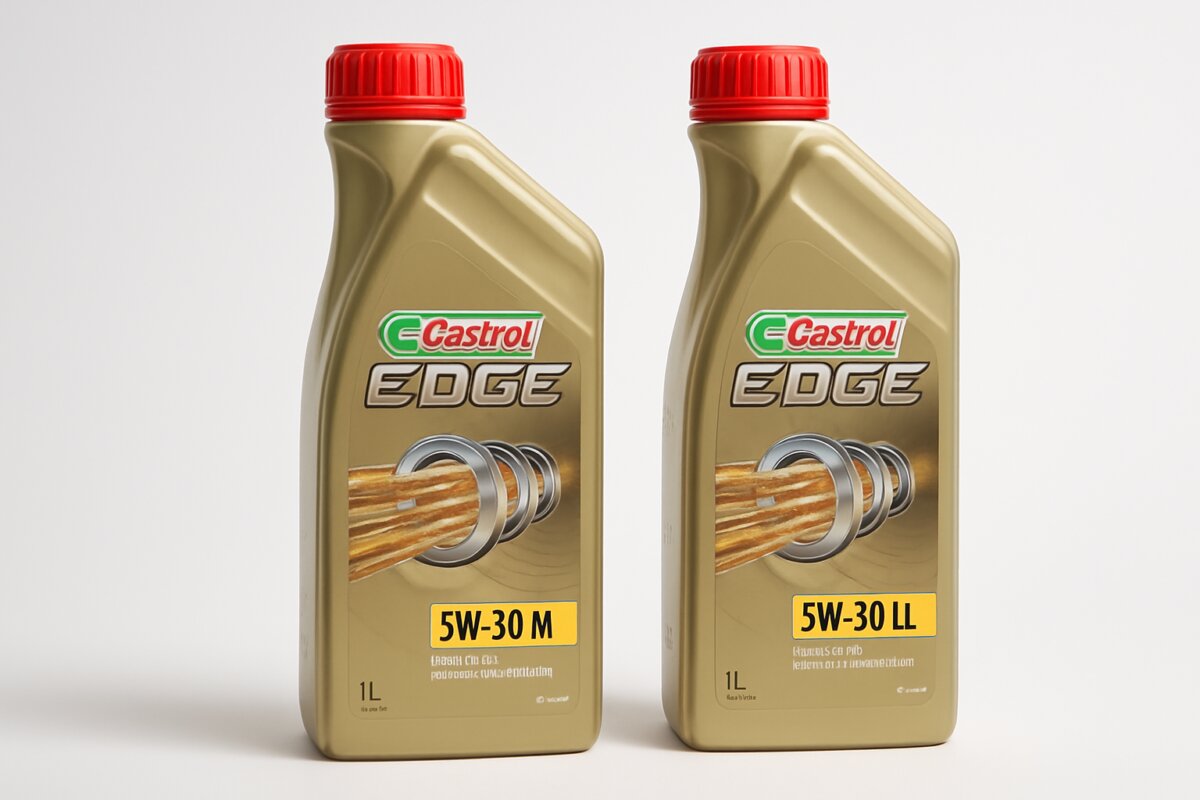
The primary difference between Castrol Edge 5W-30 M and Castrol Edge 5W-30 LL lies in their specification requirements and vehicle compatibility. Castrol Edge 5W-30 M meets ACEA A3/B4 and various manufacturer approvals including BMW Longlife-01, whilst Castrol Edge 5W-30 LL specifically targets extended drain intervals with ACEA C3 specification and VW 504 00/507 00 approvals. The ‘M’ variant suits petrol and diesel engines requiring traditional performance standards, whereas the ‘LL’ (Longlife) formulation serves modern vehicles demanding low-SAPS technology to protect sensitive exhaust after-treatment systems like particulate filters and catalytic converters. Your choice depends entirely on your manufacturer’s specified requirements, not personal preference.
Quick comparison table
Understanding the fundamental differences between these two premium lubricants helps you make an informed decision for your vehicle’s longevity and performance.
| Attribute | Castrol Edge 5W-30 M | Castrol Edge 5W-30 LL |
|---|---|---|
| Price range | £35-£45 per 5L | £40-£50 per 5L |
| Drain interval | Standard (10,000-15,000 miles) | Extended (up to 30,000 miles) |
| ACEA specification | A3/B4 | C3 |
| SAPS content | Mid-SAPS | Low-SAPS |
| DPF compatibility | Limited | Full compatibility |
| Best use case | Older BMW, Mercedes models | Modern VAG, Ford, Jaguar vehicles |
Product overview: Castrol Edge 5W-30 M
Castrol Edge 5W-30 M represents a traditional fully synthetic lubricant designed for performance-oriented applications. This formulation uses Fluid Titanium Technology, which physically changes under pressure to create an extraordinarily strong protective film between metal surfaces. The ‘M’ designation indicates compatibility with multiple manufacturer specifications, making it particularly suitable for BMW vehicles requiring Longlife-01 approval and certain Mercedes-Benz applications.
The base oil blend combines polyalphaolefins (PAO) with hydrocracked mineral oils, creating exceptional thermal stability across a wide temperature range. This synthetic structure maintains viscosity at 100°C better than conventional oils, ensuring consistent protection during spirited driving or sustained motorway speeds. The additive package includes zinc dialkyldithiophosphate (ZDDP) for anti-wear protection and detergent additives to keep engine oil passages clean.
Typical price: Expect to pay between £35-£45 for a 5-litre container, though prices fluctuate based on retailer promotions and seasonal demand.
Pros:
- Excellent high-temperature protection for performance engines
- Proven track record with BMW petrol and diesel powerplants
- Superior film strength reduces metal-to-metal contact
- Maintains performance across extended temperature ranges
- Compatible with older turbocharger designs
Cons:
- Higher sulphated ash content can damage modern particulate filters
- Not suitable for vehicles requiring VW 504 00/507 00 approval
- Shorter recommended drain intervals compared to LL variant
- May cause DPF blockage in Euro 5/6 emission vehicles
Ideal drivers: This lubricant suits owners of pre-2010 BMW models, particularly those with N52, N54, or M57 engines. It’s perfect for enthusiasts who perform regular servicing and prioritise ultimate engine protection over extended drain capability. Classic Mercedes-Benz diesel owners also benefit from its robust anti-wear characteristics.
Our workshop technicians at AutoPartsPro consistently observe cleaner valve trains and reduced sludge formation in engines serviced with Castrol Edge 5W-30 M, particularly in direct-injection petrol units experiencing low-speed urban driving conditions.
Product overview: Castrol Edge 5W-30 LL
Castrol Edge 5W-30 LL takes lubricant technology further by addressing modern emission control requirements. The ‘LL’ suffix stands for Longlife, indicating this oil meets stringent extended drain interval specifications from multiple manufacturers. Its low-SAPS (Sulphated Ash, Phosphorus, and Sulphur) formulation protects sensitive exhaust after-treatment components whilst maintaining exceptional engine cleanliness.
This variant achieves ACEA C3 specification, which demands compatibility with particulate filter systems whilst providing high-performance protection. The reduced ash content prevents filter blocking, extending the lifespan of expensive emission control hardware. Volkswagen Group, Ford, and Jaguar Land Rover specifically require this type of formulation for their latest powertrains.
The molecular structure incorporates advanced friction modifiers that reduce internal engine resistance by up to 15% compared to conventional oils. This translates directly into improved fuel economy—typically 1-2% in real-world driving conditions. The polymer package maintains viscosity stability across drain intervals exceeding 20,000 miles, assuming normal operating conditions.
Typical price: Budget £40-£50 for a 5-litre bottle, reflecting the advanced additive technology and extended service capability.
Pros:
- Protects DPF and catalytic converter systems from ash accumulation
- Approved for extended drain intervals up to 30,000 miles
- Measurable fuel economy improvements in highway driving
- Meets strict VW 504 00/507 00 and Ford WSS-M2C917-A specifications
- Excellent cold-start protection down to -35°C
Cons:
- Higher initial purchase cost per litre
- Not approved for older BMW Longlife-01 applications
- Reduced ZDDP content may not suit high-performance turbocharged engines
- Requires strict adherence to manufacturer service indicators
Ideal drivers: Perfect for owners of modern VAG group vehicles (Golf GTI, Audi A4, Seat Leon), Ford EcoBoost engines, and Jaguar Land Rover diesel applications. This lubricant particularly benefits company car drivers covering high annual mileages who want to maximise service intervals whilst protecting warranty coverage.
In our experience servicing fleet vehicles, Castrol Edge 5W-30 LL consistently maintains viscosity readings within specification even at 25,000-mile intervals, provided the engine management system confirms normal operating conditions throughout the service period.
Compatibility considerations for your vehicle
Selecting the wrong specification can void manufacturer warranties and potentially damage expensive emission control equipment. The oil filter works in conjunction with the lubricant, so always replace it during oil changes to maintain system cleanliness.
Castrol Edge 5W-30 M compatibility:
- BMW petrol and diesel engines requiring Longlife-01 (typically 1998-2010 model years)
- Mercedes-Benz vehicles specifying MB-Approval 229.3 or 229.5
- Older Volkswagen models pre-dating VW 504 00 requirements
- General European vehicles meeting ACEA A3/B4 standards
- Not suitable for vehicles equipped with diesel particulate filters requiring C-specification oils
Castrol Edge 5W-30 LL compatibility:
- Volkswagen, Audi, Seat, Skoda models requiring VW 504 00/507 00 (2006 onwards)
- Ford vehicles specifying WSS-M2C917-A (EcoBoost petrol and modern diesel)
- Jaguar Land Rover applications requiring STJLR.03.5003
- BMW vehicles with DPF requiring Longlife-04 specification (2004 onwards)
- Any manufacturer specifying ACEA C3 low-SAPS lubricant
Model year considerations: Emission regulations changed significantly between Euro 4 (2005) and Euro 5 (2009) standards. Vehicles manufactured after 2009 typically require low-SAPS formulations to protect after-treatment systems. Check your vehicle handbook or the label under the bonnet for specific requirements. Using M-specification oil in a vehicle requiring LL-specification can block the particulate filter within 10,000 miles, requiring expensive replacement.
OEM specifications: Manufacturer approvals aren’t suggestions—they’re requirements. BMW Longlife-01 and Longlife-04 are fundamentally different specifications serving different engine generations. Similarly, VW 502 00 and VW 504 00 cannot be used interchangeably. The sensors monitoring oil quality in modern vehicles expect specific chemical properties.
Installation notes: When switching between oil types during servicing, ensure thorough draining by running the engine briefly before the final drain. Residual oil mixing can dilute the new lubricant’s properties. Always verify the correct capacity—overfilling causes excessive crankcase pressure, potentially damaging crankshaft seals and gaskets. Check the level using the dipstick after running the engine for two minutes, then allowing five minutes for oil to return to the sump.
Final verdict: which lubricant should you choose?
The decision between Castrol Edge 5W-30 M and 5W-30 LL isn’t about quality—both represent premium synthetic technology. Your choice must align with manufacturer specifications to maintain warranty protection and optimise component longevity.
Choose Castrol Edge 5W-30 M if: You own a pre-2010 BMW requiring Longlife-01 approval, drive a Mercedes-Benz specifying MB 229.3/229.5, or operate an older European vehicle without particulate filtration. This lubricant excels in performance applications where maximum film strength matters more than extended drain capability. It’s the specialist choice for enthusiasts maintaining E46 M3s, E90 335i models, or W211 E-Class diesels.
Choose Castrol Edge 5W-30 LL if: Your vehicle requires VW 504 00/507 00, Ford WSS-M2C917-A, or any ACEA C3 specification. Modern VAG group vehicles, Ford EcoBoost engines, and Jaguar Land Rover models demand this low-SAPS formulation. The extended service capability makes it economically sensible for high-mileage drivers, potentially saving £100+ annually in service costs whilst protecting the catalytic converter and DPF.
Never compromise by using an incorrect specification to save a few pounds. A blocked particulate filter costs £800-£1,500 to replace, whilst a new turbocharger damaged by inadequate lubrication exceeds £2,000 fitted. The £5-10 price difference between these oils is insignificant compared to potential repair costs.
For mixed-fleet situations or uncertainty about specifications, consult your vehicle handbook or contact your manufacturer’s technical department. AutoPartsPro’s technical team can also verify compatibility using your registration number to ensure you receive the correct lubricant for your specific application.
Frequently asked questions
Can I mix Castrol Edge 5W-30 M with 5W-30 LL in an emergency?
Whilst both are 5W-30 viscosity grade, mixing compromises the low-SAPS properties of the LL variant, potentially harming particulate filters. In genuine emergencies, adding up to one litre is acceptable, but schedule a complete oil change within 1,000 miles to restore proper specification protection.
How often should I change Castrol Edge 5W-30 LL with Longlife approval?
Follow your vehicle’s condition-based servicing indicator, typically 18,000-30,000 miles for predominantly motorway driving. However, frequent short journeys, towing, or track use requires annual changes regardless of mileage. Oil degrades through contamination and oxidation, not just distance covered, so consider usage patterns carefully.
Will using 5W-30 LL improve fuel economy in my older BMW?
No. Older BMW engines requiring Longlife-01 specification need the protection characteristics of M-variant oil. Using LL specification violates manufacturer requirements and may cause increased wear in high-pressure components like the high-pressure fuel pump on direct-injection engines.
Does Castrol Edge 5W-30 M work with biodiesel blends?
Yes, both M and LL variants handle B7 biodiesel blends (7% biodiesel, 93% conventional diesel) without issues. Higher biodiesel concentrations may require more frequent oil changes due to fuel dilution effects. Monitor oil level regularly as biodiesel can thin lubricant viscosity through contamination.
Can I extend drain intervals with Castrol Edge 5W-30 M like the LL version?
No. The M specification lacks the advanced additive package required for extended intervals. Stick to manufacturer-recommended service schedules, typically 10,000-15,000 miles. Extended draining risks sludge formation and accelerated wear, particularly in engine tappet mechanisms and timing chain tensioners.

 Loading...