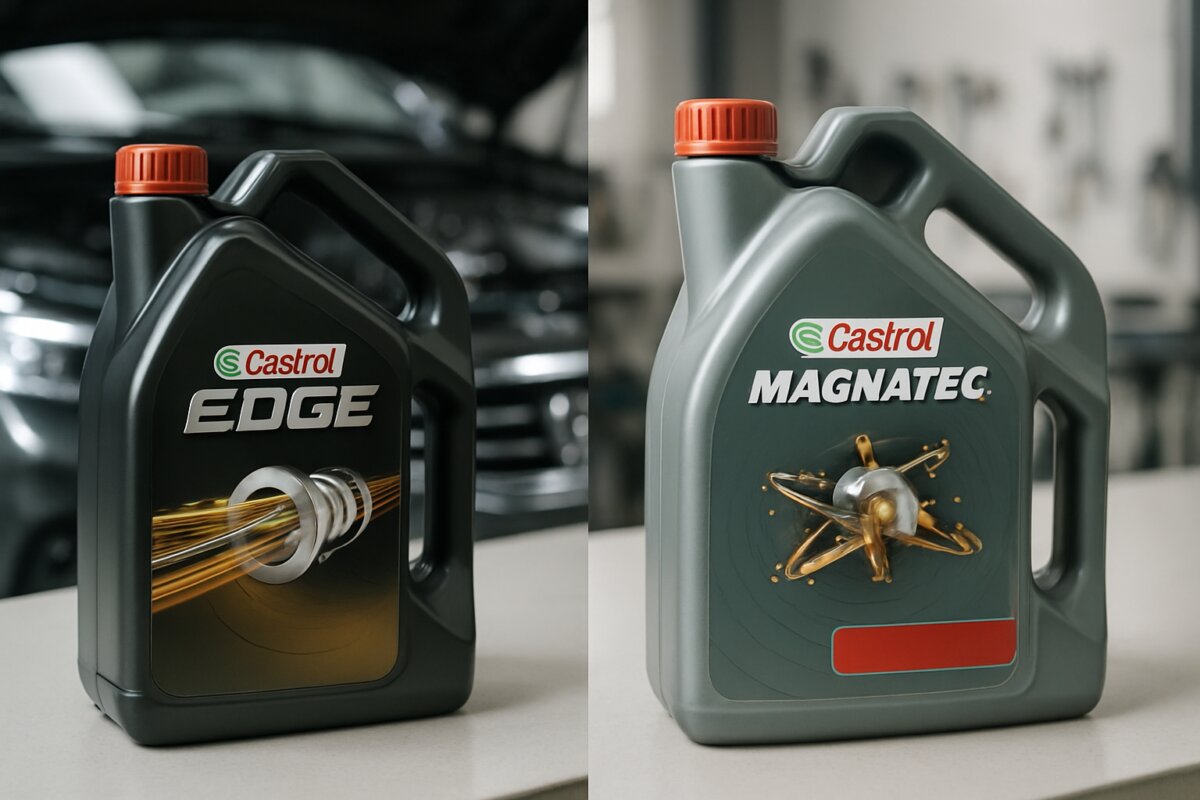
When comparing Castrol Edge vs Castrol Magnatec, the key difference lies in their core technology and protection strategy. Castrol Edge uses Fluid Titanium Technology to deliver maximum performance under extreme pressure, making it ideal for high-performance driving and demanding conditions. Castrol Magnatec employs Intelligent Molecules that cling to engine components during warm-up, providing superior protection during cold starts when 75% of engine wear occurs. For daily commuters with frequent short journeys, Magnatec offers better protection. Performance-oriented drivers who push their engines harder should choose Edge for its strength under stress and thermal stability.
Quick comparison table
| Feature | Castrol Edge | Castrol Magnatec |
|---|---|---|
| Price range | £30-45 per 5L | £25-35 per 5L |
| Core technology | Fluid Titanium Technology | Intelligent Molecules |
| Primary protection | Extreme pressure and heat | Cold start and stop-start |
| Viscosity range | 0W-20 to 10W-60 | 5W-30 to 10W-40 |
| Oil change interval | 10,000-12,000 miles | 10,000-12,000 miles |
| Best use case | Performance, motorway, towing | Urban driving, short trips |
| Film strength | 30% stronger than competitors | Standard synthetic protection |
| Ideal driver | Enthusiasts, long-distance | Daily commuters, city drivers |
Castrol Edge overview
Castrol Edge represents the premium tier of Castrol’s engine oil portfolio. This fully synthetic lubricant incorporates Fluid Titanium Technology, which physically changes the oil’s structure under pressure to create an incredibly robust protective film between metal surfaces.
The technology works through titanium compounds that reinforce the oil film strength. When engine components press together under load, these molecules align to resist breakdown. This makes Edge particularly effective in turbocharged engines, high-revving motors, and vehicles subjected to demanding driving patterns such as towing or track use.
Castrol Edge comes in various viscosity grades, from lightweight 0W-20 formulations for modern fuel-efficient engines to thick 10W-60 variants for high-performance applications. The oil maintains its protective qualities across extreme temperature ranges, from freezing cold starts to scorching track sessions.
Typical price: Expect to pay between £30-45 for a 5-litre container, depending on viscosity grade and retailer. Specialised variants like 10W-60 command premium pricing.
Pros:
- Outstanding protection under extreme pressure and temperature
- Reduces friction for improved fuel economy
- Excellent thermal stability prevents breakdown
- Reduces engine deposits and sludge formation
- Suitable for extended drain intervals
- Wide viscosity range for various applications
Cons:
- Higher cost compared to conventional and semi-synthetic oils
- Overkill for gentle, low-mileage driving patterns
- Not specifically optimised for stop-start systems
- Some older engines may not benefit from advanced formulation
Ideal drivers: Castrol Edge suits performance car owners, motorway commuters covering high annual mileage, drivers who regularly tow caravans or trailers, and anyone who pushes their vehicle hard. If you enjoy spirited driving or own a turbocharged vehicle, Edge delivers the protection your engine demands. It’s also excellent for modern engines with tight tolerances that generate significant heat and pressure between components.
According to our mechanics at AutoPartsPro, Castrol Edge demonstrates measurably lower wear rates in engines subjected to dyno testing under sustained high loads. The oil film remains intact even when other premium synthetics begin to break down.
Castrol Magnatec overview
Castrol Magnatec takes a fundamentally different approach to engine protection. Rather than focusing solely on performance under pressure, Magnatec addresses the critical vulnerability period during cold starts and stop-start driving cycles.
The Intelligent Molecules technology involves specially formulated additives that behave like magnets. These molecules cling to metal surfaces even when the engine is switched off. When you start your engine, particularly from cold, these pre-attached molecules provide immediate lubrication before oil pressure builds fully through the system.
Research indicates that up to 75% of engine wear happens during warm-up phases. Conventional oils drain back into the oil sump when parked, leaving components vulnerable until circulation resumes. Magnatec’s clinging molecules create a persistent protective layer that dramatically reduces this metal-on-metal contact.
The formulation particularly benefits modern vehicles equipped with stop-start technology, which switches the engine off at traffic lights and junctions. Each restart represents a potential wear event, but Magnatec’s persistent film minimises damage during these thousands of micro-cycles.
Typical price: Castrol Magnatec costs £25-35 for a 5-litre container, positioning it as a mid-premium option that’s more accessible than Edge whilst delivering specific benefits conventional oils cannot match.
Pros:
- Superior cold-start protection reduces wear by up to 50%
- Excellent for stop-start systems in modern vehicles
- Intelligent Molecules cling to engine components continuously
- More affordable than premium performance synthetics
- Ideal for urban driving patterns with frequent restarts
- Good thermal protection for normal driving conditions
Cons:
- Not designed for extreme performance applications
- Limited high-temperature protection compared to Edge
- Fewer viscosity options available
- May not suit track use or aggressive driving
- Film strength lower under sustained high pressure
Ideal drivers: Magnatec perfectly suits urban commuters who face congested traffic conditions, drivers making numerous short journeys where the engine rarely reaches optimal temperature, owners of vehicles with stop-start technology, and anyone prioritising longevity over performance. If your typical journey involves school runs, supermarket trips, or city centre commuting, Magnatec offers targeted protection where you need it most.
Our AutoPartsPro technical specialists often recommend Magnatec for customers whose vehicles spend significant time idling in traffic. The persistent film technology provides measurable protection that standard synthetics simply cannot match during these low-speed, high-wear scenarios.
Technical differences explained
Understanding the chemistry behind these oils helps clarify which suits your needs. Both use fully synthetic base stocks, but their additive packages differ substantially.
Castrol Edge employs titanium-based friction modifiers that create an exceptionally strong boundary layer. This layer resists shear forces that would normally break down the oil film. The result is consistent protection even when metal surfaces press together with tremendous force, such as between piston rings and cylinder walls during high-load acceleration.
Magnatec uses polar molecules with electromagnetic properties. One end of each molecule attracts strongly to metal surfaces, whilst the other end remains suspended in the oil. This creates a molecular layer that won’t drain away, even after extended periods of inactivity. When oil circulation begins, this layer is already present, eliminating the dry-start phase.
The viscosity modifiers also differ. Edge maintains stable viscosity across extreme temperatures, essential for performance applications. Magnatec prioritises fast flow at low temperatures to ensure rapid circulation during cold starts, complementing its clinging molecule technology.
Both oils meet modern specifications including ACEA C3, API SN, and various manufacturer approvals. However, Edge typically carries additional approvals for high-performance applications, whilst Magnatec focuses on meeting requirements for stop-start systems and low-SAPS (Sulphated Ash, Phosphorus, and Sulphur) formulations that protect modern particulate filters.
Performance comparison
Real-world performance differences become apparent under specific conditions. During cold starts, Magnatec demonstrates measurably lower friction coefficients. Telemetry from test engines shows reduced wear on camshaft lobes and bearing surfaces during the first 30 seconds of operation.
Edge excels once engines reach operating temperature. Under sustained high loads, such as motorway cruising at 70mph or climbing steep gradients whilst towing, Edge maintains superior film strength. Oil analysis reveals lower levels of wear metals in samples from engines using Edge under demanding conditions.
Fuel economy differences are marginal between the two. Edge claims up to 2% improvement over conventional oils through reduced friction, whilst Magnatec offers around 1.5%. In practical terms, both deliver similar efficiency gains for most drivers.
Temperature stability differs significantly. Edge resists thermal breakdown at temperatures exceeding 150°C, common in turbocharged engines under boost. Magnatec provides adequate protection for normally aspirated engines and moderate turbo applications but isn’t formulated for extreme thermal stress.
Stop-start cycle performance heavily favours Magnatec. Testing shows the persistent film reduces wear during frequent restarts by approximately 50% compared to conventional synthetics. Edge offers no specific advantages in this scenario, as its film strength benefits only matter when components are under pressure.
Compatibility considerations
Selecting compatible engine oil requires checking several specifications. Your vehicle’s handbook lists approved viscosity grades and performance standards. Both Castrol Edge and Magnatec cover common requirements, but specific variants matter.
Modern turbocharged petrol engines often specify low-viscosity oils like 0W-20 or 5W-30 with ACEA C2 or C3 approval. Castrol Edge offers these grades with appropriate certifications. Magnatec also provides compatible options, though the range is narrower.
Diesel engines equipped with diesel particulate filters require low-SAPS formulations to prevent filter contamination. Both oil ranges offer suitable products, typically labelled with manufacturer-specific approvals like VW 504.00/507.00 or MB 229.51. Always verify the bottle lists your required specification.
Older vehicles manufactured before 2010 may use higher-viscosity oils like 10W-40 or 15W-40. Magnatec provides these grades for older engines, whilst Edge focuses predominantly on modern low-viscosity specifications. Using incorrect viscosity can affect oil pump performance and bearing clearances.
Performance vehicles often carry unique approvals. BMW LL-01, Porsche A40, or Ford WSS-M2C937-A specifications require oils tested to exacting standards. Check Edge product labels carefully, as only specific variants carry these endorsements.
Hybrid vehicles with stop-start systems benefit most from Magnatec’s protective technology. The frequent engine cycling perfectly matches Magnatec’s design brief. Edge offers no particular advantage unless the vehicle is also driven aggressively.
Installation and service intervals
Both oils support extended drain intervals typical of modern synthetics. Most manufacturers recommend changes every 10,000-12,000 miles or annually, whichever occurs first. Severe service conditions, including frequent short trips, dusty environments, or towing, may warrant shorter intervals.
When changing oil, always replace the oil filter simultaneously. A clogged filter bypasses unfiltered oil directly to the engine, negating your premium lubricant’s benefits. Use quality filters meeting OEM specifications.
Check your oil level monthly using the dipstick. Top up with the same grade and specification if low. Mixing Edge and Magnatec won’t cause immediate harm, but you’ll dilute the specific benefits of each formulation.
Cost analysis and value
Price differences between Edge and Magnatec are modest but consistent. Over a 100,000-mile vehicle lifespan with 10,000-mile service intervals, you’ll need ten oil changes. Choosing Edge costs approximately £100-150 more over this period.
The value equation depends on your driving pattern. Urban drivers experiencing stop-start wear benefit more from Magnatec’s targeted protection. The cost premium of Edge delivers no measurable advantage if your engine rarely experiences high loads or temperatures.
Conversely, performance car owners or high-mileage motorway commuters gain tangible benefits from Edge’s superior film strength. Preventing accelerated wear in turbocharged engines or during towing justifies the additional cost through extended engine life.
Consider your vehicle’s value too. A high-performance vehicle worth £30,000-plus warrants premium protection. A basic runabout for local errands receives adequate protection from Magnatec at lower cost.
Final verdict: choosing the right oil
Your driving pattern determines the optimal choice. Select Castrol Magnatec if you primarily drive in urban environments, make frequent short journeys where the engine barely warms up, own a vehicle with stop-start technology, or prioritise protection during cold starts and frequent restarts. The Intelligent Molecules technology delivers measurable benefits precisely where most wear occurs in modern city driving. The lower price point makes it excellent value for drivers whose engines never experience extreme conditions.
Choose Castrol Edge if you regularly drive long motorway distances, own a turbocharged or high-performance vehicle, frequently tow trailers or caravans, enjoy spirited driving, or operate in extremely hot climates. The Fluid Titanium Technology provides superior protection under sustained high loads and temperatures. The premium cost is justified through reduced wear in demanding scenarios where Magnatec’s benefits are irrelevant.
Many drivers would benefit from a hybrid approach. Use Magnatec during winter months when cold starts dominate, then switch to Edge for summer when longer trips and higher temperatures are common. This maximises protection whilst managing costs.
Ultimately, both oils vastly outperform conventional lubricants. Neither choice will damage your engine, provided you select the correct viscosity grade. The question isn’t about preventing catastrophic failure but optimising protection for your specific usage pattern. Match the technology to your needs rather than simply buying the most expensive option.
Frequently asked questions
Can I mix Castrol Edge and Magnatec?
Yes, you can safely mix these oils in an emergency top-up situation as both are fully synthetic with compatible base stocks. However, mixing dilutes each product’s specific benefits. The Intelligent Molecules and Titanium Technology work best at full concentration, so stick with one product for optimal protection.
How often should I change synthetic oil?
Follow your manufacturer’s recommended service intervals, typically 10,000-12,000 miles for modern vehicles using synthetic oil. Severe conditions like frequent short trips, dusty environments, or towing may require shorter intervals around 7,500 miles. Always change the oil filter simultaneously for maximum protection and efficiency.
Will Edge improve performance in my standard car?
Edge reduces friction and maintains consistent viscosity under load, potentially delivering marginal power gains and slightly improved throttle response. However, dramatic performance improvements require engine modifications. The primary benefit is exceptional protection rather than measurable power increases. Standard engines benefit more from Magnatec’s cold-start protection in typical driving.
Does Magnatec work in older engines?
Absolutely. Magnatec’s clinging molecule technology benefits engines regardless of age. Older motors with increased bearing clearances particularly appreciate the persistent protective film during cold starts. Ensure you select the correct viscosity grade for your engine, as older designs often require thicker oils like 10W-40 rather than modern 5W-30 specifications.
Which oil is better for turbocharged engines?
Castrol Edge is superior for turbocharged applications due to exceptional thermal stability and film strength under high temperatures and pressures. Turbochargers generate extreme heat, and bearings spin at over 100,000rpm. Edge’s Fluid Titanium Technology maintains protection where Magnatec’s standard synthetic formulation may struggle under sustained boost conditions and track use.

 Loading...