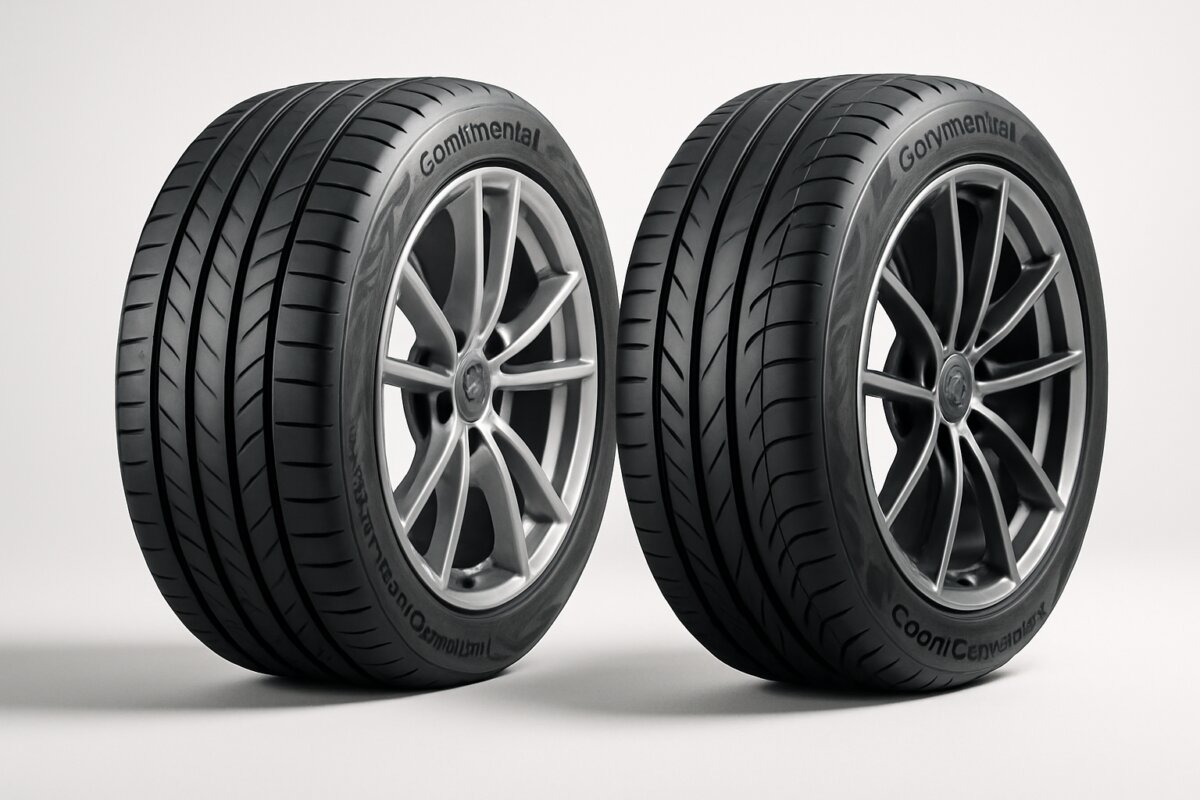
The Continental PremiumContact 7 excels in comfort, fuel efficiency, and all-weather performance for daily driving, whilst the Continental SportContact 7 prioritises superior handling, braking precision, and high-speed stability for performance-focused motoring. The PremiumContact 7 offers longer tread life and reduced road noise, making it ideal for executive saloons and family cars. The SportContact 7 delivers enhanced cornering grip and shorter stopping distances, perfect for sports cars and performance hatchbacks.
Quick comparison table
Here’s a comprehensive overview comparing both Continental tyre models across key performance metrics:
| Feature | PremiumContact 7 | SportContact 7 |
|---|---|---|
| Price Range | £80-£180 | £100-£220 |
| Tread Life | 50,000-60,000 miles | 35,000-45,000 miles |
| Noise Level | 68-70 dB | 70-72 dB |
| Fuel Efficiency | A-B rating | B-C rating |
| Wet Braking | A rating | A+ rating |
| Best Use Case | Daily commuting | Performance driving |
Continental PremiumContact 7 overview
The PremiumContact 7 represents Continental’s flagship touring tyre, engineered for drivers seeking maximum comfort and efficiency. This premium rubber employs an advanced silica compound that reduces rolling resistance whilst maintaining excellent grip levels across various road conditions.
Continental’s innovative tread pattern features four main grooves with optimised sipe distribution, ensuring reliable water evacuation and reduced aquaplaning risk. The asymmetric design balances comfort with handling, making it suitable for everything from city driving to motorway cruising.
Key specifications:
- Silica-enhanced compound for fuel efficiency
- Asymmetric tread design
- Price range: £80-£180 per tyre
- Load index: 84-115
- Speed rating: H-W (210-270 km/h)
Advantages:
- Exceptional fuel economy
- Low road noise levels
- Extended tread life
- Comfortable ride quality
- Strong wet weather performance
Disadvantages:
- Limited performance at track speeds
- Less responsive steering feel
- Softer sidewall construction
The PremiumContact 7 suits drivers who prioritise comfort, economy, and longevity. Executive car owners, long-distance commuters, and family motorists will appreciate its refined characteristics and impressive mileage potential.
According to Autopartspro’s tyre specialists, the PremiumContact 7’s compound technology delivers up to 15% better fuel efficiency compared to previous generations, making it an excellent choice for cost-conscious drivers.
Continental SportContact 7 overview
The SportContact 7 embodies Continental’s racing heritage, delivering uncompromising performance for enthusiastic drivers. This high-performance tyre utilises a specialised compound blend that maintains grip even under extreme cornering forces and high-speed conditions.
The directional tread pattern features wider shoulder blocks and increased contact patch area, maximising road connection during spirited driving. Advanced polymer technology ensures consistent performance across temperature ranges, from cold morning starts to heated track sessions.
Key specifications:
- Performance-focused compound blend
- Directional tread design
- Price range: £100-£220 per tyre
- Load index: 84-110
- Speed rating: W-Y (270-300+ km/h)
Advantages:
- Exceptional dry grip levels
- Precise steering response
- Shorter braking distances
- High-speed stability
- Enhanced cornering performance
Disadvantages:
- Higher road noise
- Increased fuel consumption
- Shorter tread life
- Firmer ride quality
- Premium pricing
The SportContact 7 appeals to performance car enthusiasts, sports car owners, and drivers who regularly tackle challenging roads. Its capabilities shine on powerful hatchbacks, sports saloons, and dedicated performance vehicles.
Our technical team at Autopartspro notes that the SportContact 7’s advanced sidewall construction provides 20% better steering precision compared to touring tyres, making it ideal for drivers who value handling feedback.
Compatibility considerations
Both Continental models offer extensive size ranges covering most modern vehicles, but selecting the correct specification requires careful attention to your car’s requirements and intended use.
Vehicle compatibility factors:
- OE tyre size specifications
- Load rating requirements
- Speed rating suitability
- Wheel diameter options (16″-22″)
- Vehicle weight considerations
The PremiumContact 7 typically suits family cars, executive saloons, SUVs, and crossovers. Common applications include BMW 3 Series, Audi A4, Mercedes C-Class, and Volkswagen Passat models. Its broad size range accommodates vehicles from small hatchbacks to large estate cars.
The SportContact 7 primarily targets performance vehicles, sports cars, and high-powered variants. Popular applications include BMW M models, Audi S-Line vehicles, Mercedes AMG variants, and performance-focused hatchbacks like the Golf GTI or Focus ST.
Installation considerations:
- Professional fitting recommended
- Wheel alignment check advisable
- Tyre pressure monitoring system compatibility
- Run-flat requirements (if applicable)
When replacing tyres, consider your vehicle’s suspension springs and shock absorbers condition, as worn components can affect tyre performance and longevity.
Final verdict and buying recommendation
Your choice between these Continental models should align with your driving priorities and vehicle characteristics. Both tyres excel in their respective categories, offering distinct advantages for different motoring needs.
Choose the PremiumContact 7 if you:
- Prioritise fuel economy and comfort
- Drive primarily on motorways and urban roads
- Want maximum tyre longevity
- Prefer quieter cabin environment
- Own a family or executive vehicle
Choose the SportContact 7 if you:
- Value handling precision above comfort
- Regularly drive on twisty roads
- Own a performance-oriented vehicle
- Appreciate responsive steering feedback
- Don’t mind higher running costs
For most UK drivers, the PremiumContact 7 offers the better all-round package, combining decent performance with excellent efficiency and longevity. However, if your vehicle has been tuned or you enjoy spirited driving, the SportContact 7’s superior dynamics justify its premium price and running costs.
Both models benefit from Continental’s manufacturing expertise and comprehensive warranty coverage. Regular maintenance, including proper inflation pressure and periodic rotation, maximises performance and lifespan regardless of your choice. Don’t forget to inspect related components like wheel hubs and hub bearings during tyre changes.
Frequently asked questions
Which Continental tyre offers better fuel economy?
The PremiumContact 7 delivers superior fuel efficiency with A-B EU label ratings, whilst the SportContact 7 typically achieves B-C ratings due to its performance-focused compound.
How do wet weather capabilities compare between both models?
Both tyres achieve excellent wet weather performance, but the SportContact 7 edges ahead with superior braking distances and cornering grip in challenging conditions.
What’s the expected mileage difference between these Continental tyres?
The PremiumContact 7 typically delivers 50,000-60,000 miles, whilst the SportContact 7 averages 35,000-45,000 miles depending on driving style and vehicle application.
Can I mix Continental PremiumContact 7 and SportContact 7 on one vehicle?
Mixing different tyre models isn’t recommended as it creates handling imbalances. Always fit identical tyres on the same axle for optimal safety and performance.
Which tyre provides better value for money overall?
The PremiumContact 7 offers superior value through lower purchase price, better fuel economy, and extended tread life, making it more economical for typical driving conditions.

 Loading...